Interviews
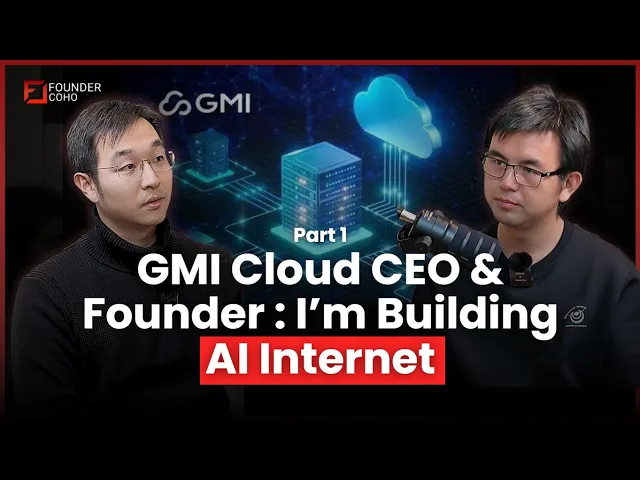
As a young CEO, Alex is on a mission to build the "AI Internet," combining a bold desire for innovation with a deep commitment to energy sustainability and ethical AI.

|
Founder & CEO of GMI Cloud
Alex Yeh, Founder and CEO of GMI Cloud, also known as "General Machine Intelligence" Cloud. A third-generation entrepreneur and graduate of Johns Hopkins, Alex bridges the gap between massive capital management and cutting-edge hardware. Before GMI, he managed a $200M portfolio for CDIB's China Life Private Equity Fund and served as a Partner at Infinity Ventures Crypto. Today, he leads one of only 16 NVIDIA Cloud Partners globally, operating nine data centers across the US and Asia. As a young CEO, Alex is on a mission to build the "AI Internet," combining a bold desire for innovation with a deep commitment to energy sustainability and ethical AI that he can proudly stand by for generations to come.
What happens when the traditional internet, built for retrieving stored data, meets a new era where every piece of information is generated on the fly? In this conversation, Alex Yeh explains why the shift from CPU-based retrieval to GPU-based generation requires a fundamental redesign of global infrastructure. Drawing from his unique experience building data centers in record time, Alex breaks down the "trial and error" process of pivoting from Bitcoin mining to AI training and inference. He shares how GMI Cloud achieves speeds 3 to 4 times faster than traditional giants by ditching old virtualization methods in favor of optimized hardware-model integration. From the "war" for GPUs to the impact of open-source breakthroughs like DeepSeek, Alex outlines his mission to lower the barriers to AI, making high-performance compute accessible to every creator and enterprise on the planet.
References
Alex Yeh's Linkedin – https://www.linkedin.com/in/gmi-yeh/
Alex Yeh's X - https://x.com/alex_yehya
Jing Conan Wang (Host) – https://www.linkedin.com/in/jingconan/
FounderCoHo – https://www.linkedin.com/company/foundercoho
Timestamps
00:00 Highlights
01:56 Introduction and Interview Focus
03:47 Elementary School Card Trading Business
07:57 Discovering Bitcoin in College
09:19 Becoming an Entrepreneur
10:49 First Crypto Business - IVC
16:56 Transition to AI Infrastructure
20:27 Founding GMI Cloud
24:24 Early Customer Discovery
27:52 Product Differentiation and Technical Advantages
30:31 Training vs Inference Workload Trends
35:01 Vision for AI Internet Infrastructure
36:14 How AI Internet Differs from Traditional Internet
37:54 Outro and Preview to Part 2
Full Transcript
100k turned to 8.6 million.
Not bad, right?
That's very good.
First investment.
Alex Yeh, CEO and founder of GMI Cloud,
is one of the youngest builders of AI
infrastructure at scale, whose journey from crypto investor
to cloud pioneer spans Bitcoin mining, venture capital,
and now powering the AI revolution across two
continents, from selling cards in fifth grade to
an 86x return on his first crypto investment.
Then everything changed.
I saw it on my Friend's WeChat channel.
Got shut down.
My investment's already grossing up to seven figures.
To me, it's a lot of money.
I had no choice but to clean up
my mess.
And so I bought a one-way ticket,
thinking that I'm just going to move my
servers to US.
How hard could it be?
Turned out extremely difficult.
No one wants to talk to me.
For the people that want to talk to
me, wants an arm and a leg.
And so I decided to, okay, I'm just
going to build it myself.
But building wasn't enough.
The world was changing.
From Bitcoin now to infrastructure, what is the
difference?
Completely different.
Just like EV and traditional car.
It rebuilt everything.
New team, new technology, new vision.
Back then, even the business model is not
clear.
It's literally trial and error.
Today, he's the only Reference Platform NVIDIA cloud partner with
major operations across both the US and Asia.
I've been on a VC investor, investing in
different technology stack.
But I've never seen anything as big as
this wave.
Every week or every day, there's new news
coming out.
A couple of billion dollars spent.
Who invested in that company?
And the new models came out, right?
Things got better, faster.
When you have a 10X increase in performance
or 10X reduce in cost, magical things happen.
From your perspective, how AI internet will be
different than the existing technology or internet we
have?
Well...
Today, we're joined by Alex Yeh, founder and
CEO of GMI Cloud, also known as General
Machine Intelligence Cloud.
A third-generation entrepreneur and graduate of Johns
Hopkins, Alex bridges the gap between massive capital
management and cutting-edge hardware.
Before GMI, he managed a $200 million portfolio
for CDIB's China Life Private Equity Fund and
served as a partner at Infinity Ventures Crypto.
Today, he leads one of only six Reference Platform NVIDIA
cloud partners globally, operating nine data centers across
the US and Asia.
As a young CEO, Alex is on a
mission to build an AI internet, combining a
bold desire for innovation with a deep commitment
to energy sustainability and ethical AI that he
can proudly stand by for generations to come.
What happens when the traditional internet, built for
retrieving stored data, meets a new era where
every piece of information is generated on the
fly?
In this conversation, Alex Yeh explains why the
shift from CPU-based retrieval to GPU-based
generation requires a fundamental redesign of global infrastructure.
Drawing from his unique experience building data centers
in record time, Alex breaks down the trial
and error process of pivoting from Bitcoin mining
to AI training and influence.
He shares how GMI Cloud achieves speeds three
to four times faster than traditional giants by
ditching old virtualization methods in favor of optimized
hardware model integration.
From the war for GPUs to the impact
of open source breakthroughs like DeepSeek, Alex outlines
his mission to lower the barriers to AI,
making high-performance compute accessible to every creator
and enterprise on the planet.
Please subscribe and turn on notification so you
never miss the next one.
Alex, it's a great honor to have you
at FounderCoHo
Welcome.
And you have an amazing journey.
And I heard that, take back to when
you were in elementary school, you were already
a businessman.
I think it's kids' play, but it's definitely
a very exciting game for me because I'm
born in this kind of entrepreneurship family.
Past three generations of my grandpa to my
father and now me, we all started our
own kind of businesses.
And so I think back in elementary school,
I think the teachers always ask you like,
oh, what do you want to be in
the future?
It's like, oh, I want to be a
scientist, I want to be a chemist, whatnot.
What was your answer?
I was like, one, I want to be
an astronaut, but second is I want to
be a business person, businessman
Back in elementary school, I guess that's my
first debut kind of caught up.
So back in the days, there was this
kind of like Yu-Gi-Oh collectible, like
Pokemon cards, it's called the Beetle cards back
in time was tremendously popular.
I've been collecting for a good couple of
years.
And then I think in fifth grade or
sixth grade, I was like, oh, I think
it's time for me to sell.
And instead of selling to like stores and
such, I sold it to my classmates and
have some rare collectibles and so forth.
And so I even invented a bidding system.
I had two kids to come to me
and say, I got this rare cards, like
bronze cards or gold card.
And whoever can bid the highest would get
this card, right?
And even combos, right?
It's like, oh, I got this really amazing
card, but I also got some common cards.
And so I was like, okay, well, you
got to buy this card, but with combo
with other cards altogether, or I won't sell
you, right?
And that's a very sure business strategy.
How old were you?
Fifth grade and sixth grade.
My heart was like pumping.
I was like, oh, this crazy actually works.
And the prices end up bidding higher than
what the rates are, that the market rates
are.
I think it's just because of that competitive
nature.
And you can't really do it like with
two people, but at the output, kind of
in a long distance, but you have to
do it in front of them.
And so they feel that competitiveness like, oh,
the card's slipping away and your friends taking
it instead of you.
I think that competition drove the price
higher.
I think that's definitely a thrill.
When I started trading and then selling my
cards, that was kind of my first entry.
Wow, you figure out supply and demand and
you have an early exposure for marketplace.
Yeah, that was crazy.
Did you make any money from that?
Yeah, I actually made $200.
$200 back in like 2000s or something.
Yeah, for fifth, sixth grade.
It's a lot.
Did you hold them?
How did you spend that money?
I actually bought my mom a face cream.
Oh, I think it's like La Mer or
something.
That's good.
Your mom must be very happy.
Yeah, they're so, so happy.
Yeah, yeah.
You are very smart, keeping figure out supply
and demand at the fifth and the sixth
grade.
And I know that you are also very
ambitious and want to do something.
And when you are in the college, instead
of doing normal college activity, you do something
very interesting.
You went to crypto meetup in New York.
And what happened?
Yeah, look, I went to Johns Hopkins with
an engineering degree, materials engineering degree.
And most of my colleagues are either in
consulting or banking, or obviously doctors and engineers
and so forth.
But I was just figuring out and what
I should do in the future.
I was junior and senior year college.
I was lucky that my high school friend
introduced me to something called Bitcoin.
When was that?
That was in 2017.
Wow, that's very early.
Yeah, so I didn't think much of it.
I was like, yo, Alex, you gotta buy
some.
I'm like, oh, okay.
I bought some and then bought some more
ETH.
And it started rising.
I caught the wave when it rose from
like 4K to $20,000.
As of today, I think it's more than
100K.
Yeah, yeah, yeah.
When I bought it, it was like 4K
and Ethereum was like $400.
Wow, very good investment.
Yeah, it was an investment.
It was to me, it's like, oh, yeah,
it's, yeah.
Bought some.
Yeah.
I didn't think much of it.
But once it started rising, the amount was
able to cover even my tuition for four
years of college.
It was a crazy amount of money to
me.
And so I started learning more into it,
leaning more into it.
And then there was two hubs in the
US that had a crypto community, like beginning
of a crypto community that was New York
and SF.
And then me being in the East Coast,
I just travel frequently to New York, stay
at my friend's place, going to meet up
to learn more about this industry.
And that's how I jumped into kind of
the entrepreneurship journey.
Tell us how you get started to become
an entrepreneur.
You just do it.
Is there any particular moment in your life
is that you think about it?
Oh, entrepreneurship is going to be the thing
I will pursue for the rest of my life.
It's definitely a gradual moment.
I've tried multiple things.
I've tried banking.
I've tried being worked in startup.
That actually got acquired by WeWork.
So I did a couple of things.
Engineering, obviously, I did research and engineering at
college.
I think entrepreneurship and having control is something
that I really need.
And so that's why I kind of started
the path in the crypto.
And I was lucky in the right wave,
in the right time.
And I think I got the success that
I have because I execute really fast.
Once I think through, I just execute.
And I go all in, basically.
That's a very important characteristic traits that founders
need.
Yeah, I do things very fast.
I don't hesitate, right?
Just like when I sell cards, I sell
everything.
I will not keep anything, right?
Once I decide, I just do it.
That's it.
I think this applies to everything that I've
done and continue forward.
Basically, yeah.
If I commit, I will commit all the
way.
You started running a company called IVC?
I was very lucky that I started my
first crypto business right out of college.
And then I was also a little bit
too early, but luckily it went well.
I was doing the Grayscale of Asia.
Grayscale is the first Bitcoin treasury, essentially, for
common folks to get exposure to alternative assets
like Bitcoin and Ethereum, right?
It's wildly popular in the US, but in
Asia, there's no access and people get scammed
and so forth, right?
And so I started that business.
And after a year, I was very lucky
to sell that to a Hong Kong hedge
fund.
And the very first investor that invested in
me was a partner at Headline, which is
a SF-based VC.
And they wanted to start a Headline crypto,
crypto investment vehicle, just like A16Z.
And so I naturally became the partner.
That leads their crypto investment.
That's where IVC came from.
And IVC was the old name for Headline
before their entity merged.
So it was IVS that turned into Headline.
They changed the name.
So we used the old name because I
think they had some LPA or some such.
So we took the old name, which is
Infinity Ventures Crypto, and where we started the
crypto VC.
Yeah.
And you raised $84 million for the fund.
And what is the story behind your fund
raising?
Again, right place, right time.
The time when we started raising was all
the cryptos are pumping like really high.
The very first, we were going to raise
a $10 million fund because that's what typically
first fund do, right?
It's $10 million, $20 million.
The first check in, $100K, returned $86X.
Wow.
When it get listed.
Wow.
And it almost returned everything.
Literally, $100K turned to $8.6 million.
Not bad, right?
That's very good.
First investment.
And so that really seeded us.
And the more like, and so that continue,
our fund continue to get oversubscribed.
And we just expanded that to over 80
plus million.
For your first investment, hundreds returns, X return.
That's pretty, pretty good.
Yeah.
You have such a great talent in investing.
And at what point did you realize that
you want to build again, not just
invest?
It's funny.
I think you interview a lot of people,
but sometimes it's founders there's a moment that
it's like, oh, I want to quit.
And I want to build my own business.
Right.
But for me, I was forced to start
my own business.
Right.
So I was investing in Bitcoin mining on
just like as an investment, as a project.
Right.
And I put a lot of my personal
capital in.
However, China wasn't so fond of Bitcoin as
an industry.
Yeah.
It got shut down.
Yeah.
I heard about that.
One day, under one day.
Oh, one day.
One day.
I saw it on my Friend's channel on WeChat.
Got shut down.
And my investments are already grossing up to
seven figures.
To me, it's a lot of money, especially
as a 26 year old.
Right.
And so I had no choice but to
go back to China to clean up my
mess.
Even though I'm just an investor, but the
amount is too great to bear.
Yeah.
And so I bought a one-way ticket
to New York, thinking that, oh, all I
have to do is just find a data
center.
I'm just going to move my servers to
US.
How hard could it be?
Right.
I continue to ask that question even today.
How hard could it be?
Turned out extremely difficult because back then, there
was no scaled data center operation for Bitcoin
mining.
Zero.
And 80 plus percent of the compute of
Bitcoin mining compute was in China.
So imagine 80 plus percent of the market
moved around the world.
And obviously, most people choose US.
And so seeking for six months, no one
wants to talk to me.
For the people that want to talk to
me, one's an arm and a leg.
And so I decided to, OK, I'm just
going to build it myself.
How hard could it be?
I like your attitude, how optimistic you are.
It's actually such an important trait of a
founder.
How hard could it be?
There's only one way that you can figure
out.
So that was the start of my entrepreneurship
journey.
And then in your next journey, you started
GMI Cloud.
Yeah.
So it's actually the same company.
But I pivoted to cloud.
It's always been GMI.
Fast forward to when I started, why I
started business was Bitcoin mining.
And in the last two years when I
started, it was four years ago now.
I built three data centers across two years,
which is unreasonably fast.
Each data center took me six months to
build.
Only six months compared to conventional build, which
is 12 to 18 months.
And at then, which is until now, I'm
still the biggest Bitcoin miner in the state
of Arkansas.
Which is interesting.
And so I'm based in New York, I'm
based in Silicon Valley, and I'm venture backed.
And so a lot of founders friend and
VC reached out to me when GPT-2
came out and say, hey, Alex, you probably
have a lot of GPU cards.
You're doing Bitcoin mining.
You must have a lot of cards.
Why don't you rent some of the cards
to my portfolio?
My portfolio needs something that's called training.
All right.
I didn't know what that is.
It's like, oh, training.
Oh, interesting.
Oh, it's probably some compute stuff for AI.
So when was that?
That was two years ago.
Two years ago.
That's literally when GPT-3 or 3.5
came out.
Yeah, yeah.
Right when it came out, I had tons
of those requests.
I think that was a time where OpenAI
showed the possibility of LLM.
It was a great model.
Yes.
Everyone was training model.
That was like the dawn of GenAI and
LLMs. And again, I pivoted very quickly.
It took me 10 months to figure things
out and then pivot right away.
So you pivot from Bitcoin mining to using
your GPUs for AI infrastructure, AI training.
That's right.
I bet this must be a very big
pivot that you are also seeing you need
to do a lot of change of your
data center, how you configure it.
Can you walk us through the journey you
had, like turn your business into focus on
from Bitcoin now to infrastructure?
What's the difference?
Completely different.
Just like EV and traditional car.
The only thing that's similar to traditional car
and EV is probably the four wheels.
Aside from that, everything is different.
Just like Bitcoin mining and cloud.
First of all, people think that the data
center can be reused.
It cannot.
You have to rebuild.
And one is focusing on hardware, heat, dissipation,
and so forth.
Cloud is focusing on software stack.
I had no software stack back then.
And so the first thing I had to
do was hire entire software team.
I had no CTO.
Hired entire software team.
And I thought Bitcoin mining is capital intensive,
but GPU is more so.
I had to hire professional CFO to come
join me.
I basically grew my team 10X, literally 10X
my team size.
Completely different to build my entire cloud team
from the software stack from ground up to
GPU management, all the way to the model
services layer and application layer.
On top of that, the entire operation team
to procure these GPUs, which the bond, like
the bill items is over a thousand plus.
And dealing with OEMs, components, chip design companies,
memories, everything.
So I basically built an entire team or
entire company again.
That's a very big shift and transformation of
the business.
Like you mentioned, from traditional vehicle to EV.
The only thing similar is maybe the look
and the four wheels.
But in all the internal structure is different.
And you mentioned about you have to hire
the new technical team, new CFO, new operation
team.
I wonder, back then, two years ago, when
you decided I'm going to do AI infrastructure
now.
Now you realize that your older team probably
is not a good fit for this.
How did you determine the first step you
need to do to do this transformation?
I actually don't.
It's trial and error.
Back then, even the business model is not
clear.
There was no coreweave.
There's no lambda.
There's nothing.
It's just people buying GPUs.
And how to get verified, how to set
up the whole cluster.
It's all chaotic.
Which stack do I want to be?
Do I want to be just the application
layer?
Do I want to be the model serving
layer?
Or do I just want to serve the
in front layer?
Or should I just build a real estate?
Should I just build the data center?
So it's literally trial and error that helped
me carved to where we are today and
where we position today.
A lot of times, building startups requires a
lot of tries and learnings.
And you mentioned that you had a very
good technical team at the start.
And how did you attract them?
Where did you hire them?
Well, I had a very good recruiter and
VCs that recommended a lot of great talents
to me.
And I had the fortune to meet the
executive teams of Google X, which is close
by.
I know they're very hard to find.
Yes, yes.
My first question that I interviewed was, it's
not me interviewing, he was interviewing me.
Alex, I'm already financial freedom.
What can you give me?
What was your answer?
My answer was, I will give you the
opportunity to change the world.
We are building the AI infrastructure of the
future.
We are building the AI internet.
I don't think there's not much chance in
our life to say, hey, I've built the
internet.
How cool is that?
Yeah, that's a genius answer.
Because I worked with Google Brain before.
And so I know your answer is very
resonating.
Because if you say that I can offer
you the money or the package, then...
They don't care.
They don't care.
But oftentimes, what they want is the opportunity
that it can have an impact in the
world.
Like really change the world, be on the
top of something.
Which is great.
How long did it take for you to...
I think I'm still hiring talents.
I'm continuing to grow our team.
Every week, I think we're hiring like three,
four people.
That's good.
Because a lot of our communities actually are
aspiring founders who also might join startups.
And what are the type of founding engineers
and employees are looking for?
I think number one trade is driven and
able to pick things up fast.
Because our entire industry has never been done
before.
This industry does not exist four years ago,
two years ago.
It doesn't exist.
And so a lot of things are brand
new.
These new models, new architecture, new GPUs, new
infrastructure are all new.
So the traits that I'm looking for is
someone that can pick things up fast and
do it themselves.
Like self-driven, self-motivated fast learner.
Self-motivated fast learner and able to handle
pain and suffering.
Because it's a startup.
It's high pressure and time sensitive.
We had to get things done, everything yesterday.
And so able to handle that pressure, I
think is something of key characters that we
need for my team.
The next question I have is that now
you build these teams, you are on the
new directions and you need to figure out
the new market and new customers.
Can you walk through us on how did
you get your first customer for your new
AI infrastructure business?
Well, when I pivoted, I obviously need a
customer for me to pivot.
I'm not going to build something without some
sort of validation.
So I was actually pushed by my customer,
which is a public HR tech company that
wanted to buy GPUs.
I was like, oh, I think I can
do it.
Well, back then I had no experience, but
I said, yes, of course I can do
it.
And it took us a few trials, but
we were able to deliver the full services
to that particular customer and one started after
another until today we built our ninth cluster
around the world.
Wow.
Wow.
In two years.
In two years.
That's very fast speed.
Yeah.
How many customers do we have right now?
Well, we have a whole sort of customers
in terms of the top 10 customers is
probably 5 to 10 customers.
And there are a long tail of developers
and creators.
That's over 35,000 people that are actively
building using our model services, using our GPUs
on our platform.
Yeah.
So we have two sets, right?
One is more enterprise customers.
Another is more long tail developers and creators.
And you build a line classes across the
globe.
Is that?
Yes.
Yeah.
I'm the only NCP, our NVIDIA cloud partner.
Yeah.
To have built clusters across US and Asia
and have significant presence in both.
I don't mean JV, direct operation and team
and staff and support and sales in across
all these regions.
Do you have any country for like when
finding customers, do you have any country talking
now or do you have any industry that
you focus on?
Uh, we are a GPU infrastructure company.
And so we actually have all sorts of
customers, right?
And so each region have its own, uh,
interesting, uh, I would say industries, right?
For example, US is mostly frontier labs and
startups, right?
In Asia, it's mostly manufacturing, uh, and as
well as traditional enter enterprise and businesses.
So there's different looks across the world.
Is there any other metrics who would like
to share for, for about the GMI cloud?
Like what kind of metrics?
Like, uh, the revenues or honestly?
Yeah.
Uh, revenue can't say, but it just say
since I started a business every year, our
minimum growth has been two to three X.
Wow.
That's very, very fast.
Yeah.
We grew seven X.
Wow.
Seven X.
And next year, just on contracted signed revenue,
uh, it's over five X on top of
what we have today.
And you haven't started yet.
We haven't started 26 years.
Yeah, yeah, exactly.
That's a great start.
Yeah.
That's a great start.
Yeah.
But, uh, now in the execution mode.
Yeah.
That's fantastic.
Yeah.
There is a lot of GPU vendors and,
um, all this cloud also provided GPUs.
What do you think are the reasons of
your customer choose you?
And I think two things are products speaks
for itself and our location.
Cloud solutions are kind of like telcos telecoms,
right?
Whether it doesn't matter how great your services
are.
If there is no GPU in that particular
region, you can't use it.
Right.
It's like, Oh, T-Mobile is great.
But I'm in Japan.
Well, you can't use it.
Right.
So this is where, uh, why we have
the global perspective, right?
Where we can service customers across all these
regions through Taiwan to Japan, to Singapore, to
Thailand, to us, and we radiate across.
So you will always have, if you're running
inferencing, right.
Applications, then you will have, uh, locations that
matches to your requirements and either in terms
of TPS or in terms of latency.
Right.
That's number one location.
Number two is our products, right?
I got, uh, well, what we specialize in
is the model and hardware integration.
Again, this is a new computing paradigm.
It's very different from the CPU era, right?
How the traditional cloud was built.
It's basically built all the, all the GPUs
or the CPUs together in storage.
And you virtualize it, right?
You VM it.
Right.
And then you carve it into different chunks
and you, uh, sell it to different customers.
Right.
But the VM layer extracts computing resource, right?
It's not optimized, but the GPUs you, because
the GPUs per unit is so expensive.
You can't afford to lose 10% compute,
right?
Right.
What we built differently is we were able
to extract maximum performance out of the GPUs.
And we do something called cluster inferencing, parallel
inferencing.
You run inferencing of model.
Doesn't matter if it's video model or an
LLM models, you run it across clusters.
And so we're able to optimize on memory
access, on computing access so that it runs
three to four X faster than traditional clouds.
You actually mentioned about a very great point, which is that traditional cloud providers all depend on virtualization. So they never sell actually a machine to you. It's always a virtual machine on top of other machines. That's how the CPU or traditional cloud works. For your case, as you mentioned about, you do this differently. You do this clustering inference. Do you need to do virtualization yourself or do you sell every customer? Do they get a dedicated GPU? How does it work?
We do. It depends. We have Kubernetes layer that manages the GPUs so people can rent on a per API basis which is mixed on a VM, VPC or you can rent bare metal machines which are pretty good for Frontier Labs or hyperscalers that needs these type of services. So it really depends but we have flexibility. I think that's the most important.
In terms of your load, computation load on your cluster, you see a trend of AI trainings or inference or research workload? What are the distributions of types of workload in your clusters?
I think half and half. Half training and half inferencing, it's mix and match. But again, we have no privy into what our customers do. Just by knowing the customer, we think that maybe training is what they are doing and inferencing is what they're doing. But I think they definitely do a mix of both.
Do you observe any trend? Is the ratio the same?
Recently it's training is dominating again. RL with post-training basically, yeah.
You also mentioned about a very great point, which is like two years ago, there's this wave of every company wanting to do their own foundation models. I assume there was a lot of pre-training workload. And now, I assume there's a lot of post-training workload. And there's also lot of inference coming from there's more applications now, there's more thinking models here. And how do you make sure your infrastructure can be flexible for all this workload and it may shift again in future?
So we're built for both. Because we started the company mostly for training workloads for smaller models. And we have definitely upgraded, not upgraded, but migrated to what our customers need. We started with smaller companies to now Frontier Labs and even hyperscalers to their requirements. And then when DeepSeek came out, I think in February, March this year, we were predicting that, okay, with all these amount of training, the entire industry must need inferencing, right? Or else, there's like, how are the models or applications going to make money? Right? And so, but we didn't know how fast inferencing came about. But DeepSeek came out and it was a roaring success that prompted all the enterprise and different hyperscalers to open source their models and just opened up the entire application world.
Yeah, exactly. I'm also curious because back in I think January, February when DeepSeek came out, it's like a shockwave for all the industry. When you first heard about this news, what were you thinking?
Oh, this is tremendous for the industry. Right? Imagine we're in the industrial revolution and you say, you now say, hey, my steam engine can run 10x faster at a tenth of the cost. What would you say? Would you say, oh my god, all right, the world is over? Or you would say, my God, I can use the steam engine and build train. I can build cars. I can build all kinds of application. Right. I think history has again proven itself that when you have a 10x increase in performance or 10x reduce in costs, magical things happen. It will a hundred x, a thousand x, 10,000x in terms of application that will spring on top of that. And it's buying more and more application being built.
When most of us look at innovation, there's a traditional thinking about earlier if you do groundbreaking innovation, when you create GPT models or when you create new models, you are doing innovation. And you touch a great point that by making things cheaper, faster and so that it can reach a different level of scale, that is also innovation. And I assume that is also what GMI Cloud is trying to do.
Correct. Yes. Yeah.
And I also wonder, from your perspective, what is your vision ahead for the AI infrastructure?
Well, I have to start with the vision for GMI, which is, well, it stands for General Machine Intelligence. The vision for the company is to build the AI internet. I've been a VC investor investing in different technology stack. I think it was enterprise SaaS back then, and then EVs, and there's robotics, there's CNN, there's RNN, and then there's crypto. But I've never seen anything as big as this wave. Every week or every day, there's new news coming out, a couple of billion dollars spending, who invested in that company and the new models came out, right? Things got better faster. Right. And so this goes back to the vision of what I want, what I see, what I can do, basically building an end to end AI Internet. And I think the infrastructure that I'm building right now will power that future.
From your perspective, what are the key characteristics of AI Internet will be? And how AI Internet will be different than the existing technology or Internet we have?
The traditional internet has always been a retrieval-based system. All the data that you've seen has already been made and stored somewhere, right? All the Instagrams, right? All the TikTok videos has been made, processed, stored, right? From the cold storage to the hot edge storage and a bunch of data center around metropolis so that you can stream things very fast. That's traditional internet, that's CPU and storage. The GPU internet is very different. Every information that you see are completely brand new. Before you type in the prompt, right, before you upload the image or video, it does not exist. Right, you're generating information on the spot. That is the difference. It's fundamentally different in terms of not just how we interact with it, with this generation of AI application. But what that also represents is the entire infrastructure would have to be built differently.
If you look at internet or all these applications throughout the internet, it's pretty much like retrieval or like ranking.
Yes, it's ranking. It's just ranking.
Everyone's talking about like when they do the train models, like always been ranking models like Google with a ranking, Facebook algorithm with ranking, TikTok algorithm with ranking, everything's ranking.
It's a recommendation engine, the ranking. That's it.
And how do you think GMI Cloud can help contribute and make that vision true, real faster?
Alex's answer to that question completely changed how I think about AI infrastructure. We're saving it for Part 2, where Alex reveals GMI Cloud's mission to make AI instantly accessible to any enterprise, startup, or creator—and why betting on compute is betting on the beta. Discover how a team of 120 delivers zero-day support for every AI model, and why Alex believes the future of AI will be so normalized, we won't even talk about it anymore. Don't forget to subscribe to FounderCoHo and turn on notifications so you don't miss it.