Interviews
We explore the 'AI Factory' concept, where energy has replaced chips as the primary bottleneck for scaling intelligence.

|
Founder & CEO of GMI Cloud
Alex Yeh, Founder and CEO of GMI Cloud, also known as "General Machine Intelligence" Cloud. A third-generation entrepreneur and graduate of Johns Hopkins, Alex bridges the gap between massive capital management and cutting-edge hardware. Before GMI, he served as a Partner at Infinity Ventures Crypto, a subsidiary of the $4.5B Headline Group. Today, he leads one of only 6 NVIDIA Cloud Partners globally, operating nine data centers across the US and Asia. As a young CEO, Alex is on a mission to build the "AI Internet," combining a bold desire for innovation with a deep commitment to energy sustainability and ethical AI that he can proudly stand by for generations to come.
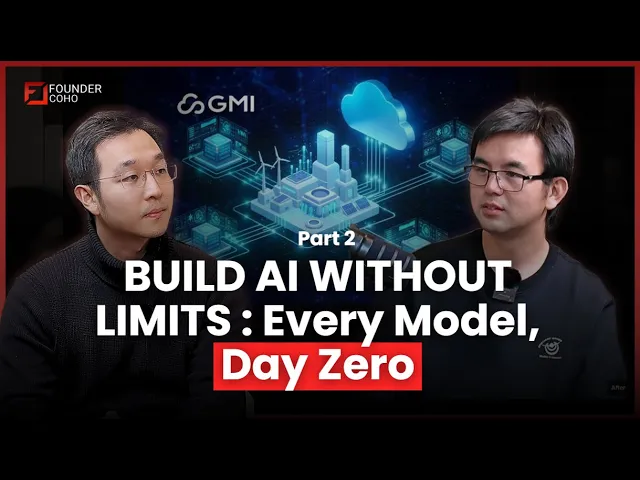
In Part 2, we shift from the 'how' to the 'what's next.' Alex Yeh dives into the 'multi-everything' world we now live in—multi-chip, multi-cloud, and multi-model. He argues that true innovation happens when developers aren't locked into a single provider. We explore the 'AI Factory' concept, where energy has replaced chips as the primary bottleneck for scaling intelligence. Alex also provides a fascinating look at the global market split, explaining why Asia is dominating the creative AI landscape with companion bots and video generation. Finally, he reveals his long-term vision for 'General Machine Intelligence'—a world where AI is so deeply integrated into our lives that we simply stop calling it 'AI' and start treating it as a new form of life. References Alex Yeh's Linkedin – https://www.linkedin.com/in/gmi-yeh/ Alex Yeh's X - https://x.com/alex_yehya Jing Conan Wang (Host) – https://www.linkedin.com/in/jingconan/ FounderCoHo – https://www.linkedin.com/company/foundercoho
References
Alex Yeh's Linkedin – https://www.linkedin.com/in/gmi-yeh/
Alex Yeh's X - https://x.com/alex_yehya
Jing Conan Wang (Host) – https://www.linkedin.com/in/jingconan/
FounderCoHo – https://www.linkedin.com/company/foundercoho
Timestamp
00:00 Highlights
01:59 Introduction
02:39 Recap of Part 1
03:19 Interview Focus
04:17 Building the AI Internet
06:51 Multi-Cloud and Multi-Model Strategy
08:17 Open Source vs Closed Source Models
10:51 Zero-Day Support for All AI Models
12:22 Team Structure and Engineering Culture
13:01 Empowering Engineers with Early Model Access
14:22 Global Team and Multi-Chip Infrastructure
16:30 NVIDIA Cloud Partner and Asia Operations
20:06 Asia vs US Market Dynamics
23:44 Energy as the Biggest Constraint
24:58 Building AI Factories from the Ground Up
27:25 Are We in an AI Bubble?
33:25 Future of Scaling and Video Models
34:27 The First AI-Generated Feature Film
40:22 Advice for Future Founders
44:05 Betting on the Beta
47:10 The Future of Normalized AI Technology
49:08 Outro
Full Transcript
Do you think that we are in a
bubble?
We are very early.
Everything is booked out in 2026.
All the GPUs are booked out.
TSMC's capacity is 100% all the way
to 2027.
When tech giants lock users into their ecosystems,
Alex Yeh, founder and CEO of GMI Cloud
and one of the only six Reference Platform NVIDIA cloud
partners globally, is breaking that barrier.
The vision is to build AI internet.
The mission is to allow any enterprise, any
startup founders or any creator to use AI
instantly.
I accept the world that we were going
to live in, multi-chip world, multi-cloud
world, and multi-model world.
No one wants to get tied in.
We have zero-day support on every single
model.
Within 24 hours, we'll have these models come
out.
It's all on our platform.
We want to be agnostic and enable anyone
to build cool things.
Today, GMI Cloud powers the AI revolution across
three fast-growing categories, software co-pilots, video
and image generation, and AI companions.
I now know you hired a team like great
engineers from Google X and gave them the
vision of the change in the world.
Everyone is super hardworking and doing everything they
could.
Instead of saying, oh, this is not my
job, my scope will work, right?
We do everything fast and together.
That builds a culture and that culture attracts
more and more talented and amazing people to
join us.
We also get previews.
Before they release, they tell us.
They're like, oh, three days before.
Oh, you get to try it with significant
discount.
And we're like, oh, hell yeah, dude.
That's really good for our engineers because engineers
just want to try new and cool models
before everyone does.
But GMI Cloud isn't just about today's AI.
We haven't even discussed the world model, which
is true world understanding.
I think that's true AGI.
It will expand our capabilities.
Film industry will be cracked.
Gaming industry will also be cracked.
If GMI Cloud is truly successful to your
wildest dream, what do you think the world
will look like?
People won't talk about AI anymore. They just think its...
We're again joined by Alex Yeh, founder and
CEO of GMI Cloud, also known as General
Machine Intelligence Cloud.
A third generation entrepreneur and graduate of Johns
Hopkins, Alex bridges the gap between massive capital
management and cutting edge hardware.
Before GMI, he served as a partner at
Infinity Ventures Crypto, a subsidiary of the $4.5
billion dollars headline group.
Today, he leads one of only six Reference Platform NVIDIA
Cloud partners globally, operating nine data centers across
the US and Asia.
As a young CEO, Alex is on a
mission to build the AI internet, combining a
bold desire for innovation with a deep commitment
to energy sustainability and ethical AI that he
can proudly stand by for generations to come.
In part one, Alex shared his journey from
fifth grade entrepreneur to crypto VC and how
China's Bitcoin mining shutdown forced him to build
three data centers in the US in just
two years.
Then two years ago, when GPT-3 launched,
VCs kept asking him for GPU cards for
AI training.
Alex saw the wave and pivoted GMI Cloud
to AI infrastructure.
He explained that we're moving from a retrieval
-based internet where everything is stored and ranked
to a generative AI internet where information is
created in real time the moment you need
it.
This shift requires completely different infrastructure.
That's where we left off.
I asked, how can GMI Cloud make this
vision real faster?
In part two, we shift from the how
to the what's next.
Alex Yeh dives into the multi-everything world
we now live in, multi-chip, multi-cloud
and multi-model.
He argues that true innovation happens when developers
aren't locked into a single provider.
We explore the AI factory concept where energy
has replaced chips as the primary bottleneck for
scaling intelligence.
Alex also provides a fascinating look at the
global market split, explaining why Asia is dominating
the creative AI landscape with companion bots and
video generation.
Finally, he reveals his long-term vision for
general machine intelligence, a world where AI is
so deeply integrated into our lives that we
simply stop calling it AI and start treating
it as a new form of life.
Please subscribe and turn on notification so you
never miss the next one.
So the vision is to build AI internet
and how we get there is the mission,
right?
The mission is to allow any enterprise, any
startup founders or any creator to use AI
instantly.
Because right now, AI is so costly.
GPU is so expensive, right?
Not many people can enjoy these services.
So what we want to do is to
break that barrier and make it seamless and
easy.
So from offering these high performance compute on
a bare metal format that people can use
and utilize a full 100% of the
raw power, right?
To startup founders or creators that's like, I'm
not going to rent GPUs, but I just
want to use, you can say 30 seconds
of pulling your API or even interact with
our console to generate this image or video,
right?
So we want to make that barrier much
lower.
And right now we're thinking, okay, you know
what?
Having these snapshot of these models, we have
over 60 plus models, right?
Full modality, that's not enough, right?
Because people are building workflows, right?
You're using multiple models together.
You mentioned that you're building agent.
I'm sure you're using more than one models,
right?
For your businesses, right?
So we built our own version of workflow
so you can drag and pull different models,
right?
On top of us.
And so we want to make sure that
anyone can build things quickly.
That's why I want to be an AI
builder cloud.
I want to enable builders to build really
interesting, amazing application.
What is your vision ahead for how GMI's
software layer will evolve that will enable faster
model building?
Yeah.
So for example, right?
If you use hyperscalers, they're kind of all
in different camps, right?
For example, AWS would be Anthropic, right?
Right.
Google would have their own Gemini series, right?
And OpenAI obviously with Azure.
But we have all three.
And we also have all the open source
models.
So you offer actually such an awesome value,
which is like every cloud provider is trying
to lock you in.
As an agent builder, I know that Google
always sells your Gemini as a ticket.
Their true intention is to sell you the
Google Cloud.
Correct.
And so you offer these values that people
are able to access on models.
I accept the world that we were going
to live in multi-chip world.
As well as multi-cloud world and multi
-model world in the future.
No one wants to get tied in, right?
And that's why there's also room for NeoCloud
to grow.
Yes.
Because for example, I'm sure you interviewed a
lot of great CIOs or CEOs.
I have never seen any CTO said, oh,
my cloud bill is very cheap.
Never.
Never, never.
Yes.
I think there is now in the CPU
world, there's a diminishing return of how the
hyperscalers can serve their customers.
They just built in inflation adjustments, increasing that
bill every two, three percent because they know
your data is here.
You can't leave.
But GPU world, we can get to build
this from the ground up.
Right.
And so we're offering very differentiated services to
our customers.
Yeah.
So that's also related to another topic I
would love to hear your thoughts because there's
closed source, there's open source.
Yeah.
A lot of the U.S. model builders
like Gemini, OpenAI, they build on top of
closed source models to lock people in their
own platform or their cloud partners.
At the same time, there's also open source
models.
What is your take about this closed source,
open source world we are in?
I think it lives in harmony and it
pushes the world to be a better place.
What I mean by that, right?
I think we can draw the same parallel
to the chip world, chip war, right?
Back in the day, it's all x86.
There's ARM, there's RISC-V, right?
There's different new architecture that pushes the other
side to have better and faster innovation.
If without DeepSeek, which is open source
model, that I think Sam Altman proudly claimed
before that, it's like, oh, no one's ever
going to be better than us, and got
passed.
And so other companies were like, oh, DeepSeek
did it, I can do it too, right?
And so it promotes competition and better model
services.
And now we have basically open source models
just right after, only a couple of months
behind these closed source models.
So I think it just pushes us to
have better things.
And also it can be used for different
applications, right?
Closed source models, well, unfortunately, data sensitive companies
are not going to use it, right?
Because I'm not going to send my patient
info or insurance info to chat GPT.
You can't, right?
If I'm doing chip design or TSMC, do
you think they can upload any of that
data to closed source?
No way.
They're like, oh, it has to come on
-prem.
It has to be in my data center.
So there's room for these open source models,
right?
And these open source models, because enterprise uses
these open source model, they can use it
for general purpose, but a lot of them
are used on production, right?
And they have a lot of propriety data
and they can do fine tuning, all kinds
of fine tuning, server-side fine tuning or
RL fine tuning on top of their own
data sets on the open source models, right?
For their specific application, right?
And so the world is so big, right?
It's not just models for everything, but it
will have verticalization and specialization on each individual
applications.
Yeah, exactly.
And like you mentioned, these two can co
-exist and actually help each other, right?
This ecosystem involves.
I wonder from GMI Cloud's perspective, what is
the strategy?
What is like a percentage efforts you put
on open source models in your platform or
closed source?
We follow both.
We follow both.
We have zero-day support on every single
model that comes out, including WAN 2.6,
right?
That just came out.
Zero-day support.
Within 24 hours, we'll have these models come
out, including Gemini 3, Veo3, all these closed
source models, right?
All on our platform.
We want to be agnostic.
We want to be able to serve customers
whatever they want.
They don't have to be tied in to
GCP in order to get Gemini series.
They don't have to get tied into OpenAI
in order to get all the GPT 5.2
or whatnot.
Yeah, yeah.
We want to be agnostic and enable anyone
to build cool things.
Yeah.
So you do the hard core things on
your side, harder things so that your customers.
We host every model.
Yeah.
So I'm very curious.
That must be a lot of work.
How big is the team?
The team is like 100 plus people, like
120 maybe.
And you can host all the models.
And I wonder what is the composition of
the team?
Is it mostly engineers?
60 plus percent are engineers.
Engineers.
Yeah.
And how do you organize the team?
I now know you have a hard team
from great engineers from Google X and gave
them the vision of the change in the
world.
And when they join your company, how do
you manage the team so that they can
actually do a great job?
Manage and motivate them.
Motivate them.
I think it's based on the culture and
the initial lieutenants that I have, right?
Of that everyone is super hardworking and doing
everything they could.
Instead of saying, oh, this is not my
job.
My scope of work, right?
We do everything fast and together.
Whatever things that need to get done, we
kind of do it.
I think that builds a culture and that
culture attracts more and more talented and amazing
people to join us.
Yeah, exactly.
Yeah.
So like you mentioned, fast learner move fast.
Yeah.
And I think instead of joining a larger
company, joining us allow engineers to hold a
lot more responsibility as to only seeing one
part.
For example, we have a small team of,
I think, only a couple of people handle
the entire video models.
Maybe two, three people.
Two, three people, but the entire video models.
Video models.
That's you.
That's you guys.
You're responsible for basically zero day support.
Right.
They have a lot of power and they
can play with these GPUs and trying on
these latest models that they wouldn't be able
to.
Right.
We also get previews.
Like we get like all these large model
companies when they release pre-release before they
release, they tell us they're like, oh, three
days before.
Oh, you're going to try it with significant
discounts.
And we're like, oh, hell yeah, dude.
I think that's good.
Really good for our engineers because engineers want
to try new and cool models before everyone
does.
They're like, oh, we have the coolest model on
the screen.
Yeah.
It's like, oh, yeah.
And we kind of come out, but you
guys don't know.
But we know.
So is the team a global team with
mostly US?
Yeah, global team.
Global team.
So you also like run a team globally
and also have data center globally?
Globally, yeah.
How do you manage a global team?
I think I just sleep less.
Yeah.
So I have like, I'm either in Mountain
View or I'm on the plane flying somewhere.
Going to where?
To airport.
Yeah.
I think you need a Elon Musk rocket.
Yeah, that'd be great.
All right.
So another thing I want to touch is
that like GPU space is also pretty competitive
space.
Yes, definitely.
What is your view about competition in this
space?
Everyone has their own niche, I would say.
There's definitely overlaps.
There's definitely overlaps.
But everyone kind of does their own niche.
For example, I have the entire Asia Asia
pack market.
And Asia pack is very fragmented compared to
US, for example.
And so you really have to dig deep
into each region.
That's why some other peers and other companies,
they're like, oh, I'm going to do JV.
No, it's not going to do well for
you.
That's after JV, nothing is going to happen.
Right?
You need your own team to push locally
and understand the market, the dynamic, and who's
who that can help you penetrate the market.
Right.
And so that's definitely, I would say, very
important, right?
That's why we are known as kind of
the core weave of Asia.
Yeah.
We have a significant presence there.
Yeah, exactly.
And what we're also known as the performance
that we can get, because coming from kind
of the supply chain world of Taiwan, and
control of the servers.
I'll tell you a secret, right?
We even code our switch.
Right?
Because we want to do parallel inferencing.
Right, right.
You need to control the switch.
Yeah.
Right.
In order to separate out the models, the
MOE models, right?
Multiple experts into individual GPUs.
Right?
And we want to separate out the compute
workload on memory bound problems and compute bound
problems into two sets of GPUs.
Right, right.
Right?
If you don't have these low level control,
you won't be able to do anything.
Right?
If you VM everything, no way.
You can't touch it.
Even if the customers want to do it,
they can't.
Yeah.
Right?
That's why we have a significant performance difference.
Yeah, yeah.
And this also is an interesting thing that
we know it works is we can mix
heterogeneous chips together.
So tell us more, because this is actually
sounds very interesting technology.
Yeah.
I mean, look, it's compute bound and memory
bound.
Right?
Yeah.
AMDs, they have MI350, right?
I think.
Massive memory.
Right?
But their compute is okay.
So you can mix AMD and NVIDIA chips
together.
It's theoretically possible, right?
And we have tested it, but we just
prefer to stay on NVIDIA stack because we
are short staffed at this moment.
We don't want to expand into different tech
stack, tech tree yet.
Yeah, yeah.
But we want to stick with the NVIDIA
gears because the NVIDIA stack also upgrades every
single year, right?
There's H1, H2, B2, B3, GB2, GB3.
Yeah.
So we just follow that tech tree, right?
And then it works.
But we can also mix and match the
older generations of GPUs together.
Right?
So you can have all sorts of GPU,
maybe even the GPU for Bitcoin mining.
Well, that is different.
That's ASIC.
That's ASIC.
They can't do anything.
But different kinds of older GPUs, yes.
So for example, people use our API, right?
We don't tell them what's behind the APIs,
right?
Which powers it.
But we can mix a cluster of H1s,
H2s together.
So you can dynamically choosing which chip is
faster, which chip can give you more capacity
and do this intelligently.
Yes, 100%.
So that is some proprietary software you build
to enable that.
Is that also the reason why you say...
Google X team.
Google X team.
Yeah, I know they are very good at
it.
So is that a reason that you can
do it in the cheaper by mixing different
chips and faster?
Yeah, 3X, 3 to 4X.
3 to 4X cheaper than...
Yeah, higher throughput, right?
Higher throughput means, you know, cheaper cost.
Yeah, yeah.
That's good.
That's cool.
You also mentioned about NVIDIA.
I know you are one of the only
six NVIDIA NCP, NVIDIA cloud partners globally.
How did that happen?
Well, it's definitely an invite-only process.
Right?
We slowly leveled up our capabilities, right?
From the software stack to the capital that
we need, the data center locations.
We offer a very unique services.
Again, across all the other six peers, right?
Coreweave, Lambda, etc.
Everyone is regional based.
Everyone's either US or Europe, or maybe both.
We are Asia and US.
That gives us a very unique edge.
We have really great, amazing enterprise customers, as
well as developers across all these regions.
It's related to another point, because you mentioned
about a lot of AI innovation happened in
Asia as well.
Asia is a very important market.
Oftentimes, it's underestimated by people in the US.
What would you say how the Asia market
looks like compared with the US?
US definitely leads in terms of foundational model
research, either pre-training or post-training, and
some inferencing.
But Asia leads in terms of inferencing, absolutely
inferencing.
And there's three areas or three categories that's
fast growing.
One is software copilot.
As we all know, there's a lot of
dev shop, right?
And a lot of developers in Asia, right?
Across like Vietnam, Taiwan, China, Japan, etc.
And the use of copilots, I mean, coding
copilots are bananas growing really fast.
And that's one.
Number two is the video and image gen.
Image gen can be used for advertisements, can
be used for all the e-commerce.
All the e-commerce are all from Asia,
right?
Even on Amazon, right?
Most of them are.
Exactly, yeah.
All the all the laobans are all in
Asia.
They need the entire marketing team to do
all the advertisements, product placements, right?
And don't mention short videos.
How many videos that you see online are
kind of AI generated?
Yeah, yeah, yeah.
All come from Asia.
Yeah, exactly.
So they need all the GPUs there.
Right, right.
And third is AI companions.
That's also huge across East Asia and Southeast
Asia.
Right, right.
And you can't wait for your AI friend
to respond after one second, right?
It has to be below 50 milliseconds or
less.
So having GPUs close to the customer is
important.
The application layers of the Asian market and
the US market is involved independently actually get
a lot of different insights coming.
Asia's companion is very strong.
Like marketing, the video generation is very, very
strong.
In the US, people are working on the
business cases, lawyers, doctors.
And what do you see about the trend
in the future?
Do you think that these two markets in
terms of the applications will continue evolving like
this or eventually they will merge?
What would be the future you predict?
I think it's kind of like the questions
that you asked, like open source and closed
source.
They're going to copy each other.
Right?
I think back then, like 10 years ago,
there was a trade, the China-US trade,
essentially.
It's like, oh, what is great in the
US, let's move to China.
Yes, yes.
Let's do it again.
Copy to China.
Same thing.
But now, oh, damn, TikTok is great.
Let's copy to the US.
Let's Instagram, let's do Reels, right?
Let's do the stories.
Right.
Same thing.
It's like, oh, Asia is doing this.
It's great.
Yeah.
Right.
All the ideas diffuse and Asians have a
lot more people.
Right.
And so whatever model that's moderately successful, let's
copy in the US.
Right.
Same thing.
It's all these like note takers and so
forth.
Right.
You know, they just exchange info.
Yeah.
So it's really good for everyone.
Right.
So another areas I would like to talk
about is that you have mentioned that energy
is the biggest constraints in the entire market.
Not chips, not talent.
It is energy.
Can you tell us more why you think
that way?
We have gone a long way expanding our
footprints, right?
From no data centers to nine data centers
in two years.
Well, we have scaled to a moment where
we need to get much, I would say,
larger customers.
And the problem is.
We have all the money we have in
the world and customer contracts, but I can't
fill it because there's no place to place
it.
Just like when I started in the Bitcoin
mining world, which is my service.
It's in China, right?
Or it's in TSMC, but I can't move
it out.
It's collecting dust.
I need somewhere to put it, right?
Right now, the grid, power grids in the
US, there's nothing above 10 megawatts.
Nothing.
So I have to build it myself.
So you have to build your own power
plant in order to make it happen?
I'm exploring.
Yes.
Yeah.
Wow.
Wow.
Yeah.
So actually walk us through, what is the
process of building your own cluster?
Like, do you need to figure out power
plant first?
What exactly the process is like?
Increasingly, as we're chasing and talking to larger
customers, we have to control the real estate.
And so the latest is, we just got
a power shell.
Right?
No cooling.
We had to put cooling ourselves.
We need liquid core.
They have no pipes.
So we put in the piping ourselves.
Right?
So because we've gone to a lot, to
a size of what we're building is called
AI factory.
Right?
It's not just, oh, the server is different.
No, it's not that.
It's the entire rack design, entire power distribution,
cooling distribution, right?
Piping design.
Yeah.
Different.
Right?
So I have to build everything myself from
the ground up, control from the ground up.
That's called AI factory.
That's what we're building.
Right?
And the future, right?
Which is planning what we're building 3X the size
of what we're doing.
So for example, I'll share with you.
There's a project that we're building.
It's a 10,000 GB, 300, the liquid
core cluster in Taiwan right now.
Wow.
It's the first of its kind in Asia.
The first, right?
And the equivalent compute, right?
Is a hundred thousand H100 in terms of
compute power.
You can't imagine that two years ago to
look how fast the entire industry have gone.
Right.
To 10,000 chips.
Right, right.
One versus 10.
Right.
It's crazy.
And we're building something that's much larger in
US.
Right.
And now we have to control even the
real estate itself.
And the power that comes in.
Because there's not enough power that goes into
these servers.
All the problems we are facing eventually will
become energy problem.
Because like all these AI computation will turn
energy into intelligence.
In some sense.
Yes.
Yeah.
So, and you mentioned about like, actually it
takes a very heavy investment infrastructure.
You need to buy the real estate.
You need to like install your own pipe.
That all requires investment.
And we are currently in the AI boom.
Like the OpenAI, they raised $500 billion to
continue business.
Everyone is like trying to raise more money.
Do you think that we are in a
bubble?
We are very early.
I have to say.
Right.
I'll give you two answers.
I'll give you the hedge fund answer.
First.
Okay.
Because I'm very close to the supply chain
in Taiwan.
Everything is booked out in 26.
All the GPUs are booked out.
TSMC's capacity is 100% all the way
to 2027.
Oh, 2027.
Yes.
Two years later.
Wow.
So that's the hedge fund answer.
That's the math answer.
Right.
All the power signed.
If you're a frontier lab, try to find
a 2000 plus cluster.
Doesn't exist.
You can't find anything.
Right.
That's the numerical number.
And I'll give you, I would say a
product answer.
Right.
Is.
Here's the waves that I've seen.
Right.
Two years ago, it was just LLMs. A
bunch of LLMs that came out.
And then it diverged into multimodal models.
And then into post-training on the LLMs.
RL on all kinds of applications.
And the cool thing is RL is you
can't generalize the whole thing.
Right.
You have to train it for individual tasks.
Right.
And so there's basically unlimited things that you'll
be able to solve.
Just on that side, on this sector.
Right.
And on the multimodal wave, we have just
cracked video.
Like your video quality isn't like pixel perfect
yet.
Right.
Right.
Generation.
But it's gone very close.
That's just video understanding.
Right.
Right.
But we haven't even mixed video and LLMs
together.
Right now we're doing a trick.
Right.
We're kind of putting a classifier model on
top of that and putting LLMs and videos
together.
But in the future, we have to put
videos, image, LLMs all together.
Audio models all together.
That's one sector.
And we haven't even discussed the world model,
which is true world understanding.
Right.
Right.
Is right now, I think arguably, unfortunately, sometimes
the dog is smarter than LLMs. Not LLMs,
models.
Right.
A dog can understand, be perceiving the world
much better than a robot can.
Right.
Because it has.
he real world context. Robots right now doesn't have real world context. And so I think that whoever can crack that world model, basically how I define it as real world understanding that you can pick up a cup without not through a thousand times training. Right. Right. Right.
to understand and perceive the world. That's true game changing, and we haven't cracked that yet. And with that, we'll have robotics and so forth. So I actually want to answer your question from earlier. You said, what is the name GMI come from? General Machine Intelligence. I think people was like, AI is taking a human's job, and so forth. But actually, I think.
It's just another silicon life form. It's just machine intelligence. I think it's a continuation of the carbon intelligence. A machine intelligence is just a plus that can expand our life beyond Earth. And if we can generalize that, a general machine intelligence,
I think that's true AGI. It will expand our human kind of carbon life form to beyond Earth and beyond our capabilities and solve the most difficult problems and visit the most difficult uninhabitable places in the future. I think that's why I believe in the general machine intelligence. It's an extension of the carbon life form.
that's a very great name, beautiful name and beautiful visions. And I love you mentioned about there are so many interesting applications that we haven't even cracked the surface yet. that's actually related to another question I have is that a lot of people, are talking about scaling law is slowing down. Yes.
From your perspective, do you think scaling law matters? Or does it still matter? What is the take on?
On LLMs Of course, on LLM it slows down, right?
But there's like a lot of new applications like…
New applications, right? And I forgot the number, don't quote me. But internet is very vast, but we exhaust it. But most of the data is actually stored privately. I think 60 plus percent. And we haven't used that yet. And that's just LLMs.
We haven't used image and videos and text all together for PDFs, PDFs, right? All kinds of different file types. Right. Yeah. So I don't want to call it LLM anymore. Right. I want to call it large models.
It's not necessarily a language model, it's just machine intelligence.
Machine intelligence model.
Exactly, yeah. Yes, that's cool. That's So there's a lot of great things we need to do that I think a lot of great things will happen in the next few years and like you mentioned There's a lot of breakthroughs every week like it has been three years. It has still hasn't stopped yet every new every week this morning I saw the Gemini 3.0 flash they come out. Yeah From your perspective, what are the areas that you feel most excited in the next six months?
Next six months.
That's a good good. That's a very good question. I think it's in probably The video model space it's really exciting and I see that
Just think about like two years ago. Right. We have Will Smith eating the noodle spaghetti.
I cant imagine, it feels like 2 decades go but it’s only 2 years.
It's great, right? But you can still see a thing like a couple things and but now like we even was able to do the fingers perfectly right now, right? But sometimes the pores are too perfect. So you can tell it's probably AI a lot of times even like the cute
videos on Instagram and things like that. couldn't tell. So I think in the future, in the next six months, we will have even better quality videos, I think will reduce
cost on different product placement, advertisement, film industry. I'll share with you. We have the first AI video movie production company using us. Well, maybe not six months. In two years, they're going to come out with 100 % AI generated movie. Two hours. Right now, all the clips are like five seconds, 20 seconds. Two hours.
I would be very looking forward to it.
Imagine the cost right all the big videos are movies. So we're like, oh each cost like 300 million a billion
Exactly like when James Cameron did all these Avatar does thing like this CG is extremely expensive. A billion plus! Yeah, a billion plus. god. Yeah. And how tedious it is to make animation, put dots and everything, explode things, you know.
Yeah, so I think the film industry is a super exciting industry. cool. I would like to dive a little bit deeper on that since you mentioned about video is a space that you feel very exciting in the next six months. So OpenAI obviously is a leader in the space and they released Sora. Yes. And it was a hit. But recently also a lot of people say that the retention is not very good in the Sora. What is your take about these video generation applications? what do you think needs to happen before people start to actually use it daily or become like a next phenomenal product like TikTok.
I think video generation is a tool, right? It's just it's a model. It depends on how you use it Right and Sora is something that people are exploring Exploring but it may not be in the format of social media right each generation of AIs will have different applications, right? Right. So we may not Have a social media
Right. Yeah. But it could be a very useful tool. Maybe it's another Adobe. Yeah. Very could be right. It proven that it can be Adobe. And if you can change the products and change the characters as you wish, right, then it will be powerful. Because I think in the film industry right now, the problem is like, I just want to use this actor's face, right? It's not I can't type the same prompt, but swapping the the face out.
So if you can get to that level of control, film industry will be cracked. Video gaming industry will also be cracked. Gaming is huge. It powered the biggest of the companies. People think Tencent and all is WeChat. No, it's a gaming company. It's the biggest gaming company in the world.
you mentioned a great point, like when everyone talk about industry, they like to talk about SaaS, is as if it's the only industry. But oftentimes there's a lot of industry like gaming, when nobody talks about it, but it's like huge.
Do you know just the skin trade alone? Do know like the gaming like video gaming skin like League of Legends I want to change to like to gold skin. Do you know skin trade alone is?
Yeah, I don't know what was it. Yeah
It's a hundred billion trading volume. A hundred billion dollars a year on virtual skin. And the entire gaming, video gaming industry. Right?
Its combination of an entire US sports plus Hollywood combined and bigger. That's gaming.
Wow that's really...
Massive, massive, building a game is so hard, especially a AAA game, right? Back in the days, Blizzard, it took them 10 years to build a hit, world hit. Even right now, AAA games takes five plus years. If you know any animation or gaming experts, damn, each character takes so long, all the world creation, super tough. But if you have generation, they have generations, create 3D assets and...
That can change the whole industry.
The cost and also the timing.
When everyone talks about AI, they typically talk about co-pilot. That's one of the applications. There's many other applications like gaming, entertainment, film industry, traditional industry. That's going to be revoluted.
The application on top of it, I think it's like, like you mentioned about Sora to TikTok, you probably couldn't just copy TikTok and just replace the sublime side to be AI and you hope to create the next generation app.
And I think what my job is, is to build a good enough tool so that a product genius can take that models and build something.
Yeah, enabler, right? I'm probably not going to build the next social media, but someone can. Yeah. Right. And why does it have to be a social media format? It could be a complete brand new industry and businesses that we have. We don't even imagine. Right. It's maybe it's not search. Maybe it's not social media. Maybe it's just something else. Maybe it's just a general intelligent agent. It just does everything. Right. It could be a trillion dollar 10 trillion dollar business on its own.
Yeah. Exactly. Yeah. So there's a lot actually, like you mentioned, at very beginning, there's a lot of opportunity that needs to be cracked. And I'm also curious, if you are going to advise someone who wants to be a founder today, what advice would you give to them?
Persistence. Yeah, persist. Keep trying. You don't have to be like. Even though Silicon Valley favors it, you don't have to be a technical founder. You can just have really amazing team to support you. And I think the key trait is when you commit, just go do it and all in. And don't hesitate and be persistent because...
In the startup journey, 99 % of the time is just terrible and you feel horrible, right? And, but you just have to be persistent and stay in the game.
Yeah, be persistent and stay in the game. And I think you are proof of that. Like when your Bitcoin mining business was wiped out in one day, you didn't give up. You persist. Yeah. You turn that into GMI cloud.
I have to say, like, all the folks that went in in 2017 with me, the people who stayed in the game, all made money, all millionaires. Same with the people who pivoted into AI. As long as you're in the game and don't go bust, don't die, you will win. You will win big. Just stay in the game. Don't give up. Never quit.
Exactly, yeah. And you have went through a long journey going from beetle cards when you were in fifth, sixth grade to crypto to build a GMI to build AI internet, enabling the product genius to build the futures of AI applications. If you put in the way, what is the one thing that connects the dots of your life journey?
One thing that connects the dot is... Persistence. Honestly.
When actually you talk about... otherwise I realize you actually have perfect proof of...
Commit. Just commit, just commit and persist. You can take your time to think through things, but when you think through, commit.
And another question related to that.
if you go back to younger version self and tell them to do one thing differently, what do you do? One thing differently.
Doesn't matter how hard you think the problem that you're facing now, it's going to be trivial in the future. Like literally, like I still remember like the first problem I was like, my co-founder is going to leave, it's going so painful. And then now me thinking about it, it's like...
It's honestly not a problem. I probably couldn't sleep for an entire week for something like that. Yeah. Right. And all the problems I face, I'm going to lose a customer. I'm going to lose my head of sales. It's not a big deal. I'll fall right, right. Everything's going to Everything is going to be fine. As long as you say it again. it. Yes. Don't quit.
Don't quit, yeah. And you have a great point, actually, that everything you mentioned about persistence, staying in the game, and also believe, being optimistic, everything's going fine. It's about us really thinking about our long horizons. Like, take a step back and what is the true thing you want to do. And don't get bothered by the small obstacles or the challenges or the challenges in each stages of your art. Just keep trying, and things will be fine.
Yeah, but also I want to share a thought it's not like a blind optimism into the things that you're doing. But everything has to be grounded in in practical reality, right. And this also explains how I think about
why I commit in this industry or why I commit to do what I do. So like what you said, it's a long horizon. It's a marathon. It's never a sprint. Why I got into Bitcoin, why I got into Bitcoin mining is because I observed there's a pattern in the crypto industry. Everything goes up and down, but Bitcoin is kind of the anchor.
right of the of the industry right it will not go anywhere like if bitcoin goes up everything goes up if it goes out everything goes down right and so all i have to do so my axiom is okay crypto is going to be something blockchain is going to be something in the future all i have to do is bet on the beta right that is the most anti-fragile thing
Yeah, the beta is the overall trend, the long horizon.
long horizon so I just bet on Bitcoin so Bitcoin mining makes a lot of sense to me right that I can bet 10 years we're doing the same thing for 10 years we'll be fine same thing with AI you mentioned social media right you mentioned film and you mentioned music you mentioned robotics right all kinds of stuff
Right? I don't know who's gonna win. Maybe social media with Gen.ai is a dead end. Maybe it will just be a tool. It will never be a generational social media company. It could be like we don't know. But what is the biggest common dominator? Everyone needs cards. Everyone needs GPUs, the beta.
So I can do this again and again and again and again and be confident of what I'm doing no matter how hard the trouble is because I know the found the fundamental Axiom doesn't change right, which is this generation of gen AI or LLMs or what are big models? They all need compute right, right. So I just need to be a compute provider and make sure my product is kick-ass is amazing It's multitude better than the other competitors that I will stay in the game for a long run.
Exactly. Yeah, I think that's a perfect first principle thinking about the future and like you mentioned about beta, which is a great framework. Just focus on the beta. Don't be bothered by the fluctuations. And related to that, I'm actually curious about your vision and your thinking of the beta in the future. If you work hard every day, sleep very less, to build a GMI cloud, to be the enabler. And five years from now, If GMI Cloud is successful, truly successful to your wildest dream, what do you think the world would look like?
People won't talk about AI anymore. They just think it's a new way of interaction.
They will be normalized because it's so common and all sorts of applications already exist.
Back in 2008 or something, people were like, oh, have you tried a new smartphone? Have you tried smartphone? Right now, it's just called phone. It's your phone, right? And so people are like, oh, it's a new cool thing, it's going to be your new application, your new way to interact with machine. It's just a new silicon being that you interact with.
New general machine intelligence.
For us, we probably think, oh, it's a new thing. for probably our kids, generation before, after, they'll be like, why are you searching? Why are you indexing? Why do you take so much of your time? It's just you type in and then search and pop up. Maybe it's like, oh, why are you interacting with your phone? Maybe you just like to talk to your class, maybe.
Yeah, exactly. I think that's actually such a beautiful future. It's like the technology has enabled the whole society and people normalize and take it for granted. There's already tons of things in our life that we take it for granted. And this will be yet one more thing that will be taken for granted. And it's awesome that you built GMI Cloud to enable this vision. And this is a platform and this is like
tools that will be needed regardless of what applications that will be built on top of it. And really appreciate your sharing and today I learned a ton and I think our community members will also learn a ton from you and we're truly excited for the future that you envision.
Likewise, thank you for letting me to share my thoughts and my ideas about the future.
Thanks for watching the full interview. Don't forget to subscribe to our YouTube Channel and turn on notifications so you never miss the next one.