Interviews
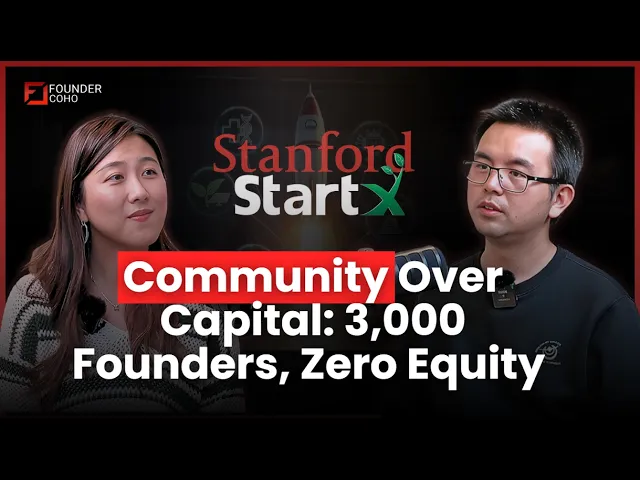
Pengpeng pulls back the curtain on StartX. She explains how their rare, zero-equity, non-profit model creates a high-trust environment where 'paying it forward' is the only currency.

|
Partnerships & Ecosystem Leader | AI, Robotics & Startups | Ex-StartX, Bain | Stanford GSB
Pengpeng Wang, Head of Community and Campus Relations at StartX, Stanford's prestigious non-profit startup accelerator. After leading corporate innovation at Pfizer China, Pengpeng reset her career in 2021 by joining Stanford GSB's MSX program, where she took classes across six of Stanford's seven schools—building the network that became her superpower. Today, she orchestrates a community of 3,000+ founders and 500+ mentors at StartX. In our conversation, she'll reveal how to break into Stanford's ecosystem, why successful founders help others first, and the surprising career lessons from someone who chose learning over certainty.
What makes a startup ecosystem thrive, and why is community a founder's ultimate competitive advantage? In this conversation, Pengpeng pulls back the curtain on StartX. She explains how their rare, zero-equity, non-profit model creates a high-trust environment where 'paying it forward' is the only currency. We explore the 'Neighborhood Program'—a unique peer-support model Pengpeng describes as an 'AA group for founders'—where leaders can safely navigate the lonely challenges of entrepreneurship. Drawing from her work at the Office of Technology Licensing, she shares how to bridge the 'lab-to-market' gap and find the perfect co-founder. Pengpeng reveals why community beats competition, how to access Stanford's ecosystem even if you're not affiliated, and why her "30% certainty rule" unlocks more opportunities than perfect planning ever could.
References
Pengpeng Wang’s Linkedin – https://www.linkedin.com/in/pengpeng-wang/
Stanford-StartX - https://web.startx.com/
Jing Conan Wang (Host) – https://www.linkedin.com/in/jingconan/
FounderCoHo – https://www.linkedin.com/company/foundercoho
Timestamp
00:00 - Highlight
02:15 - Early Career in Healthcare and Working at Pfizer in China
04:38 - Decision to Attend Stanford GSB and the MSX Program
07:27 - Taking Classes Across Six Stanford Schools
16:22 - Working at Stanford Office of Technology Licensing (OTL)
22:35 - Joining StartX and Role as Head of Community and Campus Relations
26:17 - How to Apply to StartX and Program Eligibility
28:13 - Finding Stanford Co-Founders and Co-Founder Matching Resources
29:52 - What Makes StartX Unique - Community and Zero Equity Model
33:05 - The Neighborhood Program - Peer Support Groups for Founders
38:35 - Key Takeaways from Community Building
41:22 - Future Aspirations for StartX
48:15 - Advice for Aspiring Community Builders
50:54 - Outro
Full Transcript
At GSB there's this running joke that you can only choose two out of three: Sleep, social, and academics.
I kind of deprioritized my sleep. Pengpeng Wang helps lead one of the most powerful founder communities in the world — 2,500+ founders, 500+ mentors, built on a zero-equity, help-first model at StartX.
But her journey didn’t start there.
She once had a perfectly mapped 10-year plan — a leadership track at Pfizer in China, clear milestones, steady progress. Until she realized something was missing.
Today, she works at the center of Stanford’s startup ecosystem — where lonely founders find co-founders, where 6-person “neighborhood” groups replace isolation with trust, and where bold leaps are taken with just 30% certainty.
From lab-to-market breakthroughs to late-night founder therapy sessions, her work answers one question:
What if the real startup advantage isn’t capital — but community?
I was still young and I wanted to make impact, I wanna work at a faster pace. Maybe I should just go where the cutting edge happens. And there's nowhere better than the Silicon Valley."
So she did something radical. She reset everything.
My career was kind of very carefully planned. I tried to have a five-year plan, 10-year plan, and I worked my way towards that plan.
But one thing after Stanford that changed my perspective... Don't feel like you need to be 80% or 100% sure before you make your move. Maybe 30% or 50% sure and then just try.
That leap of faith led her to take classes across six different Stanford schools in one year. To say yes when she was debating whether to sleep or attend one random campus event.
I struggled a little bit and eventually I decided to check out this event instead of sleeping. And I'm very happy about my decision that day.
Today, she leads community and campus programs at StartX, the Stanford-affiliated accelerator that has backed 1,000+ companies worth over $120B combined.
what's the catch? You don't take equity, you give out a lot of free stuff. There must be a catch.
The only thing we ask is you give back to other people. You pay it forward.
Do you think that helping others actually gives you competitive advantages?
Please subscribe and turn on notification so you
never miss the next one.
Pengpeng really great to chat with you.
Yeah Good to see you here. Yeah, and I'm very happy to have you in our community. You've been an amazing community member and I already see like you connect with so many founders and help other people. So yeah, happy to also help here.
I realize we always talk about StartX every time we meet. I'm very curious about your early days, the life you had before StartX. I heard that you had worked long time in China, had a very awesome career over there. But then you decided to reset your career and come to Stanford and to become a student again. Tell us why you made that choice.
Okay cool, yeah my previous life feels like quite some time ago. I was in healthcare before Stanford. I actually, was born, grew up in China, came to the US for undergrad and after graduation I went back, worked in healthcare consulting and also pharmaceutical company. I worked at Pfizer.
corporate innovation team where I actually it's a very non-traditional role where I actually interacted with a lot of startups, VCs, accelerators to find opportunity the next innovation opportunities for Pfizer and yeah I was truly inspired and excited about you know like a lot of digital health companies for example how those companies can help patients better monitor their health
and that could in the long run increase the adherence for those patients. And yeah, and then I thought, okay, if I'm this excited about early stage ecosystem, instead of working at a big company, maybe I should, I was still young and I wanted to make impact, I wanna work at a faster pace. And I was like, okay, maybe I should just go where the cutting edge of health and the digital health and innovation happens. And there's nowhere better than the Silicon Valley. That's how I decided to come back to the US and apply for a business school at Stanford.
when was that? When was that year?
I went to GSB in 2021 and I went to this program called MSX program at Stanford GSB. It's a one year program for mid-career professionals. I usually call it a program for people with one-third life crisis. We're not quite half life crisis yet. Usually it's people with at least eight years of work experience. But on average, I think we had 13 years of work experience. Some people have graduate school experience on average. It's people in their mid-30s to early 40s.
That sounds like a fantastic program, MSx program. And that's actually a very interesting topic I think a lot of our audiences, they already working in companies. A lot of them want to have a career change. Some want to become startup founder. Some want to come to Stanford. And from your experience, what would be the options for people if they decided to also go come back to campus and learn? What would be the options people have?
Actually, there are really a lot of options depending on your interest, your experience and like your goal of going back to school. If you have very particular areas of interest, for example, like digital health or health informatics, there's program for that. If you just want a broader network, more just around business or startup, I think GSB, the business school is a no-brainer and within GSB there's different programs. There's your typical two year program, MBA program. You have MSx program, which is one year. You have a summer program for experienced executive. You also have short term programs. And one thing that's really interesting is this program called DCI, Distinguished Career Individuals at Stanford. These are targeted at people in their like really late career maybe 50s, 60s, even 70s. At that time they still want to go back to school and explore what's next for them after they retire from their career or they exit their companies. And yeah, it's a so like even that different life stage you still have different choices.
So MSX is an awesome program for you. So this program come to Stanford and come back to the US. You did a very unusual path as usual MSx or MBA student. I heard you took a class from seven schools in Stanford?
Six out of seven.
Six out of seven.
The exception is the law school. I tried to take one, but I decided to drop it after.
What motivated you to take so many classes in different schools?
Yeah, I think part of the reason why I chose Stanford is its ecosystem and the diversity of its network. And for my program, there's only one year. So I wanted to take full advantage of that one year by actually connecting with people from different backgrounds, different schools. So I actively took classes in different schools, especially like out of my own comfort zone, for example, in the computer science department. I took classes in a sustainability school or education school, which were completely different from what I used to. But I also took a lot of classes from the medical school, which is very related to my background. I think that experience really opened my horizon and also helped me connect with people, like made friends with key connectors in different schools and that turned out to be very very helpful in my later career.
Wow, so you've packed all those classes in one year program? Yes. Any tips for time management? That sounds like incredible time management skills.
Well, at GSB there's this running joke that you can only choose two out of three, Sleep, social, and academics.
Right. So what did you choose?
Well, I think I kind of deprioritized my sleep. Social, yes. Spent a lot of time meeting new people and organizing community events at Stanford. And spent a lot of time just taking classes at different schools. Yeah, but I didn't really care that much about grades, but it's more about the experience.
I heard that through these activities you got your first internship at a Startx which was to analyze 250 healthcare companies. Tell us more about that project.
Yeah sure. I learned about StartX very randomly. I think they had a campus demo day. And as a Stanford student, I was debating, should I sleep that day or should I go to this event? I struggled a little bit and eventually I decided to check out this event instead of sleeping. And I'm very happy about my decision that day. Yeah, so.
It was basically a day where they invited a lot of StartX founders back to campus and shared their entrepreneurial journeys with us. And I was like, wow, this is really cool. And how can I be involved? And turned out they need some volunteers. And I signed up to be a volunteer. And now I work full time at StartX. And one of the projects they gave me was to analyze their community of healthcare founders. StartX has a very strong healthcare vertical. 20 to 25% of our community companies are in the healthcare space because we had a really strong medical school, we had a really good hospital, and we actually had a very active community. So that attracted many, many companies.
And one thing I realized was number one, think how diverse that community was. It's not just biotech company, it's medical device, it's digital health, it's healthcare services. So I was amazed by the diversity of founders, which is quite rare because a lot of Silicon Valley accelerators, they focus mostly on enterprise SaaS companies. Healthcare companies are known to be notoriously long in their life cycle and they have a lot of regulatory barrier. Yeah, it's just a very hard industry.
Yeah exactly.
Yeah, so I was very surprised to see a community for this vertical and also there's so many different kinds of digital, like healthcare companies, not digital health, but also like, you know, biotech and the medical device, which tend to be a little bit longer.
Yeah, that's also something that really surprised me when I joined the current cohort of StartX. Usually in the accelerator you have a lot of SaaS companies, AI application companies, but when I first joined I was surprised by how many healthcare robotics hardware companies StartX has. I wondered from your perspective is it related to the fact is Stanford affiliate is non-profit? Like what is the focus of the star X when you select companies.
Actually a good question and why there's such a diversity of founders in our community. Number one, think because we are affiliated with Stanford and again Stanford has seven schools. like what we have in our community reflects a lot on like what Stanford is doing. So that's why besides traditional like SaaS companies, enterprise SaaS or consumer tech companies, we also have healthcare.
a lot of Ed Tech because of the education school, have a lot of sustainability companies in recent years because of the Doerr sustainability school, we also have, you know legal tech, hardware because of the engineering school, so I think that's one. Another reason I believe is our non-profit and we don't take equity because of that we care less about if this company will make money or profit for us. We care more about if that person is a good founder, if that person could bring new perspectives to the community. So that's why we actually back a lot of companies that usually take longer to commercialize, you know, hardware or healthcare. Yeah, in like less sexy spaces.
Yeah, exactly. Yeah, I think similar to what I feel in the community is it's really long-term driven. It really believes in the future and dream the Like interest like really passionate about high high tech and a long-term investment technology spaces I'm actually curious since you mentioned about StartX diversity is very related to the seven schools. Do you think your experience of taking classes in six schools helped you in the process?
Yeah of course, Stanford is a very interesting ecosystem in that the entrepreneurial resources are very decentralized. In a lot of other universities, there's probably like this one center for entrepreneurs or the Office of Technology Licensing is probably like the center of all entrepreneurship activities. But Stanford, in each school, there's usually at least one accelerator, there's multiple classes, and there's a lot of student groups. So like for me, as head of campus and community at StartX, I actually work with like easily 40, 50 different kinds of organizations on campus that are related to entrepreneurship.
So it's a very diverse community.
It's very diverse, very decentralized.
Yeah, so for me, I'm not a Stanford student, but because of StartX, I'm involved in this community. One question I always have is that people would often think about Stanford has generally so many amazing companies. But one thing I'm very surprised is that StartX is the first university affiliated accelerator.
And I heard that over time, you really did value passions of helping Stanford founders to be successful using your own background, both community building and commercialization skills. And do you recall any particular moment you have this like wake up moment for yourself saying I want to help other people especially in the Stanford ecosystem to become successful.
Yeah. It's hard, there's a lot of self exploration, self reflection, because at Stanford, it's pretty easy to be brainwashed that you need to be a startup founder yourself. Otherwise, like why do you come to Stanford? Especially from the business school. I think self awareness is...
very rare, it's underrated. A lot of times I think people do that for the sake of doing it. yeah, I think GSB and my Stanford experience, as well as a lot of my work experience really helped me figure out who I really am, what are my core strengths, what are my core, I guess, motivations in life.
And yeah, well, it's not like a fast edition. I actually had to try different things before I make that decision. But I think one key... I guess key experience that made me realize that I am passionate about supporting founders was my work with Office of Technology Licensing at Stanford, where they paired me, someone with more commercial background in the healthcare space, with researchers and physicians from Stanford. And my role was to help them evaluate their technology and find potential use cases and find potential business models that can help them commercialize their technology.
Yeah, so that experience was really helpful.
A lot of our audiences might not be familiar with the Office of Science and Technology. Can you describe to our audience about what is this department is doing and why Stanford created this department?
Sure, so I think that is actually a very important stakeholder in this ecosystem. As we all know Stanford has amazing scientists doing great research. But what sets Stanford apart is how you can actually commercialize all these technology and put them, move them from the lab to the market and actually benefit the society. And this Office of Technology Licensing actually plays an important role by connecting these founders, sorry, connecting these researchers and scientists with industry players who might either license the technology or some of these researchers or professors, they just want to start a company using their own technology. So yeah, as an example, with one of the companies that I work with, eventually I did a lot of competitor research and I found a company that's in the same space, but they really lack a technology. Like this, the technology the researcher is building is very complimentary to their product line. So I reached out to them and we started this conversation and eventually they decided to license the technology.
Yeah, so it looks like it's an incredible service for startups in the ecosystem to help them to find potential buyer for their licenses. Does all companies founded by Stanford alumni, they can be benefited for this? What is the requirement for being the program?
Well your intellectual property needs to be registered under, the patent needs to be with Stanford. That's the prerequisite.
So that would mean that you either develop this technology as a faculty or as part of the lab.
As a student, yeah as part of the lab you have utilized Stanford facilities to develop your technology.
Cool, yeah. so and Stanford has a lot of cool technology, so it must be very busy when you work over there.
Yeah. well, and also as a, know, after your technology is licensed or is commercialized, Stanford would actually take a cut from the revenue.
How much is that?
So one third would go to Stanford, one third would go to your department, and one third would go to the researcher.
That's actually a very generous offer.
Yeah, I think Stanford is pretty flexible and it also they can also take like equity different terms and Yeah, it's also a great way to I guess to support us university to function and to operate
How long did you work in that department?
Not very long, I was mostly helping two companies commercialize their technologies. And interestingly, after I have helped them think about their strategy, business model, market and product, and I reached out to StartX because I wanted to apply for StartX on behalf of these two companies. And that was when I met our CEO. And then yeah, then found out that StartX is also looking for someone. So I joined StartX.
It also leads your way to the StartX. I want to dive back to your experience of a startup, like StartX. How was the experience of StartX look like? Tell us more. How did you get involved in StartX?
It started with me volunteering at StartX while in school. And I've been just keeping in touch with the organization over the years, even after I graduated. And yeah, how I reconnect with StartX was when I work at Stanford OTL.
Did you send a message saying that you want to work at StartX?
No, I just reached out and I asked them, I have these two potential great companies for StartX community. I want to apply. Can we just chat a little bit? then, yeah, and then I would, I reconnected with a previous CEO, Kyle. And yeah, I learned about that StartX was looking for someone who could help build their community.
You mentioned that you were working on a startup back then?
I was helping two companies from Stanford, right?
To apply for StartX. Yeah.
Well. While I was at the Stanford OTL, my role was to support Stanford teams start their company.
And then you connect with StartX and you realize that they actually have an opening. They decided to join.
I decided to join because it's a very rare opportunity that combines three of my passions. Number one is community building. Number two is early stage innovation ecosystem. And number three is Stanford. yeah, I just started. It was a perfect mix.
That's cool and I can see you're super happy everyday over here. I know your title at StartX is head of community and campus relations and tell us more about what is your day-to-day life? What is the job duty of this role?
Yeah, sure. So on the community side, we have 2,500 Stanford-affiliated founders in our community over the past 15 years. This is our 15th anniversary, actually. And we also have 500 mentors in the community. So yeah, and they're very, very diverse across very different verticals, across different stages.
And my role on the community side is to make sure all these founders, they continue to be engaged, they come back, they give back, and they help each other across different verticals, across different geographies across different years that they've been with StartX. And on the campus side, as I mentioned, Stanford is a very decentralized ecosystem. So how do you build relationship with them and collaborate with the school and build that bridge between StartX founders and the school is also something that's very exciting.
And beyond that, another role I have is application. So each year we have three cohorts. if, yeah, and for each cohort we probably have 300 companies that apply. So attracting promising founders is also a part of my responsibility.
Related to that question, think a lot of audiences will be very, very interested about that. How they can apply StartX? How they can join this community?
There are two ways. If you are a Stanford student, alumni, or professor, then you are eligible to apply as either our full-time founder program or a student program. None of your team members is affiliated with Stanford. You can still apply to our visiting founder program. The requirement is you get at least three StartX founders endorse you.
And there's also a lot of opportunities for you to know StartX founders. Yeah. Yeah.
A lot of our events are exclusive to our community but there are also a few that are open to the public, what we call Friends of StartX. So yeah, if you want to learn more about the community, feel free to sign up for those events.
I think that StartX is starting from Stanford, but I think it's also incredibly helpful open to the whole startup ecosystem here. It's not that hard to find three friends in StartX community.
Yes, If you come to our events, it's very easy to do that.
Yeah, join Pengpeng's event. I think you will have a Luma calendar we can post below the video. Also there's a lot of StartX founders in the FounderCoHo community as well. So just join more events. In the Bay Area you will find three StartX friends and make your way.
Very easy and also just want to highlight that not all of the founders need to be Stanford affiliated. At least just one co-founder is a Stanford affiliated founder is good enough to apply.
Yeah, that's a great call out. In fact, that related another question I have. I think a lot of people in our audience and community and also generally know would be looking for co-founders. And if they are looking for a Stanford co-founders, what would be the ways they make friends over Stanford?
Sure, well first of all our community is organizing a few co-founder matching events. We just did one I think last month and we're doing more. Hopefully that will connect you with StartX founders. And there's also a bunch of accelerators or student groups on campus that are doing co-founder matching events.
In fact, I believe there is a list of people within Stanford. They would list out their ideas on the website. And then you can just click on it to learn more about the idea, the team, and then reach out to them.
Is there any like a webpage that has those?
I can find it.
Yeah, that'll be great. We'll also put that below these videos. I think the listeners will get so many pointers to get into the Stanford ecosystem and StartX related that actually one thing that I want to dive more into is about the role of startX in helping the companies in the cohort in the ecosystem many of our audience might not be familiar with StartX and many of the friends also had question like what's the difference of StartX than like YC? What would be your your answers to them?
Yeah, I think two keywords for StartX. Number one is community. Number two is zero equity taken. So at the very core, we are a community of Stanford, mostly Stanford-affiliated founders. And as we all know, Stanford is probably the top school that produces you know, a very large number of successful companies. So we are very fortunate to stand on the shoulder of a giant because we basically just screen, every year we screen founders on top of that Stanford, very high quality Stanford founders. So, and if you put that many high quality people together in a room, usually magic happens, be it fundraising, be it team building, be it like recruiting, you know.
the connection of this community is amazing and people really care about each other maybe because they are they have this common Stanford ties and maybe because they're love for entrepreneurship it's a very very close-knit community so that's very different from just being an accelerator we do have accelerator program too you're going through you know the current cohort right but we are more of a lifelong community so it's not just about this current cohort after you graduate. It's more like a, actually it's an induction to this lifelong community. And yeah, and I've seen many communities, I've built many communities. I would say, you know, not all communities are built equal in that like different communities have different ethos. For us, I think it's...
It's very non-transactional. It's also very safe environment. I would actually, I would say the key reason behind that is we don't take any equity. It's a nonprofit organization and it's free. So everyone that's in this community is basically a volunteer. And because of that, I think it creates that culture of not very transactional to each other, people are here for the right reason, and they're just paying it forward. So I think, yeah, those are probably the two differentiations.
Yeah, yeah, I can testify to that as a founder in the current Cohort, it's a very close lead group and we even, so we have this event every two weeks, but full day events of every two weeks, but also we keep in touch all the time, make intros with each other. So this is fantastic. One thing I really like the program is also in the neighborhood program. I think it's very interesting. Like it's a, I haven't seen this in other accelerator yet. Do you want to share a little bit about what is this neighborhood program? And for me, I'm also very curious, like, what gave you the original idea of the view of this neighborhood program?
Yeah, definitely. The neighborhood program is a very special design that we have for our founders. We match them with maybe six to eight other peer founders, similar stage, similar industry, and for them to share their challenges, compare notes, and encourage each other, support each other. And it's, we sort of call it like an AA group for founders.
That goes back to my point about Starix being a safe space for our founders. We realized that it's actually a very lonely journey to be a founder. And we also have a mentorship program, even though the mentors are very important, very helpful. Sometimes they're like quite a few years. There's some gaps between what's going on right now and what was successful before.
So it's also very valuable for founders to learn from each other to get the most updated information. So I think that program, I can give you an example how it supports our founders. One founder...
in the past was going through some very, hard issues with her co-founder. And it was her first time, so she wasn't sure if she should break up with her co-founder. And she doesn't really have a lot of other people. She couldn't talk about this with her co-founder, obviously. So she decided to talk about it in the neighborhood. And then she asked people, have you ever broken up with your co-founder and surprisingly, almost every single one raised their hand. And that gives her tremendous amount of courage to actually pull the trigger and to have the hard conversation with her co-founder and eventually they broke up. But I think it's something that people don't really talk about. You know, you go to like a speaker event, right?
Yeah, exactly
These kind of things don't really get discussed, but it's only with that small trusted group of founders that you can share your vulnerabilities. You can get support just by knowing that someone else has gone through the same thing. Obviously they also give her some practical tips. Actually, in fact, one of the people she met in that neighborhood later on became her next co-founder. So I think it's pretty amazing. like that peer support group how it helps our founders.
Yeah, yeah, yeah. You had given great examples. And a lot of times when we do our startup of journey, there is like we need some safe space to talk about issues we are in. so because StartX is nonprofit founder first community, you actually get that vibe that people are coming to help you. And it's usually very hard to discuss this question when there is a VC in the room.
Exactly. Because we don't take equity, we don't have any incentive. In the process, we just really want to support your growth. We're a nonprofit. The mission for us is actually an educational nonprofit to just help founders learn better from each other, from mentors. So yeah, it gives us a very different vibe.
I agree with you if your potential investor is in the audience, right? You might want to be a little bit different from when you're with your friends.
Yeah, dynamics is little bit different. Yeah I think because the environment is so so lovable and helping each other. I know start X doesn't take any equity. But a lot of founders are starting to give back because they appreciate the community. Do like, I think some founders you might know more I heard about some companies actually just gave, donate their shares
We're actually kicking off our donation efforts. some founders have already generously given their equity.
That's more like the testimony of how the value they get from this community. Cool. Yeah. For next one, I want to dive back a little bit about your personal journey about that. I know that you mentioned about you always be very passionate about helping founders and building the community. What is your biggest takeaway through the journey of both working in the technology office licensing and also the star X. What is your biggest takeaway as a community builder?
I think working at StartX makes me realize how important it is to have a community as a founder. Actually, StartX was started by our founder Cameron, who did a ton of research around what makes startups successful. And one of the key takeaways is you need to have a community that supports you, both emotionally and practically. that's why he started to build this community for founders. Yeah, so I think...
We've talked about the emotional part, but also practically it's good to have someone either share knowledge, but also collectively we can have a lot of bargains. We could get perks, we could get resources from corporate partners, and we could also get collective knowledge. For example, if an investor treats a Starbucks company really bad and everyone would know about this. and that creates a protection for the community.
Yeah, yeah, connecting what I mentioned earlier is basically creating a sense of belonging among the StartX founders.
And another takeaway I think is, well, my vision for our community is it could be a self-sustaining organic community organized by our founders themselves. So we are a facilitator in that process. For example, a lot of our neighborhoods, a lot of our events were organized by our founders, not necessarily by our staff. We do support them, but we do want this community to be self-organized. part of my priorities this year is to build different verticals for StartX and the different geography chapters. And each vertical, each geography is led by a StartX founder.
So it will be globally distributed, organization.
Yeah, self-organizing communities it's like an ecosystem where everything is self-organizing and sustained rather than it's all managed and top-down by StartX staff.
Yeah, yeah. And so that's actually related to my next question is that from your personal perspective, what would it be the the example of exciting project that you want to do in the next like one year, five years and 10 years? Yeah.
This year, as I mentioned, we really want to reactivate our community. We're doing a good job with the current cohorts that go through our program every year. over the past 15 years, we've got 2,500 founders in the community. How do we keep engaging them, making sure they give back? That's something we need to think about and design programs and structure for them to keep engaging, So vertical, building vertical, we have AI vertical now. We are also hoping to strengthen our medical vertical, FinTech and energy sustainability verticals. And also geographically, we want to expand beyond the Bay Area to say like New York City, LA, or even Asia or Europe. That's our goal for this year.
And also as for yourself, what is your life's mission if you see yourself 10 years from now? What would you do in 10 years?
Oh can I add one more to the previous question?
yes, absolutely.
Another thing that's on our radar, which is also more long term, is how we viewed our relationship with Stanford and strengthen that ties. So I'm currently in discussion with different schools to formalize our strategic partnerships. Hopefully we could find a way that we could complement, so we could be a bridge between Stanford students founders and after they graduate before they you know go full-time into this entrepreneurship world they need also need a community to keep supporting them so we want to be that bridge and at the same time we also want to give back to the the school by recruiting students by teaching at Stanford by mentoring students by giving lectures or being a speaker at Stanford. So I really do see a lot of collaboration between the two organizations and together to build a stronger ecosystem for entrepreneurs.
I think it will be part of the very, very important part of the Stanford startup ecosystem and help all the founders in the system to basically be their launch pad. Yeah.
Exactly. A lot of people have, you know, students have a lot of resources at Stanford, but once they graduate, they are no longer...
That's absolutely true. Yeah.
So where should they go next, right? So hopefully this would be their lifelong community home. So yeah, that's more long-term plan that we have.
That's cool, that's
Oh my personal, right.
Personal 10 year, 10 year passion, 10 year vision.
I well, I definitely think community building is something that I'm passionate about maybe for, yeah, like for the rest of my career. This is something that makes me feel very motivated every day, makes me feel very fulfilled.
you are also a community builder yourself, you know, like it's not always glamorous. There's a lot of, you know, logistics, a lot of, you know, dirty work. But once you know why you're doing it, makes like all these like hard work, it makes it feel meaningful, right? So I think.
I don't know what kind of communities in the future, but you know, where is the community going? yeah, being a part of that and connecting more people together, we could do bigger and better things. I think that's my life long mission.
Yeah, helping others. And one thing that you mentioned and also that is resonating to me is that it's actually incredibly satisfying to helping other people because the relationship we have is usually very reciprocal. If you're helpful to others, usually everyone treats you very well. By itself, that's already very satisfying.
Yeah, and I see actually the most successful founders in our community are the ones who help others first.
That's actually very interesting. I am very curious about your thinking on this as you are building the community is that there is a concept of founders. Like usually people would put in different, like some founders are like go getter, they will get the, they will take it first. Like some founders they are helping others first. And you mentioned about like many of the successful founders you see are basically helping and very helpful to each other. What is your, what is your take on this? Like, do you think that helping others actually give you competitive advantages?
I do think so. Yeah. And I actually, I think that also gives StartX a competitive advantage as a community too. The catch? Seems like you don't take equity, like you give up out a lot of free stuff. There must be a catch. And we said, actually, the only thing we ask is you give back to other people. You pay it forward. And I think...
people do follow that and then collectively that's how we survived over the last 15 years. And the same goes to founders too. think people, well from what I've witnessed, people who first give to other people, eventually they benefit more. So that's definitely something I would encourage a potential founder to do.
Cool, Yeah, thank you so much for sharing your experiences of growing as a community builder, getting to the stand for a startup system and build a community in the StartX. As we're starting to wrap in this interview, what would be your advice about people who want to be a community builder or people who are figuring out their career?
Before I joined, before I came back to school, my career was kind of very carefully planned. I tried to like have a five-year plan, 10-year plan, and I like worked my way towards that plan. But one thing after Stanford that changed my perspective around life or career planning, is this this book called Design Your Life by a Stanford professor. He in that book talked about how you actually approach life not as a problem to solve, but as an experience where you actually get a lot of feedback and the input as you go. So don't feel like you need to be 80% or 100% sure before you like make your move. Maybe 30% or 50% sure and then just try for a little bit and then
Once you go there, you will get more input that invalidates or invalidates your hypothesis and then you can make your move from there. And after a while, you will look back and see how the dots connected. That's what happened to me after GSB. I went to work for that OT, Office of Technology Licensing. It kind of led me to StartX today. I kind of took just a leap of faith. And yeah, and looking back, you know, I didn't know what I didn't know back then.
Yeah, yeah, that sounds like an incredibly useful book. I'm going to check it out. I'll also put a link below the video so our listeners can also find a book. But what you mentioned is I think so useful for me as well. It's like a lot of times you couldn't solve for your life as a problem. You have to live the space. Like explore and that's how you get a serendipity if you control everything wouldn't get a serendipity. Yeah Cool. Awesome. Yeah
Right.
Thank you very much for sharing your journey and for our listeners who want to follow up and reach out to you. What would be the best way for them to reach out to you?
Yeah, free to add me on LinkedIn.
LinkedIn. Cool. And follow StartX and Pengpeng's LinkedIn as well. Yeah.
Sounds good. Thank you so much for having me. I really enjoyed our conversation today.
Likewise, thank you. Thank you so much for coming. love to chat more in the StartX
we'll see you, yeah at StartX
Thanks for watching the full interview. Don't forget to subscribe to our YouTube Channel and turn on notifications so you never miss the next one.