Interviews
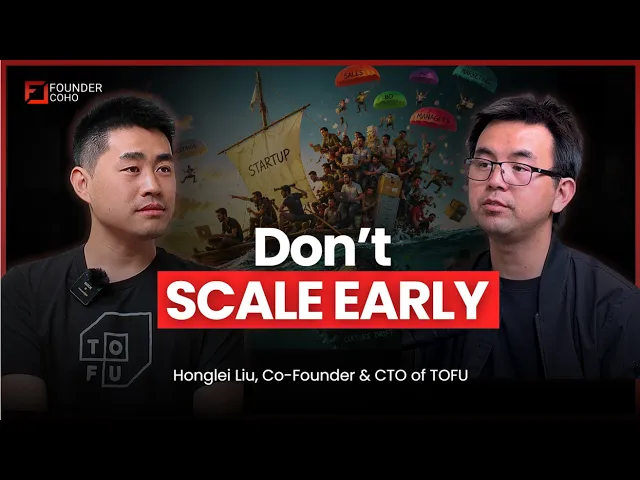
Honglei shares the operational lessons of witnessing the premature scaling and eventual collapse of Fast (a startup that raised over $100M before product-market fit).

|
Co-Founder &CEO of Tofu, Ex-Facebook and Twitter
Honglei Liu is the Co-Founder and CTO of Tofu, an AI-powered B2B omnichannel marketing platform backed by SignalFire. He is a seasoned AI researcher and engineer, having worked on Natural Language Understanding (NLU) and AI assistants at Meta (Facebook) and Twitter. In this deep-dive conversation, Honglei shares the operational lessons of witnessing the premature scaling and eventual collapse of Fast (a startup that raised over $100M before product-market fit). He outlines Tofu's meticulous customer discovery playbook—including speaking to over 50 CMOs and heads of marketing before writing code—and explains why they chose Sales-Led Growth (SLG) over Product-Led Growth (PLG) to build a unified, omnichannel marketing platform. Honglei also shares his advice for technical founders on building co-founder trust, running mutual hiring trials, and focusing entirely on customer pain points over VC funding hype.
REFERENCES & RESOURCES:
Honglei’s Website - https://honglei.ai/
Honglei Liu on LinkedIn –https://www.linkedin.com/in/honglei/
Jing Conan Wang (Host) – https://www.linkedin.com/in/jingconan/
FounderCoHo – https://www.linkedin.com/company/foundercoho
TIMESTAMPS:
00:00 - Highlights and Intro
02:14 - Early Entrepreneurial Beginnings
05:46 - Meeting Co-founder EJ at Facebook
07:33 - Fast Startup Experience and Collapse
11:16 - Twitter Journey During Chaos
15:27 - Meeting Third Co-founder Elaine
18:27 - Choosing B2B Marketing as Focus
20:31 - Customer Discovery Process (50+ CMO Conversations)
23:23 - First "Aha Moment" with Design Partner
26:07 - First Paying Customer ($1,200)
27:05 - Defining Ideal Customer Profile (ICP)
30:46 - Competitive Landscape and Omni-Channel Strategy
37:29 - Building the Founding Team
42:23 - Company Culture: Builder Mentality
46:31 - Advice for Technical Founders
48:09 - Staying Updated on AI and Closing Remarks
Full Transcript
Money is actually not a deciding factor whether you can be successful or not, but product and customers are.
we actually raised a big amount of money, but the company still had to shutdown.
Honglei Liu has a PhD in machine learning. At Facebook, he built AI assistants that reached billions of people — and co-created the open-source tools behind them. At Twitter, he led the knowledge graph powering over 10% of the company's revenue. Then he watched a well-funded startup collapse around him. Today, he's the co-founder and CTO of Tofu a generative-AI platform built to put B2B marketing on autopilot — replacing dozens of fragmented tools with one system.
But Before he built a company, he learned what actually holds one together.
Being able to trust someone is the number one thing that you should look for when you are trying to look for a co-founder.
you should never underestimate the speed of iteration of technology.
But the hardest lessons didn't come from what worked. They came from what fell apart.
When the pandemic was over. the VC market actually stopped pouring money into startups, then that was a time for the whole company to realize, like we cannot actually sell our product.
I think right now I'm making only a quarter of what I was making before... So we actually sacrificed a lot to work on this company.
So why walk away from everything to start again?
We want to build a generational company. We want to build something great. we want to completely revolutionize how people are working with marketing today, especially B2B marketing.
I'm Jing. As a founder myself, I learned something about this journey. The best way to build a startup is not to read a manual, but to learn from your fellow founder stories. That is the reason why we compile those unfiltered raw founder stories and share with you in this channel. Before we dive in, I have a small favor to ask from you. If you find value in conversations in this channel, please hit subscribe button and turn on
notifications. It helps us keep the mission going. And this will be the only favor I will ever ask of you.
I would love to wind back the time and walk through the listeners where this everything begins. Can you tell us a little bit about your early days? after college, you came to study in the US and then you went to work for Facebook. Tell us a little bit more about that experience.
I started by working on natural language understanding. know, like, was about, when you are talking to your class. So we have to understand exactly what you are trying to tell us. So we call that natural language understanding. And then I also worked on a dialogue system. It's about, like, how we make our assistant to have a conversation with you. And also I worked a little bit on recommendation systems and also machine learning infrastructure, things like that. So it was a very wide range of machine learning related products, mostly in the assistant space.
A lot of the audience might only heard about chatbot or chatgpt and think this type of technology only exists after 2002. But there was a lot of technologies that people used to build chatbot before, like in LLU, large language understanding and dialogue system that you mentioned. I'm curious about what is your main takeaway from that journey of experience in Facebook?
I would say first of all, from a technical perspective, I was able to see the evolution of technology. when I first joined around 2017, we were building intent models using LSTM. And then we had the transformer, we had the BERT, and then after I left, actually we started seeing a huge revolution on large languages. And now, of course, everyone knows all the systems are powered by the large-language models. I would say the learning from there was you should never underestimate the speed revolution of technologies. So it was only a few years to see that, to have a system that was literally not able to do anything to have a system that can not only understand text, but also like video and audio, and also being able to act on behalf of you. So it was not actually, when I was first at Facebook many, many years ago, I wasn't able to actually predict this could happen, even though I had a PhD in machine learning. So that actually taught me that you should never underestimate the speed of iteration of technology. That’s on the technical side. On the business side, was also very interesting to me because, as I mentioned, when I joined, the team was very small, and then we saw a huge demand of people wanting to use AI in their daily life. And then I was able to see a huge growth of the team or the adoption of the product. So that was also fascinating to me to see something that, to see a product at its early stage and then growing into something that everyone can use daily.
And for that knowledge now you are starting using that in tofu
Hopefully yes.
Yeah, cool. Cool. I think it is also in this during this period of time you met your one of your co-founder from tofu, right?
Yes, EJ
Yeah, tell us more
So we were not working in the same team, but we collaborated a lot. And at that time, I think EJ was... was clearly one of the best people I have ever worked with. when I was collaborating with him, so he was very down for earth. He was able to always thinking problem. I would say like the best part about the EJ was that he always tried to do the right thing. So that's a very rare quality that I see people like I see from people. I think one thing that when I was trying to look for a co-founder was whether I can trust this person or not. So clearly EJ was a person that I can trust. And so after we worked together for I would say like one and half years or two years and then he actually left Facebook to join a startup. So at that time, we kept the chatting and I really wanted to eventually start something with him. So I left Facebook and joined the same startup so that we can work together a little bit longer to build even more trust before we can finally start something together.
Tell us more about examples or cases that, or moment that you feel, wow, EJ is the person I'm going to work with in the future.
Being able to trust someone is the number one thing that you should look for when you are trying to look for a co-founder. I think at that time when I was working with EJ, clearly I was able to see that he's the type of person that I can trust. I think that's the type of people that I was looking for and clearly EJ was that person.
I know that like EJ went to a company called Fast and then you followed him and then what happened to the company?
If you have read the news about Fast, then you will probably know that Fast was a company that raised a lot of money and eventually they had to shut down due to running out of money. That was during the pandemic when all the startups were getting an insane amount of money from VCs.
that's also a very interesting journey that you had, like within a year you experienced a high-flying startup kind of collapsed. How does that influence your philosophy or your view of startup world?
Clearly I learned a lot of things not to do when I'm trying to start my own company. Basically I got a lot of learning from that. The number one learning that I got was never scale your team until you have a true product market fit. And also a bunch of other learnings clearly. Work-wise, that was definitely one of the best working experience I ever had throughout my whole career. So I met a lot of fantastic people when I was working at FAST. But even before we had the product fit, because we raised such amount of money, so the team grew too quickly. We have so many people without product market fit, and then everyone... Started to try all the different things trying to like find the product market fit and because of that We were actually spread to seen on trying different directions without actually making real progress And so we tried that I think the whole thing it was very fun clearly we were able to try many many different things as an engineer I was really happy because I was able to build a many many different things but From a company perspective, I think we lack the focus so because of that we weren't able to make progress on finding true product market fit. When the pandemic was over and the market, the VC market actually stopped pouring money into startups, and then that was a time for the whole company to realize, like we cannot actually sell our product.
the danger of scaling the team prematurely before the product market fit is the lack of focus. Yes. And it actually might be even worse on that because if you have a small team, it's much easier to refocus later.
Totally, you can iterate, like you can pivot very quickly.
Yeah, and when you have a bigger team, everyone has their own ideas, you need alignment sessions, so it actually gives, it reduces the chance of finding product market fit by having a bigger team, which is a little bit contrarian
Totally. That's so true. When you have a really small team, if your current direction doesn't work out, you can easily pivot. But imagine when you have 300 people, 400 people already working on something. sure, the direction you're working on might not be working great. But if you actually want to make a big pivot, that's a lot more convincing that you have to do than when you only have a few people in your team.
Yeah. So after working a year and the fast you joined Twitter
I joined the trader around mid-2022. That was a time when Elon was trying to back off from his offer to trade. And then they had a big lawsuit. At that time, Twitter was not even hiring. So I was able to join Twitter because at that time, they were trying to rebuild their whole knowledge graph. And I found that that's a very interesting opportunity. I didn't stay at Twitter for too long, but one thing that I learned from the process was that during a very chaotic period, I think that's a time when you can truly tell the difference of focusing on a mission than focusing on career growth, would say. So at that time, when it was very chaotic inside Twitter, but I still met a lot of people at Twitter who are still very dedicated on making the product better. I think that taught me that if you really care about the product, it doesn't matter how chaotic the environment around you is. You can still make progress on the product side.
when there's no chaos, then everyone started to optimize performance review, promotion, and all other things. But when the environment is a little bit more unorganized or chaotic, people started following their passion.
Exactly, that's so true. Yes, and also that's where you can tell who are the people who are truly passionate
Well, true, as you can confirm. I'm curious, like, what EJ's doing during this period of time. So he stayed back.
he was at a firm. Yeah, yeah, yeah. At that time, I think he was at the firm doing pretty well. He was able to help a firm to launch a new product at that time. Pretty exciting time for him.
Are you still like, hunting all in the weekends? Start to think about the future ideas?
Yes, as I mentioned, since we both left Facebook, we were always brainstorming about what we should do eventually. So after Fast, both of us thought that might be a good opportunity for us. we were just not anything official. We were just brainstorming over the weekend, thinking about, what can we do after all the chaos ends?
It looks like for you and EJ, you have been talking on Facebook, you joined Fast, then you went to Twitter. That lasts for more than a year or two. What keeps you both motivated?
Both of us just really wanted to do a startup. Before EJ joined Meta, he actually had his own startup. He already did a startup before he joined Meta. Similarly, I had a similar experience. As I was telling you, when I was in college, when I was doing my PhD, I always had this passion of trying to start something eventually. So that has always been on my mind. So it's just like we were trying to find the right timing for doing that.
What was the reason you started compiling around that time?
We started like officially spending a lot of time thinking about the product idea around the end of 2022. That was a time even before ChatGPT was released. We only had like GPT 3.5 model. And at that time, we already see the power of large language models. And we were thinking, oh, clearly this is gonna revolutionize everything. But we need to find the right problem to solve. reason was because at that time, before chatGPT, like when we only had a gpt 3.5 model, the model was not even that powerful. The model was like clearly revolutionary, like but it was not super good at doing reasoning or math or coding related tasks. At that time it was only good at doing content creation or writing. That's when we thought, clearly we can see the evolution of technology over time, but we need to find a problem that the technology at that time was already good enough to be used in production. that's why after a few months of iteration, we eventually landed on marketing. That's how we started TOFU.
I think these are probably many founders also very interested in which directions you want to focus on. It looks like it took you a few months to figure out the direction, which is the B2B marketing. this time you're still like iterating the waking the project with EJ and you have the third fund co-founder join you around this time. What happened? Why, how did you convince the third person join you?
So my third co-founder, she was actually working as a partner in winter capital firm doing investing in startups. And it was a very interesting story for us because at that time when we first met Elaine, we were treating her as someone who was trying to invest in startups. So we were trying to pitch her our ideas. But what happened was it turned out that she had exactly the same idea as what we were trying to do, and she has even better ideas than us. So the three of us quickly came together and eventually started this company together.
I'm curious like among three of you, what is the division of duties?
Elaine works on the go-to-market and the sales side of things. I mostly work on the engineering side of things. And EJ is our CEO. Clearly, he works on everything. But he also has a focus on product, the design, the customer support, et cetera.
I also heard about you have talked about that you want to build a generational company, not like a niche solution. Tell us a little bit more about that.
When we started this company, now from a financial perspective, I think right now I'm making only a quarter of what I was making before. Similarly for everyone in our company. So we actually sacrificed a lot to work on this company. And the reason why we are okay with doing this is because we want to build our generational company. We want to build something great. We don't just want to make incremental changes. So we want to completely revolutionize how people are working with marketing today, especially B2B marketing.
In five years or 10 years, like if you achieve your visions, how the world will look like.
about 25 years ago when Salesforce was started, no one actually knows about CRM. CRM was not even a thing. But now if you look at in the marketing and the sales space, like everyone uses CRM. So we want to do something similar. In about 5 or 10 years if you really think about it, how we are working on marketing today will be completely revolutionized by AI. There will be a new way powered by AI to work with marketing. So that's what we want to become. We want to become the company that is offering a new AI-powered workflow for B2B marketing.
What made you decide to choose the B2B marketing?
This has to go all the way back when we before we started the company, we actually tried many different directions. We actually talked to more than 50 CMOs and had marketing at different companies. We didn't start by working on B2B marketing, just to be honest. So we at that time, we wanted to work on something in the marketing space. that was a time around the end of 2022. So the model's capability was not good enough. It was only good at writing content. And if you really think about it, content, what are the functions in a company that are closest to content? I think sales and marketing team. So at that time, our prediction was that clearly the technology will evolve. But if you think about all the teams in all company, I think sales and marketing teams workflow will be revolutionized first because that's how technology will evolve. And so that's why we decided on working on marketing. a lot of founders, when they ask me for advice, when they have this idea and they want to start a building company around it, I always tell them my own story, which is never do not start something until you have talked to enough potential customers. So that will help you to narrow down what you want to work on and what are actually feasible to be solved. Before you can finally build a business around it.
Yeah, exactly. Yeah, you mentioned that this is a great point because a lot of times after you have this hypothesis, you have some like very wishful thinking about what a future will look like. This can only be like adjusted after you talk with real users and understand what is real life they have. So this is the whole point of the customer discovery process. I'm curious about how you run this process. Did you just like talk to them? Did they take notes? What did they do?
It was very adhoc at the beginning. So at the beginning, like we just scheduled meetings with the head of marketing or CMOs at different companies.
So you cold outreached them? Yeah.
Yeah My co-founder, Elaine, she definitely has a huge network, so she was able to help us find a lot of people that we can talk to. And of course, also cold outreached people on LinkedIn as well, so that also helped us to put some meetings. But at the beginning, it was very open-ended conversations. So at the beginning, we didn't have anything to show to them. We just asked them, what is your day-to-day look like, and what is your workflow? Do you have any painpoints and we were just trying to understand what's going on in marketing? But then after some time we started to make it more and more process driven like we would actually to we would actually come up with some ideas we want to test the test on and then we would actually even like build a figma design file and we can show to the people that we were talking to and get their reaction and then we would come back and the fine-tune that product prototype and then iterate on this until we find something that people really really want to use and pay for.
A lot of those feedback will be really polite, very nice. And in the early days of founding a startup company, will get a lot of, of course you'll get a lot of harsh feedback as well, but also you will get a lot of polite feedback from your friends. And so everything becomes very noisy. How did you figure out the insights from these noisy signals?
It was definitely very noisy but one thing I do want to say is that when you actually have some idea that the people are so excited about you will see people's eyes pop up so it’s actually that's the moment that you know, you are definitely like working on something that people would be interested in paying for or you are actually bringing real value to them. I think what you were saying was that sure if directly asking people for feedback, oh, what do you think about this program? Most people will be very proud and say, oh, I like this idea. It sounds like a pretty cool idea. But when you actually have something that is solving their real painpoint, you will actually see their reaction. You can tell the difference. They are literally saying, oh, can we get it tomorrow? Can we get it next week? Can we actually pay for it? So I think that's a time when you know you are working on something real.
I also want to touch on another thing related that is about design partner. And when I first started, I don't quite understand the difference between design partner and a customer. And especially, like you called our customer discovery call and talk about what's the difference. But like you mentioned that...
The reason why they are partner, not your customer, is that they are shaping the future of your company and the product together. So like exactly what you mentioned. And I would love to learn about your early experience of working with, obviously the one you mentioned, the first design partner, but also with other detail partner. How did it work with them?
Gosh, I feel so appreciative of all the patience that our design partners gave us. know, that's exactly like you mentioned, that's the main difference between a design partner and a real customer. So a design partners are the people who are willing to take the risk of trying the early stage prototype of your product, even though they know it might not work, but they still like want to give you the patient and then try out the product. So I think that's why I'm so appreciative of all the design partners that we had in the early days. I still remember like the first design partner that we had was this company, like they started using our product when we only had an MVP. And at that time, our product was not even working properly, I have to say. like you know like one of the thing that we offer to our customers were having them to build a personalized marketing campaign. So at that time, we had an MVP that can have them generate the content, but because we didn't have all of those integrations, so there was no way actually to run an end-to-end marketing campaign using our product. What we did back then was the three co-founders, me and my two other co-founders, we literally spent two days just doing the manual copy-pasting to make the whole can be work for our design partners. So clearly, it was also very painful for our design partner at that time as well was because like they had to give us a bottle access to their internal tools so that we can make the whole thing work. it was a very painful process, but I think we were only able to build the true product because of that.
Also, the next milestone for a company is often to get the first check from the customer. When did you get it?
That was around July, 2023, I would say. Yeah, like probably like one or two months after we had our first design partner.
so what is your ideal custom profile and how do you find?
We iterated on our ideal customer profile quite a bit over the course of past two years. right now we are mostly focusing on mid-market and enterprise customers. But when we started, that was around 2023 and early 2024, we were just trying to find any customer that we can find.
And after you get some customers and like did you like what was the trigger for you to start to think about ideal customer profile?
Retention and the churning problem. actually so and you know like that was very early 2024 when we started like onboarding a bunch of new customers and We had some churn problems because some customers were not like where a problem was quite hard for them to use and they were not getting enough value of the product and that was a time when we started realizing, like we actually had a very different fields, different segments of customers. And some customers were finding real value of the products and some value, some customers, were just not very happy with the product, no matter how much we try. So, and then we started realizing, maybe it's not the time for us to focus on the customers who cannot get the value of our product. Maybe we should actually like narrow down our ICP and really focus on the customers who are the better fit of our product. And then maybe later we can further expand to more customers. after we changed our strategy, think we were, so we had to adopt not only a different product strategy, but also a different sales and onboarding strategy as well. So that actually took, that definitely took us some time to pivot.
To pivot and implement from product side. Exactly. That's actually the short-term pain many companies need to take. In your case, basically created the service areas that product team need to focus on to build, which delay progress of growth growing. But also for many other cases, they have to let like one third or half of their customers go. That's more painful cases.
We were still at that time, we were still at a super, super early stage. So it's not very hard to pivot.
So you made it very early, so very promptly did that.
Yeah, I think we always had this idea in our mind that we need to narrow down our ICP. Just at the beginning, we were trying to explore a little bit more to figure out who could be our ICP. And then we started narrowing down.
do you think it's a wise decision for you to standard narrow the ICP?
100%. Gosh, like I can't recommend that enough. Always think about who are your ACP. Even if that means that you are losing some businesses. Because it's so important. So for super early stages startup, you have such a limited resource. You cannot make anyone, everyone happy. So you have to be able to find the people who can get a real value from your product. And then really focus on them, make them happy, and make your product better for them. Otherwise, you will spread yourself to the scene. Yeah, I can't say how happy we were to start narrowing down our ICP.
Also another fact and often people need to consider about is competition So when you have you are entering especially in marketing with market B2B marketing. Yeah, they're both very broad market, but also They're very competitive market. They can see many companiesin the spaces And so a lot of times you have to focus just to stay to be competitive. Can you walk us through the competitive landscape of the space you are and what is the position of Tofu?
Yep. Historically, marketing and sales are very competitive space. There are so many different tools, and it's a very fragmented space as well. But if you look at the current market, there are a lot of tools for marketing and sales, are mostly like point solutions. So you have some tool that is only focusing on making your email campaign better. You have tools focusing on building landing pages. You have tools focusing on LinkedIn. You have tools focusing on writing some types of code. There are a lot of these small point solution tools because the marketing space is a very fragmented space. So the strategy that we have been taking is also because of our viewpoint of the market that is like everyone actually wants some consolidation or the point of solutions that's where we come in. We want to be the tool that can consolidate the different marketing channels not only focusing on one part of one marketing channel or one tiny problem in marketing but also actually building a platform that can connect the different marketing channels together and like provide a unified solution for midway marketing workflows. That's how we differentiate ourselves.
The Omni channel.
The Omni channel marketing solution. at our core, we not only generate the content for you for different marketing channels, but also we understand you as a company. So we actually try to build a knowledge graph by ingesting data from your company and also integrate it with your CRM system so we know your potential customers as well. And by integrating all the data sources together, we have a deeper understanding about your product, your services, your value proposition. And also we use AI to do our kind of research to understand about your targeting companies, like product, services, and their painpoints, and your value proposition to them. So by utilizing all of this data, we can generate hyper-personalized marketing content across different channels. And when I say marketing content, I'm not just talking about text or image. I'm actually talking about marketing marketing campaign that you can run end end. We do a lot of dirty work by integrating with all the marketing automation tools such as HubSpot, like Marketo, Salesforce, Outreach, Parallott, SalesLab, all the tools that you currently use. By doing all of this, we can finally create all the omni channel marketing campaigns across different channels because you have this AI layer that is like... acting on behalf of human to create the content and managing marketing campaigns across different channels. Then finally, all the different marketing channels can be connected together in this way.
Wow, that's very, very fascinating. Actually made me want to use your time. So what I you say is that because of the AI, it allows you to understand the thing, the data from all different channels and generate the content in a very reliable, scalable way that empowers you to do tofu. So it's the right time to do it. And at same time, you did all the dirty work for integration, which is also equally important. That makes the whole process much easier.
The reason why we can do this now, again, is because all the things that I mentioned earlier that Tofu can do was done by human before. because you have, when all of this were done by human, you will end up having a different team or person working on different channels. And because of that, you will have different processes working for different channels. And then you will end up having different tools.
I want to dial back a little bit about how you nailed the ICP because you mentioned earlier you talked about middle market enterprises, and that is a very different strategy If you compare the words if you're targeting on SMB or do PLG options, why did you make such a choice?
You mean why do we do SLG rather than PLG
Yeah, SLG and talking on middle market and also enterprise
Many different factors contributed to this decision. One thing is something that I mentioned a little bit earlier. So when we first started, we actually had a lot of customers who are small business or startups, even solopreneurs. And then what we quickly learned from that was, even though if you target small businesses, it's a huge market. And there are a lot of people who can use our tool, but the problem with them is that their workflows are not unified. So it's very hard to build something that can satisfy the needs of all the small businesses. And also, honestly speaking, I think their churn rate is higher compared to bigger companies. Because for bigger companies, they actually do very rigorous evaluation before they finally buy a product. So if they do decide to buy a product, that means you are actually solving their real problem. Well, for smaller businesses, they might want to try a but they quickly give up.
They also have a higher lateral churn.
Yes, exactly. So that's definitely like one reason. So retention is definitely higher if we target the middle market and enterprise companies. And secondly, speaking, I would say it's more related to our part of the strategy. So as I mentioned, we want to work on omni-channel content creation and the marketing, build a unified marketing platform. If you really think about it, actually, the middle market and the enterprise company, they can benefit a lot more from using our tools than those smaller companies because for smaller companies they actually don't have the resource to go omnichannel even if you have the ability to do so. They only care about one or two channels and make it work. Clearly that's a rather strategy for them. But when you grow larger then you start expanding to more channels and then you can really benefit from having an omnichannel solution. That's where we come in to help them.
So I want to dive in another part of the company building, which is how to build a team. Tell us a little bit more how you define, we talk about how you define your co-founders, but how do you define your early founding members?
Some of our early engineers have worked with us before and some of them were introduced by our investors and some of them we just hired them through an interview. Cool.
You mentioned about three things, right? Hiring from network, intro by investors, and then the normal how, how processing. And any advices on the founders who just started, but they don't have that huge personal network for hiring?
I would say just try to utilize all the channels you can find. especially try to, can clearly do outreach to our LinkedIn, right? So even if you don't have a huge network, if you find someone who are working in adjacent areas that you are working on, give it a try, ping them, and you will be surprised how many people are interested in doing a startup. I actually that's something that I want to mention as well. So try to find those people who actually want to do a startup, to join a startup. So it's very hard for a super early stage startup founder to convince someone from big tech company to join a startup if they are not passionate about your mission. Because for them, it's a huge risk that they are taking. And honestly speaking, for people who are really good, they can always find and really good opportunities, regardless of job market. So what that means is that you can only convince someone to join a startup if they already want to join a startup. So yeah, so I would say just try to find those people.
Yeah, exactly. It's such a great point. I think startup in the mindset, like working in the startup, is also a mindset. And usually mindset cannot be changed. So finding those person and creating the service stems for those persons to know that they actually love to join startup is a way to find them. And a lot of times it's like, I realize that I just created some startup events. Let's see if they join. even if they join on like a weekend or like an evening. If they're not waiting even to spend some time just like, hanging around, like they clearly don't have the interest in that at all."
Actually that that resumes resonates with me a lot because the way that we actually do interview with people is It's a happy embedding part of that into the process. So, you know, when your team is really, really small and you don't need to hire a lot of people, you can really take the time to make sure that there's a mutual fit between you and the candidate. It's also good for the candidate as well because for them, joining a super early stage startup is a lot of risk for them. They don't know, like, it's rare for people who have never worked with you. They don't know you, they don't know your company, they don't know whether your service is good or not, right? They are taking a lot of risk. Taking the time, actually to like to get to know them. For example, in our interview process, we even give people the opportunity to work with us for a few days or even a week if they want to do so, so that they can get a really good understanding about how we operate and whether they like it or not.
Yeah, exactly. Also another interesting thing about finding the good early engineers is that let them find you. I heard a lot of advices from my mentor about building in public. And when I was initially applying this to when I do my own startup, I initially don't understand why. But later I got it. Because no matter how much time you spend on finding them, you have a limited time. But they are working in a big company. more free time so you can have them to find you and the only way to do that is you by building public show what type of culture and value and value company is yeah like and even they are really already interesting startup they will be able to follow you and there's a many times that they have been following for a while yeah and by the time they reach out to you they already want to do startup.
Another related question I want to ask is about the team culture and team value. So what is your philosophy on that?
at a high level, We are trying to build a builder culture. So for us, solving a real... customer problem is always the thing that we are optimizing for. So we don't care about anything else. We just want to solve customers' painpoint, build a better product that can bring real value to the customer. That is what we are focusing on. That is the culture we have in the whole company. Just a builder culture, solve a real problem."
I want to move to another side of the topic, which is fundraising, so tell us a little bit more about your fundraising journey.
So when we were raising for our seed round, it was pretty straightforward. So at that time, we already had our product built out. We already had a paying customer. And we just needed to have some capital to hire people and make our product better. So I think it was pretty smooth experience for us to raise our seed round. And for our series A round, was also pretty interesting because we have our existing investor signal fair. They have been tracking our progress for a while. they like our partner and friends there. like what we are doing and our progress. And it was pretty natural to get to the next round.
that's the best part, which you don't need to fundraise in VC Camp .
Yes, it definitely saved us a lot of trouble. know, fundraising can be exhausting. And for us, we would rather spend the time focusing on product and customers.
In fact, you mentioned about a great point because fundraising is something that founders care a lot. And oftentimes a lot of founders think that fundraising is the most important thing for the company. But in reality, building the product is the most important thing. If you have a good product and attraction, VC comes to you.
Totally. But I do want to say that you do need the money though, You do need the money, but once you get them, you get enough money for you to build a product, clearly focusing on the product and the customer is the most important thing.
Yeah, exactly. think what I can infer from what you say is that money is very important, but as long as you have enough money, it doesn't matter that they highly optimize how much valuation you have.
I would even add on that, saying that money is actually not a deciding factor whether you can be successful or not, but product and customers are.
Yeah, it's like you need money to be successful, but it's not actually a determining factor.
The thing about my past experience at Fast, we actually raised a big amount of money, but the company still had to shutdown. Exactly.
Did you use any framework to make fundraising a little bit easier? I know it's always a hard process, but did you do any trick that made it easier?
Clearly, we need to prepare a pitch deck. and for us, what we did was we were trying to condense all the investor calls in one or two weeks so that we schedule most of the meetings within one or two weeks so that we can meet all the VC’s together and we can make a quick decision from there. Actually, that happened quite a bit because we didn't want to drag the decision for too long.
That's a great call. In fact, In fund raising you should run it as a process. Don't make it too long because it's difficult.
Totally, it's very very distracting. I think we literally didn't spend any time improving our product for a whole month because we were like doing those fundraising thing and we were just so happy when it was over because we were finally able to go back to make our product better. So I would say like try definitely try to make the whole process shorter and try to talk to as many we see that possible.
Another question I to ask you is more from your career side So from your career you're starting from a very technical background Yes And your research background and then doing the R&D in big companies like Facebook and enjoying startup and now become a founder So what advice do you have for other technical people? Why are they working in big companies who might be still doing PhD to become a founder? So what would be your biggest advice to them?
You need to actually talk to potential customers, talk to potential users, and validate whether this is a real problem to solve until you get to the solution, which is the most joyful part, actually, the whole process, because after you have the problem to solve, building something or solving the problem is actually easy.
Yeah, exactly. Yeah, I think this is such an awesome advices and in fact the same advice I would have gave to technical people to do founders And I've been through a similar journey as you do Yeah, but I realized that like it's very very important the early stage of company is like trying to be raised as fast as possible. Yeah For technical people technology is not a risk. They know yeah, it's doable or not. that risk, whether you can find a customer, whether it's something right for them, just focus on that thing first, then you can erase as fast as possible.
Totally, totally. Once you solve those problems, as I mentioned, building something is actually the fun part.
For people who are interested in tofu either as potential customers or join you, what is the best way to reach out to
Go on our website, tofuHQ.com, and or just email me, Honglei at tofuHQ.com.
That's cool, cool. That's awesome. Yeah, thank you very much for sharing with the community. It's such a fun conversation.
Thanks for watching the full interview. Don't forget to subscribe to our YouTube Channel and turn on notifications so you never miss the next one.