Interviews
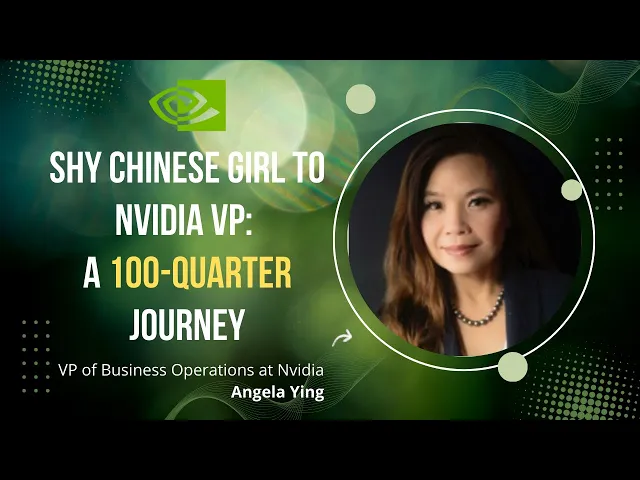
Angela, NVIDIA VP of Business Operations for 25 years, reveals the company’s internal success formula.

|
VP of Business Operations at NVIDIA
Ever wonder how NVIDIA transformed from a gaming company to an AI giant worth trillions? In this exclusive interview, I sit down with Angela, NVIDIA's VP of Business Operations for 25 years, who reveals the company's untold success formula. Angela shares what it's really like inside NVIDIA's culture, where business units compete for survival and Jensen conducts 8-hour meetings with "90% of the talking." Discover why she recommends staying physically fit to keep up with NVIDIA's intense pace and how she transformed from a "shy Chinese girl" to an executive who managed the company through both "flat as pancake" periods and explosive growth.
References
- Angela Ying Linkedin: https://www.linkedin.com/in/angelaying1214/
- Jing(host) Linkedin: https://www.linkedin.com/in/jingconan/
- FounderCoHo community: https://www.foundercoho.com/
Timestamp
00:00 Highlight and Introduction
01:28 Family background and her scientist father's expectations
02:55 Life lessons from a disciplined upbringing
04:18 The surprising connection: Chinese culture and NVIDIA's DNA
05:44 Joining NVIDIA after IPO: "The stock is too high already"
07:19 The $0.10 stock price that could have made millions
08:54 How a persistent friend changed Angela's life
10:34 The secret to staying at one company for 25 years
12:26 NVIDIA's unique approach: "Multiple startups under one roof"
14:18 How business units are held accountable like real startups
16:17 The thrill of "making the quarter" for 100 consecutive quarters
17:17 From "flat as a pancake" to AI-fueled stock explosion
19:33 Defying Wall Street: The 16-year gamble that paid off massively
20:59 Jensen Huang's superhuman work ethic: "8-hour meetings with 90% talking"
22:56 What leadership looks like: "No bullshit allowed"
25:30 Being recognized by Jensen: "I always knew it would be you"
27:16 Why fighting for opportunities matters more than talent
29:14 How to advocate for yourself at work - especially for Asian professionals
31:17 Breaking cultural conditioning: From silence to leadership
33:33 The counterintuitive path to success: "Do more than what's fair"
35:24 Why even seasoned executives need to keep learning
37:12 Her biggest career regret (not being aggressive enough)
39:03 The overlooked success factor: Physical health and stamina
Full Transcript
sometimes feel like I work for multiple startups. A lot of people within the
company still has that startup mentality. You have to survive with limited amount of
funding like startups. You have to be vocal. You have to communicate that to your manager
because nothing is given. Nothing is going to be handed to you. Everybody screamed,
wow, we're getting rewarded for all the hard work we have done.
Not only focusing on the academics or on the talks. Take care of your
health because at the end it's a race and you have to be physically capable.
Meet Angela, VP of Business Operations at Nvidia for 25 years. She joined in
1999 right after Nvidia’s IPO and has managed 100 quarterly
closings. Despite her scientist father's expectations, she forged her own path,
evolving from a self-described "shy Chinese girl" to a powerful executive
Go behind the curtain as Angela reveals Nvidia's $2 trillion secret sauce:
divisions run as "hungry startups" that sink or swim. Experience what it's like with Jensen
Huang — and why "getting yelled" by him is a badge of honor. She shatters workplace myths with
her truth: "Nothing is handed to you." Angela's unfiltered playbook offers priceless insights.
You mentioned about your father is a scientist? Yes. Yeah. Yes. My dad was a scientist in China.
And when he came here 1987. At Berkeley as a visiting scholar. He's a chemist. So
later on he's still doing the research in the chemistry field. So I think before he retired,
he was working at Eli Lilly, the big pharmaceutical company.
So he's a scientist and I think he always wanted me to be a scientist too. But, I was a
disappointment back then. I was a disappointment. But I think he's happy with me now.
You are definitely, he will be very proud of you . A lot of what you have
done right now in immediately driving the scientific Greek suit as well. Yes. I think
he's very proud of me now, but I think he's very typical Chinese parent. He's,
never really say that, oh, I'm so proud of you, but I know he is.
they're not very vocal about those things. I think when I first got promoted to vice
president at Nvidia and his reaction was, how many vice presidents are there
at Nvidia? I was like, quite a few. And then he's then that's not that impressive.
I was like okay. What else can I say? And what are the biggest you learned from from your family? I
think my dad actually set a very good example of he worked very hard. He worked very hard,
even when the environment was not as good back in China back in the days.
I think a lot of people when they started working, they start to slack off a
little bit. But he always worked very hard. After work, he will spend hours every day,
every night. Read extra books and, study on his own when he's already working.
Yeah. So he never really stopped improving himself. I think that's
like a mentality that really inspired me. Yeah. Yeah. As you are describing
I actually can visualize such a great dad and also very self discipline and be a role model
of the yes, absolutely. Of the kids. Yeah. And actually also reminds me the whole Nvidia culture,
for example, like when I see the Jensen feels like the same, like always have high standard,
always move forward. Yes. Do you feel like there's a connection between the
culture you grew up and as a typical like very Chinese parents has high standard for kids,
have the love but doesn't show in front of them, and also like the culture that Nvidia has shown.
Yes. Definitely there is definitely a connection. I think when I joined a company 25 years ago. It
was a very small company. But already IPO. People always ask me that question like,
did you join before or after IPO? I definitely after IPO, but the company was still small. When
I joined I was think about 300 employees and it was a very fast paced working environment.
Very fast paced. That was that just felt so natural to me. Because I think I was
always very efficient. And when I work in such a fast paced company,
it just felt so good. The day goes by so fast. Because when you have some questions,
need something to be resolved, that you send out an email, you get response right away.
And people ask me a question, I respond right away. So things just get done so fast. Simple,
just direct and move on. Yes. Just like no politics, just like purely get things done.
I totally love that. So the first few years just went by so quickly.
The time flew by so fast. Because everything's so fast paced. Yeah. And then there are so many
smart people. That was end of 1990. Sorry. 1999. I joined December, 1999. And I think
Nvidia went public early 1999, so that was the end of the year. That year that just went IPO.
And then the following year 2000 was Nvidia actually got the Xbox deal. The stock
goes up went up so much. What was the price when you joined Nvidia? I, when I joined Nvidia, that
was I remember it was a $36 but back then the $36, right now I think it's 10 cents. 10 cents. Wow.
Yeah. Yeah. Have you keep most of the Nvidia stock back? Of course not. Of course not. Yeah. Back
then it was like stock option that you have to exercise and back then nobody had that much money.
And you don't really like, okay, I'll buy the option and keep it, and then, wait until whatever.
Everybody's okay, the stock went up, let's cash then, and,
buy a new car and live the life. So there was, I've talked with a couple of coworkers that,
start around the same time. Nobody kept the stock. Are you kidding me? We have to
live our life. Yeah. I bet there must be a lot of people talking in Nvidia
stock was too high back then. Yes, of course. When I first joined the company and my friends
was asking me like, Angela why did you pick that company? The stock is already
very high. There's no upside. Why did you join the company? I'm like, okay.
Because before that I was at a very small company.
I was like, okay, I wanna join a slightly bigger company with better benefit. I had no idea. How
did you find, how did you find I had no idea. Nvidia is such a company,
I had no idea. Actually, it was a girlfriend of mine, she referred me to Nvidia. It was a
referral and she actually tried to get me to Nvidia before the IPO.
But I was like, ah, no, I, it's not, the timing is not right. And
I just didn't want to go through the interview process back then. And then,
finally end of 1999, I said, okay I'll apply. So yeah, she actually approached
me multiple times. So you trust your girlfriend? I trust my girlfriend, yeah.
Yeah. Yes. Have you back then imagined that Nvidia one day were not be a gaming company?
No, of course not. Of course not. Had no idea. Nvidia is a very interesting
company that I have been following Jensen, the Nvidia's journey for a
long time as well. And there's a amazing part episode with nvidia.
It's a long, it's a long complete history with a lot of involvement.
And you also spend incredibly 25 years in company. So that's a long track,
like long time to spending one single company, especially at Silicon
Valley. It's not normal. Yeah, it's not very common. I think it's Who does that?
Yeah. I think the average tenure is four years. , what, what made you stay so long?
I think as I said earlier, I was very busy. I was kept busy. And things go
so fast. It's a very fast paced company. You don't realize that how fast things are going.
And then the team I'm in business operations. We are responsible for the company revenue. How to
achieve the company revenue. Manage all the business. So quarter after quarter. It's so
fast. You don't realize that time goes by and it's already another quarter, another year.
But of course. I think I've always felt like I was challenged. Always being challenged and
always learning new things, so never felt boring, so I was not bored. That I need to
find something else to do. I never felt that way, but of course, absolutely being honest,
it's now 25 years I never thought about leaving.
But every time I thought about leaving, it's not because of the company, it's because my you know
direct manager. That's what people say, right? The number one reason people leaving their job is not
really about the job, it's about their. Manager. Yeah. Yes. I went through the same thing, which
is typically and I think but ended up, I stayed at Nvidia is because my manager is actually, he's a
very nice person. He's very smart. And he kept his promises and he gave me different opportunities.
So I was, I'm able to grow myself. Learn new things and start my own team do all that.
So then, it becomes a very exciting journey. Instead of you're stuck at one place. I also
feel very fortunate in my role I get to work with. It didn't really feel like I worked for
a big company sometimes. Sometimes feel like I worked for multiple startups because we always
start like a new business unit and we have to make sure that new business unit is ramping up.
How to ramp up that new business unit, all the problems that we need to solve, ramping up a new
business unit just like a startup. I feel Nvidia. oftentimes new business unit always still have
a very startup mentality. It's not like a big company like what people perceive Nvidia today.
So a lot of people within the company still has that startup mentality,
just get things done, how to get things done the most efficient way. Like you
don't have infinite amount of money to burn, you just have to. Make it,
you have to survive with limited amount of funding. Like startups. Yeah, exactly.
Yeah. So Nvidia does definitely have that startup mentality to go through, the stages
of growth. Yeah. One thing you mentioned is very interesting is the difference between business
unit Nvidia and the business unit in many company, like business unit in Nvidia feels like a startup.
Can you share a little bit more about how does business unit in Nvidia works with each other? I
think for the people who manage the actual business unit, we call them the. Of course,
the general manager of that business unit, Jensen, called them the CEO of that business unit.
They have to own that business unit. They have to make a profit as a business unit instead. Oh,
so they have their own like KPR to make a profits themselves?
Yes. But which is also very rare. Many other companies don't do that
well. You have to do that to measure if a business unit is successful or not.
Which give a lot of freedom as well as responsibility, accountability for the business
unit itself. They have to make it, they have to be profitable. But otherwise, every time during
the business review meeting, that business unit, is getting grilled, you're still losing money.
You're still, what happened, what did not work? So I think each business unit is very motivated
to be successful. Of course, you have to have capable people. But every business unit shares,
finance, shares, operations, share business operations, which is my team does shares those
resources sit on top of the business unit. So we help to align. Business unit to make
sure their process how they are doing things is within the company guideline
and process. So that is actually making things a lot more efficient. They don't
have to be like a real startup, have to create everything from scratch.
They already have a baseline of support team that we know the business. We know
how to make it work. We know how to fit it in, fit in a new process into the current process,
how to, maybe tweak a little bit to work with that business unit. But the baseline
is there. I see. Yeah. That's a very interest way of company, organization.
So what I hear you mention about is each business unit operate like a startup. And
they have own goals of making profit and be. Self-dependent. Yes. Nvidia provides
a common infrastructure. Yes. The common tools business operation team to support
all these different business unit. But they need to be in valued independently.
Yes. On that. So this mode of work is like a investment strategy within company. Yes.
And you also mentioned about you as a head of the business operations department, you're supporting
so many busy units. Yes. As there's more, it must be very challenging job for you. Yes,
of course. I think over the years the company grew so much and we have many different business units.
Of course, the bigger business units requires more support, but the smaller one or the startup
requires a lot of attention as well. And making sure all things roll up, all things
follow the process. It is challenging. It is quite challenging. But it's, challenging means it's fun.
And you get a tremendous amount of job satisfaction out of it. Do you
have any examples of like your part of the job that you feel very challenging,
but also feel very fun? Making the quarter. Making the quarter. So I think,
I've reached my 25 years anniversary last December and looking back, that's 25 years.
That's quarter century. To us it's like a hundred quarter or that's a hundred quarter
exactly. Yeah. A hundred quarters and a hundred quarter ends. There's
a lot of quarters to make. Yes. But that's also like the most. Exciting,
most exciting and most rewarding experience that's making the quarter.
It's just so much fun. So much fun. So much sweat and tears and so much fun. Yeah. So I absolutely
love it, and people says okay, you can retire anytime. I was say yes, financially,
but what's gonna be more exciting than this? Among like more a hundred, like earning calls
that you have helped propel that in the watch together, which one is most memorable for you?
There were many memorable ones. The early days, there was this memorable ones. I think back then,
we only had the GeForce business and we had distributors and we had analysts ask
questions. Very brutal. That's early 2000 very brutal questions that you guys didn't grow.
You guys are flat, as flat as a pancake. I never forget that. Flat as the pancake.
Flat at the pancake. That's a memorable, that show, that's a very memorable one.
That shows from pressure from the Wall Street. Yes. Yes. I think the expectation,
right? I think that was inspire us to do better. Nobody wants to hear that kind of comment.
Nobody wants to hear anybody telling you that you're flat, you're not growing,
we're you're a pancake. Yeah that's a very memorable earnings call. I think another
earnings call that's very memorable was about two years ago, I think. I
think it was probably May of 2023. That's like about a quarter plus after chatGPT came out.
I think our revenue grew so much and our guidance was so high. And I think that
day the stock went up a lot. I think pretty much when the earnings came
out we just released earnings. Even before the call, we saw the number,
the stock just wouldn't stop. I remember that. Yeah. Wouldn't stop.
Yeah. And I think in our area, we, before we even got into the conference room,
tried to listen to the call. Everybody was looking at their phone, looking at
the stock market, everybody screamed. That was such a great feeling of,
wow, we're getting rewarded for all the hard work we have done.
It was a great feeling. Yeah, those are definitely two memorable earning calls. For
one. Flat as a cake one is skyrocketing. Yes. And many people when they think about this
Nvidia stock or earning call they nowadays, they think it's easy. Nvidia stock is high.
But there was a long time Nvidia stock, it's like flat as a pancake for 15 years.
More than 15 years like that. And you mentioned that there was like strong pressure from Wall
Street for the Nvidia. One great thing that Nvidia has done is that it hasn't
really caved into the Wall Street Project to optimize earnings cut workforce. Instead,
double down a key, a couple of key investments like CUDA,
which back in 2006 or 7, nobody really understand what's the value would be.
It was until 2012. The very first application started show up and then that leads to the
second earning call you had eventually when the AI took off. Everyone realized the CUDA,
the Nvidia GPU is so powerful, but that was 16, 17 years. From your perspective
as one as a part of team who, who made it everyday decision making it happen?
How did you set your goal? How do you ensure that is on right track, not caving to Wall
Street? I think we talked about earlier, Jensen is a very visionary leader. I think for anybody
who listen to him talk, who understand what he's trying to do, we all believe in him.
We all believe in the investment that he wants to make.
Although, in the short term, it might hurt the company,
but we all believe in him. it's like when you know Jensen you have the faith in him.
It's just like he's a very smart person. Very smart. So much energy. The amount of
energy he has is incredible and he's the most hardworking person I have ever known.
He works super hard. He works seven days a week, long hours. You cannot find somebody who works
harder than him. That's a long time I know. And I think one of the example that to me was super,
super amazing was one time we were having a meeting, the meeting started at noon. 12 o'clock.
It's supposed to be a five hours meeting. It's a long meeting,
five hours meeting to talk about forecast. Came in at 12 o'clock and he did 90% of
the talking and the meeting didn't finish until 8:00 PM so eight hours,
he did 90% of the talking. Think about that amount of brain energy and physical energy.
It's just incredible. I don't know anybody who could really do that. Just talking about,
I think most of us were just sitting there in the conference room. We were exhausted. Exactly.
Yeah. You know who it's like almost non-human. Yeah. How can you stay so intense for that long?
And that's not even the beginning of the day. That's from noon
to eight o'clock. Yeah. It's just amazing. And he's super focused and super sharp, and he doesn't
slow down. So if you wanna keep up with him, you just have to work hard too And be healthy.
Stay healthy. Otherwise, you wouldn't be able to keep up just like sitting there. You wouldn't be
able to keep up. Yeah. Yeah. His energy level is very high. From what I see, like all his
interview, he's like doing this talk in the GTC and the way he can influence people around him.
Like even there's like tens of thousand people around that. It's amazing. Yeah. And the the way
you put it is that also is like determination, like a push, push, yes. And has his own vision,
so that influenced the whole Nvidia. Another thing I wonder, as you are working
together with Jensen, what other things that make you feel very impressive from Jensen?
Other than energy level, he's very focused. He knows what's important, I think at his level,
the priority. It's very important. Of course, when he's in a meeting,
he's super focused. He wants to achieve what he wants to achieve. He wants to help you if
you're in a meeting with him. So interaction with him is just that you have to stay super focused.
When he asks you a question, you have to answer the question. You cannot give excuses.
He hates. When you waste his time when you give excuses or when you try to
derail the question. Yeah. He hates that. So you, when you want to work with him,
you have to answer the question, stay focused, and there's no bullshit allowed at all in his meetings.
He's not easy to work with if you're not used to his style. But out of the meeting room,
out of the conference room, he's a very nice guy. Very nice, very understanding, really taking care
of the employees, really think about employees benefits and everything. He's definitely a great.
Great leader. Yeah, exactly. I also, the other day I watched also Nvidia way, there was a one that
also wrote a sentence that is very interesting is that if Jensen hadn't yelled at you, you are not
in the inner circle working with Jensen yet. It is almost feels like an honor if Jensen yell on you.
Is that true? It's true. Yes. Yes, the Nvidia way. That book,
I actually finished the book too. My son was asking me, it's like, why do you wanna read
that book? You've been there forever. What's interesting about the book? And I was like,
the book, talking about Nvidia starting from 1993, there's six plus years I've missed.
But the other reason I want to read the book was because I wanna see how realistic book is,
from when I joined, to today. How do you think? I think it's very realistic. Very, it's a very good
book to read. There's a lot of stories. It's real stories. I just felt like I'm reliving the past.
Very exciting. Yeah. I totally enjoy the book. Totally enjoy the book. It's worth reading. If
anybody wants to know about Nvidia, that book is a good book. Among your journey,
Nvidia, what are the the most cherishable moments that you have in the time? I think, of course,
getting recognized, getting promoted, it's always a good thing. Yeah. I think I got promoted to
the vice president a few years ago. And it was not like easy promotion. I think because my
old manager retired and then they of course need somebody to step in be the new leader of the team.
And at that time there were including me four candidates applying for the job. So I
went through the whole interview process talking with all the executives, and at
the end I got the job. I actually did not feel great about, I had to go through that process.
To get a job because I felt like I've done everything. I had the most experience. I
should be the most qualified candidate. It should be given to me, but it was not just
given to me. I had to fight for it. Then I met Jensen at a event. He came to me,
Jensen came to me and asked me, its Angela, I always knew it's gonna be you.
What do you feel at the moment? And I was like, I look at him and then he look at me like,
I know your question. If I knew it's gonna be you, why did we put you through that interview process?
And I was like, yeah. He said, isn't that gonna be, isn't that a lot more rewarding this way?
So I think that made me feel great. Of course, I think getting recognized by
him that he always knew it's gonna be me. And he knew I was going to
win that fight. That, that, that felt good. And also he told me, he said,
I believe in you. I know you know what you're doing and I know you're gonna do your best.
I know whatever the results gonna be. I know you're gonna put in your best and you tried
your best. So that's very, that's a moment I am not gonna forget. So I am of course,
always putting my best and to make a quarter. Because I do have the
most experience. I don't think anyone else has closed that many quarter ends.
Yes. You mentioned that yeah your experience is very touching. Is that actually also very
relevant for me and many people I talk to there are many situations in our career in which
that we have done everything we could. We are the most hard working person in
the teams. We have contributed most of the revenue of the team.
We think there's opportunity will be handed to us. No, and it's not, and it's never like that. It's
never like that. It's not gonna be handed to you. Yeah. You know when I talk with younger
generation of people that trying to do better, trying to get somewhere, I always tell them,
if you don't tell your manager you wanna more, how does your manager know you wanted more?
Yes. Yeah. So you have to be vocal. You have to communicate that to your manager because nothing
is given, nothing is gonna be handed to you. Of course, as a manager myself I sometimes I hand,
rewards to my team members, but there's not that many good managers like me.
When you are in a team that's the manager is not nice, which is probably majority of the case,
you have to be aggressive and ask for it. You have to approach your manager and say, what does
it take? For me to get to the next step, what can I do so I can get to the next step? Yeah, I
think it is a very fair and valid question to ask if you've been in the group for a while.
If you have been contributing, just talk to your manager and say, what can I do, what else do I
need to do to get to the next step? I think most managers will be happy. Will be happy to tell you
what needs to be done. What are the areas that you could do to get to the next step? I think
like a Chinese culture, I think, I don't know about now. I think China has also changed a lot,
but when I was growing up, I think I was taught to be, humble. Humble, yeah. It's such a big
thing to be humble. It's rewarded to be humble in China. Yeah, I don't know about that today.
It changes now, but it used to be. Yeah, it used to be. But I think here in United States,
in the high tech industry sometimes you cannot be too humble. You have to
be expressing yourself. You have to get it. Yes. You have to get it yourself. I
think when I first. Started at Nvidia for a couple, first couple of years.
I was doing my job. I was doing a great job. Every time when my manager talked to me about my review.
He always told me, Angela, you're doing great, but you're too quiet. And I think the message
I got was, if you stay quiet. Other people will step up and be your manager. And do I want that?
I don't wanna be managed by somebody who's not as smart as me, who's not as capable as me,
just because they could talk. I was very typical Chinese girl. Didn't want to talk as much,
was taught to be quiet. You have been such a great role model for all of us.
Thank you. I really want to learn from you on that,
and I wonder what made you have this transformation. Like how you turn
yourself from a shy and silent Chinese girl into a leaders and it's also very
important for your team members because you, you don't get, for your team, your department.
They won't, again, you wouldn't have the resource be hand to them to take care of them. I think it's
over the years it doesn't, people don't change overnight. It takes practice. It
takes practice for me to speak up. I think for me the beginning was, it was not easy.
But then I force myself to speak up more, be able to talk in front of people, in front of meeting,
group of people. I don't feel shy. I don't feel intimidated because I always prepare.
I know my stuff and I know what I'm talking about. So being prepared is important and.
To make myself feel confident about what I'm doing, what I'm talking
about. So it's a gradual process. It's not, definitely not changed overnight that okay,
I want to talk and I start talking like a professional. It doesn't happen that way.
So I feel like younger people should start practicing more.
Every opportunity you get. Don't be shy, stand up and express yourself Stand up to be Asian women
leaders, a VP of business operation in Nvidia. From your perspective
what are the other things people can do to improve themselves to,
to be more lucky? I feel I've already, talked a lot good things about myself.
I can continue to talk about good things about myself what's what I have done.
And I feel like I have always worked very hard. I worked very hard in the 25 years.
So there was nothing about luck. There's nothing about, people, the keyword these days, DEI.
There's nothing about that. I worked very hard since the beginning. Long hours. I think the
early days, especially the company did not have that much resource and you are capable,
you're just gonna do more. And do I feel it's fair? I
do a lot more than my peers and I probably get paid about the same.
Is that fair? It's not fair at that moment, but I feel like when you do more, you learn more. When
you take on extra work, extra responsibilities, you get to learn more. When you learn more,
those things, those knowledges experience is in your toolbox that nobody can take
away. So I feel don't get caught up with, oh, I'm doing a lot more than my peers.
How come I'm not getting recognized? Continue to work hard, continue to do more, and,
you'll learn more, have more experience, have more skills,
have more tools than your peers, than you're gonna be standing out. I think even 2019,
at that time I was already a senior director. I signed up for the Harvard Business School.
Business Executive program. And a lot of my friends is that gonna benefit your career.
Is that gonna help you? I was like, I don't know. Probably not. How do you feel like the
program? It's good. It's good. Especially, do you need to join the Weekend or fly to Harvard?
I flew to Harvard a couple times. I think that program the reason I wanted to do that
was because at that time I was already like almost 20 years. 19 years at Nvidia. I felt
like I was in the Nvidia box. You're very shielded box. One company that long and
I felt like that's gonna be my weakness one day that I don't know anything about outside.
So I wanna see what other people do business supply chain, what is the best practice
out there? And it was definitely time and money well spent, open up my horizon and,
really help me to make better decisions. Some of the tools or, our softwares that we're currently
using to help improve efficiencies and stuff. So I think it's definitely, when you want to learn
something new, when you want to get out there, just do it. It's never too late to go back to
school to learn something new. It's never too late. Never too late. It's never too late.
Regard to that, you mentioned about like you have a tremendous career that done a
lot of amazing things, but one question I have is, throughout all your career,
what are the biggest regret you have? Biggest regret? Yeah. Good question.
Biggest regret probably. I think still going back to, not able to speak up early enough.
I think that was probably the biggest regret. I feel I'm still not aggressive
enough in situations. That's, many people probably didn't think so,
but I know there have been opportunities that I missed because I was not aggressive
enough. Because. Background. We're approaching the end of the podcast.
Do you have any recommendation for our audience for books, podcasts, or any information source
you normally follow? I think we talked about the book Nvidia way. It's definitely a great
book to read if you are interested in a company about Nvidia. And I think Jensen is such a great
leader. Great speaker. Follow him. I'm sure a lot of people do already. Yeah, he has a lot of
talks. I know. And that, the public. I think he was just as CES in Las Vegas. He had a keynote
and every year I think he had keynote and CES as well as, it's coming up this month in
a couple weeks is GTC, I think follow his keynote and follow the Computex keynote.
Those are the three very important keynotes that he spent a lot of time preparing for it,
and I think it's very exciting, very rewarding just to listen to him talk about the future of AI.
I think the other advice I want to give all the younger audience is
that not only focusing on the academics or on the talks or all that information,
take care of your health because at the end it's a race. You have to be physically capable, not just
the brain power. You have to have the physical energy so you're in the same room with Jensen.
You can stay at the end To be successful, you need to be physically fit to be successful,
otherwise you cannot make it. So take care of your health. That's another advice that
people usually don't usually give, but you have to be healthy. Take care of your body. Yes.
Awesome. Thanks for the great advice and really appreciate you sharing such a touching story.