Interviews
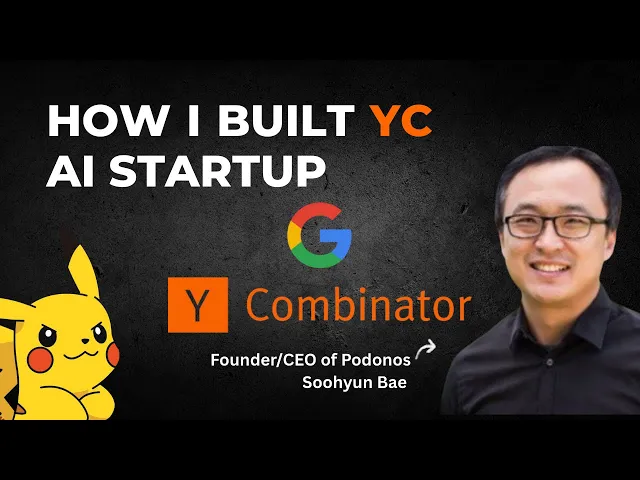
Podonos Founder & CEO Soohyun Bae, YC alum and ML PhD from Georgia Tech, on building AI startups.

|
Founder/CEO Podonos | YC alum | Ex-Google
Discover the inspiring journey of Soohyun Bae – from coding assembly language as a middle schooler to founding cutting-edge AI companies and raising venture capital! Soohyun's unique perspective combines his experience as a former Google Maps engineer and Niantic engineer lead with his current role as founder of Podonos, a rapidly-growing AI evaluation platform. His Y Combinator experience and cross-cultural insights provide a masterclass for anyone interested in the startup ecosystem.
Reference
💼 Looking to solve GenAI evaluation challenges or join a fast-growing AI startup? Connect with Soohyun on LinkedIn (link below) to discuss your specific needs or explore career opportunities at Podonos!
Soohyun LinkedIn: / soohyun
Timestamp
00:00 - Highlight and Introduction
01:23 - Early programming experiences in Korea
02:23 - How family environment shaped career path
03:05 - Learning assembly language as a middle schooler
04:00 - First software sale at a young age
05:00 - Teaching programming vs. AI to children
06:08 - 3D reconstruction technology expertise
06:43 - The decision to leave Google for entrepreneurship
07:53 - Co-founder dynamics and vision development
08:41 - Successful acquisition by Niantic
09:28 - Real-world business lessons through startups
10:08 - Pokemon Go and scalable data collection
11:56 - Unique culture blend at Niantic
13:03 - Y Combinator: insider application insights
14:03 - YC's laser focus on customer problems
15:01 - What YC really looks for in founders
16:39 - The hidden value of YC's program structure
17:45 - Leveraging YC cohorts for growth
18:41 - How YC founders support each other
20:01 - YC Demo Day strategies and fundraising realities
21:43 - Are YC's terms worth it? SooHyun's take
22:53 - When NOT to apply to YC
23:57 - Strategic decision-making for startup phases
26:10 - Podonos: solving GenAI's evaluation challenge
27:33 - 100+ customer conversations that shaped the product
28:43 - Identifying the billion-dollar pain point
31:05 - Trust-building with enterprise customers
32:51 - Converting feedback into product solutions
34:35 - Uncovering the deeper customer problems
36:45 - Product focus vs. market expansion
38:41 - Building a global team across US and Korea
40:37 - Creating 24/7 customer responsiveness
41:40 - Managing distributed teams effectively
42:55 - Single-KPI focus for distributed teams
44:45 - Essential advice for first-time founders
47:35 - Risk assessment differences: Silicon Valley vs. Asia
Full Transcript
That's a great way of representation of the reset of the career. it's not a way of developing your career. If you think of a better career, you should go to different company. Joining a company is really good, but the founding a company is basically reset of your career.
YC teaches, how to think from the customer's perspective.
I have a cool idea. I have cool technology. I wanna build a business. The first answer is, Hey, what are customers?
one of the biggest, blocker for, founder is basically like ourselves. Like we have an ego and we have, some thoughts that I'm trained, I'm educated.
The important part is that you have to keep learning continuously over time.
Imagine writing code before you understood basic math. That's where Soohyun Bae's journey began. After doing groundbreaking work at Google Maps and Pokémon Go, Soohyun spotted an invisible bottleneck crippling AI development.
He discovered countless hours are wasted to evaluate AI manually. He joined Y Combinator to found startups to solve this problem. His latest startup, Podonos, now can evaluate AI in hours, not weeks.
In this episode, Soohyun shares his insider YC playbook—from application strategies to demo day secrets—giving you the blueprint that YC taught him. His battle-tested wisdom might just transform how you build in the AI era. Let us get started
Yeah, I was born and raised in Korea. I went to college and then worked for a company in Korea, when I was young, I was naturally raised as a software engineer. My dad was a software engineer and my brother was also a software engineer. I still remember as a third grader, we shared a computer source code in a magazine.
And once I come back home, my job was to type the source code. Sometimes it is in the machine language or the assembly. Type two to three hours. And once my father came back home and we got together, check if the code works or not, and sometimes we need to debug with ourselves. It was really fun to understand how the computer works, how the graphics works, and, we discussed why it works
or it doesn't work every night.
Yeah. That's a very fascinating experience because I think you grew up in that, ages, very few children have access to computers stand alone doing programming as the homework.
Yeah.
How do you think that impact your future career choice and influence your life?
Typically, the children's think, they want to be a president or a politician, or the general in an army or their doctor teacher. But I, because of the unique environment in my family, I was naturally thinking, okay, I'm gonna be an engineer. I'm gonna be, a scientist. So I was thinking that, oh, it's going to be an engineering, it's going to be something like writing computer code. And making the computer understand the world, interact with the world is going to be cool. So I was basically dragged by something cool. And even in the middle school days, I started writing code in, assembly.
Wow. Assembly in hard language. It's a hard language. My dad brought a book of system computer programming and it's quite challenging book. And I was reading that book and started writing coding assembly the computer friends, we started writing code and showing something cool.
It is not really useful, but something cool. And we show some images of slangs and something cool effect assembly Monday morning we got together and we showed that, Hey, mine is cool. Yours is cool. That was fun. And at some moment I started writing some code.
I shared that in a community and, it started writing, making some noise. One of the college students contact me that, Hey, can you turn off the noise? And I said, yeah. And I added an option. Later he contacted me, can you sell the source code? And I said, yeah, how much you gonna pay me? He said, $25 deal.
And we got together and I, sent a code in a printed format and he gave me $25. That was my first sales of computer
software. While you are a businessman in such an early age, that was a lot. One thing you mentioned about it is so interesting that you basically grow up in an environment with. Such a good vibe of both academic research and computer science and also business you basically are the first generation known computer science.
Now there's all enter into AI. So a lot of kids now, they are just growing with AI as their first thing..
I'm curious, are you teaching the AI to your kids nowadays?
I
taught Python. And much easier than
I really want my kids to understand the basic concept of the computer program, like functions, variables, and whatever they do, these concept will be very useful.
And AI is, in some sense, is very hard topic in some sense. It is fun in each topic, right? If you think of Prompt engineering as an AI is something cool, but if you think of, the AI as a Transformer's perspective, it is very challenging. I really want them to utilize whatever the AI is for
One thing you mentioned about that is very fascinating is about the parallel between AI and programming because they're all so very hard, for children. And oftentimes we will think of this thing are so hard, so we shouldn't teach children.
But in fact since we feel like hard, it might feel easy for them and especially when they grow up with that high environment, with those technology inside, they take it for granted. From your experience, it actually gave you a very good starting point of, computer science, career.
Also, like you mentioned about in high school, you started do a little business, in your high school and then after college, did you continue with the majors or with passion?
I got more interested in the reconstruction of the 3Ds, and around the time, I got connected with leaders in the imaging groups in the Google Maps.
So then I got an offer from Google and I joined Google Maps team.
Yeah. I saw that you spend like. Almost five years in Google. And then decided to do a startup. Yeah. And I know that's a very big decision, for many people to make, to leave Google and do a startup.
What prompted you to make such a decision? What happened?
The typically Googlers, spend years in one team and then they look for another fun project and switch a different team and work on the same different project. But no, in my Google days, I spent five years at the same team and I worked on aerial 3D reconstruction, satellite basing, construction and drone reconstruction.
I was thinking, okay, I'm done with flying cameras, so I'm gonna come down to the ground level cameras on smartphones. I think the smartphone has a very strong capability for the 3D reconstruction, but at the time, the smartphone was not really actively used for the indoor reconstruction.
So internally I was, talking with several people to support the project, but, none of them was really interested so I decided, okay, I wanna do this. I cannot do this inside Google. I start a company. So I left Google, started a company.
When you leave the Google, did you find a co-founder then?
Yeah. I had a co-founder, he was a different amazing person. He was a CEO, I was a CTO. And then we have a clear vision of the map construction and sharing on mobile phones, and they can be used for the gaming experiences and also robots. And then we built a platform, the communications was, quite fast and straightforward.
At some moment we got connected with. My friends and my friends company was acquired by Niantic, and then we also got connected with Niantic. And that was the very smooth process of selling the company.
I see. And then you joined the Niantic, as part of this acquisition?
Yeah, so we sold the company to, and I joined and Ian has a heritage of Google Maps.
Yeah, totally.
Yeah. When I arrived at the office, one third of the people in the office was not new. I saw you in GW too, I saw you one backs building. And then they recognized me. I recognized them, and I was feeling like it is not selling the company.
It's more like coming back home.
Yeah, actually that's very interesting because Niantic, I also know a lot of the people, they are like very Google culture. And in fact, a lot of the Googlers, when they do the startup, they will be acquired either back by Google or like Niantic.
How do you feel like the experiences have a journey of startup and come back to same environment? What is your, takeaway from this core journey?
Yeah, I think, during the process I learned a lot. It is a real business. And then we were clear about the businesses, but we had to be much more clear about the businesses, especially defining ICP size of the market.
How to set up a strategy, which tech we're gonna build. We initially had to have clear picture of that one. Unfortunately, nothing happens as planned. Since you are running a startup, you know that even though this is a goal, you have a plan, but in the reality it goes a totally different direction.
But you should have a goal, but have a clear plan. That was a really great journey and a huge amount of learning.
that's, such a great way to learn and bootstrap learning. About doing the business as well. And you spend a couple of years in Niantic. Tell us a little bit more of your experience there.
Yeah, that was the another Paradise for the Engineers.
Pokemon Go has huge number of users all over the world and the, even before, I started a company when I was at Google Maps we saw the success of, the project. We were thinking that oh yeah, they, work with the people all over the world and let people walk all over the places.
How about working with them to scan the wall so that we can have live read of the real world. It's going to be closed, they will work on that. And then later I realized that I am working on that. It is amazing that once we launch a feature and people started using that, collecting huge amount of feedback.
And that's really scalable and cheap way of collecting data all the world. And that was a dream for augmented reality and 3D reconstruction.
Yeah. Yeah. Niantic is, a very fascinating company. Most people know that because of the Pokemon, Pokemon Go, but also Niantic is internal startup at Google.
So they come of Google Maps team, they have a incredible book called The Never Lost Again, which I also read when I was Google Getting Inspired. It was Google Maps team. They were acquired by Google and spent a couple of years and they built Google Maps inside Google incredibly successful.
And then they started to start up internally. And spin out, become a separate company. I'm curious if, from your experiences, in Niantic, how do you like Niantic culture? What is the part that is the same as Google? And also what is the part that is different?
The Niantic is a very unique culture. The gaming industry has its own culture. Inside Niantic, we have a gaming team and also the technology teams. We, have two types of cultures, moving well together. Basically the infrastructure build the technology and, interact with the people in an academic society, and also bringing those infrastructures to the game experiences.
The war with the human collaboration. In some sense we were thinking that, it is a, real world, social network because we encourage people to see each other, interact with each other.
The very fun culture, very exciting culture. And I was really impressed with how these two type of cultures are mixed together and they build a unique culture inside Niantic.
Yeah. The Niantic culture is, very, bold. And then later you decided to start your founder journey again. You mentioned about you went to YC.
Yeah. Because YC is like an accelerator. Like incubator in the sense of turning ideas into a business. A lot of the people working in the bigger company, we have very cool ideas about doing ask for projects. But it's very far away from being a real business. That's the purpose of accelerator or incubators.
The YC is actually designed for that turn ideas into startup. Can you tell us a little bit about your YC experiences?
Yes. YC was really amazing place for the founders. The founders have a different background. Some of them are college dropouts, some of them are engineers.
Some of them from Amazon, Google, Facebook. And some of them, already accomplished researchers. I saw some of them, fellows, they have tons of publications and they're working on something very futurist of some of the project. But whatever they do. What YC teaches, how to think from the customer's perspective.
I have a cool idea. I have a cool technology. I wanna build a business. The first answer is, Hey, what are customers? Who is going to pay money and why it is a burning problem, burning pain, and how much are they going to pay? And how to approach those customers. These are the current questions.
They continuously ask. If it's not clear and push them, you should think about the problem and have a clear answer. And if it is clear, your answer is going to be short.
Curious how the YC program look like, how does the process how long did it take for you to apply?
What exactly happened when you enter YC?
So we submit application process is not that hard. Just fill out some of the questionnaires and the record video of ourself, one minute video and then product video, submit that one. And then once you are selected, you will have an interview with the partners.
Partner and other members having a question. And very short, straightforward. The typical first question is, what are you guys working on? And has to be, it has to be short answer. We're working on X, Y, Z instead of long descriptions.
How big is going to the market, what the customer. Why they use that, why it is not, a problem. They can solve it for the competitors. And how do you approach that? What is the unique, idea that others don't have, but you have, and all those questions are very relevant. If you really want, you can look for YC interview questions, you can easily get 200 questions.
But the YC partners genuinely wants to understand who you are, what are the businesses, because there are so many cases that the YC company change the direction. And even during the batch period, many companies change the direction, but they want to focus on your ability and the team.
Gotcha. And during the YC program, do
you get a regular meeting with the YC partner?
Yes. Regular meetings. And also the YC invites the former YC founders from DoorDash, from, other well-known companies and shared experiences. It is very inspired. Building a startup is not a fun way.
They followed that, why they fail, how they fix it, and market changes how they respond to those market changes.
And the partners will work with you on figuring out the solutions on that.
The invited speaker sessions and the partner discussions and also the one important part is the working with other founders, they share the experiences and ideas with other founders, and our founders are encouraging each other. And also, they try to find customers.
Do you think this is a customer of your service? Oh, yeah. I'm gonna make an introduction and try to increase each other's customers. Gotcha. So the founder connection is basically prominent even after the batch? We encourage each other, we communicate, sometimes have a chat, sometimes have a deal to it.
I see.
Because right now the YC batch is pretty big. When it started with small batch, but now it's every year, like batch has a few hundred companies. Is there any smaller cohorts within the YC?
Yeah, so they build a small cohort depending on the partners and also the types of businesses.
The small groups, those companies are working on similar types of B2B, B2C companies are grouped together B2B companies, some of them are working on finances, insurance legal tax, and they get together, share ideas and sometimes become their customers.
Becoming a customer is really important. Not just for the revenue perspective, but also learning how they build a product and giving an idea how they move really quickly and giving feedback that's basically learning process from each other.
got it, so you just mentioned about the YC partners and they will offer you advices and helping to solve the problem. Also, there's cohort of founders who could potentially
become your customers and help each other. Yeah. Actually, that's why think very interest because a lot of people, they have this concept like YC gun or YC group. Like they help each other. Yes. And you mentioned about the becoming customers from each other.
Any other support you would, you would get from the YC fellow founders? Yeah.
Yeah. One of them, another benefit is the mutual introduction to the investors and potential customers. And former founders for recruiting. Sometimes, hey, I know I have a connection with this, investor. I think, they are the right fit for your company and they make an intro. And another part is I know one company who they did a good job, but the one founder started leave and they're looking for another YC company that they want to join.
Especially like there, someone who has a founding experience is a really great team member in all these stage campaigns. So they make an intro and they join the campaign and they work together. There are lots of, the mutual interest and then support each other. And also, not only that one, there are also the paper reading groups.
Oh, paper reading. Yeah. Paper reading groups and ski teams. So sometimes they go to ski together. There are many active channels among the follow
society. Gotcha. So that's really helpful. many people are very curious about YC. They also have the demo day. Yeah. Is demo day helpful?
Demo day is definitely helpful, but many things happening before demo day. Even before demo day, they started talking with VCs.
So they will have a kickoff of fundraising process.
The, it depends, like sometimes VCs got to know them and then make a connection with the founders. Or, some companies just be quiet and focusing on the product and customers try to go as farther as possible during the batch and even before the demo day.
It depends on before and even after the demo day, they go through the long process of fundraising. So like the investors wants to know about more details of the company, and some of them are in, some of them say no, and some of them, some of the investors make an introduction to other vc.
One thing you mentioned about, some companies they would do fundraising after the demo day.
I'm curious that the, do you have to finish the fundraising during the final day? If you do it afterwards, does the process getting harder? Do you get any penalty 'cause you didn't finish
I think it depends. I think there is no penalty if they finishing up fundraising after the demo day. Some company we start early and some companys start late. I think there is no big difference between that. Basically, some company have a different, funding structure.
Different caps or a different amount of money. So it depends on each company's goal.
Yeah. So the different company have different goals about fundraising? Yes. So YC is providing a platform. So if you need to do the fundraising, they can help to make the intro before the demo.
In the demo days. Maybe that's a lot of investors and also afterwards.
And also let's say that, we know which company is funded by which vc, so we can approach those founders, Hey, your company is funded by this vc, can you make an intro? And typically it's always sure can you share a blurb and I'm gonna share
Gotcha. Do you think that YC platform is helpful for the fund raising process?
The fundraising is, a way of committing with each other. Basically like a basic is committing onto the company. And then before making a commitment, they should have a confidence.
Let's say that I got to know someone really amazing, but I don't know them really well. The building of confidence takes some time, but in some cases this new person is my friend's friend. I have a trust on my friend, and then my friend said, oh, this is cool. I know that really well.
Then it helps us to shrink
time for building a trust of each other. And a lot of people are very interested in YC is a very good platform. But also the YC terms are not super great. So how do you think about the YC terms and do you feel like the equity they take is worthwhile?
Yeah, the YC terms are already widely known. They put 150 K for 7%, if I remember correctly. And if you think of their value, what they actually provide is huge. At the first step, you are in the community and you get advices from experienced partners.
Second, you are in the community of the founders and you share the information. Even inside YC, even after the batch, many companies share their experience of fundraising lots of postings are there. That is a huge opportunity to be in the community.
So you should not think of it as, a similar YC SAFE investment. It's a different type of structure.
Yeah. So YC providing a lot of other values outside the initial money they provide. I'm also very curious, what would be the situation
a founder should not apply.
It depends. Like the YC is definitely only stage accelerator. If you think you are a late stage, it may not be a right place. And also, it is an accelerator, which means that you should accelerate and you should be ready to move extremely fast.
Then I think YC is the right place. You are moving relatively slow, it's a big bolt moving slow. Then I think YC is not a place. So it depends. You should be small and nimble, move fast, and, the getting an advice, accepting advice, they move really fast, then YC the best place
So YC provides you structures that, which will give you the platform to move fast. And also get in this momentum. If you feel that your company is not in that stages, you're not ready to do that, maybe the later batches would bad idea.
Yeah.
Yeah. Yeah, that actually comes to a very interesting question. As we doing the startup and like you have done a couple startup, like this startup have different cycles in it. In very early stages, you are not sure what they're going to do. Figuring out the mapping the landscape.
Yeah. And some stages you'll feel like have more, gas, like the vehicle will move faster. The startup move faster. I'm very curious through your startup journey, both in this and other startups, how did you decide which stages you are? How did you decide should I accelerate?
Should I still keep exploring? Yeah.
I think it depends on your type of business. Let's say you are in B2B. And there will be multiple stages. The market research stage basically talking with potential customers. And the second step is building a product. Or talking with real customers and generating revenue.
Having customers from one to ten is definitely challenging. ten to hundred is a different challenge. Hundreds to thousands. Another type of challenge. At each stage you need to go through a different type of challenges happens inside your company and your customers.
And you need to figure it out, make it work. You can think of it as, for the B2B cases, which market you are tapping into and how many customers you have. And also the size of the deals. So depending on that, you can think of the place you are now in the market.
Yeah. You mentioned about that you work and the tic that make me realize data is very important and you work on the staff and then. Later you get very excited about data parts. And, that leads the, for Podonos. Yeah. Curious that, how does that journey get started?
How many customers Podonos currently have?
Yeah. We currently have our own ten customers. We are focused on voice areas first.
I'm interested in voice image generation, LLM, 3D reconstruction, all these areas. But as a small startup company, we cannot do everything right. So we have to pick one market, which is growing fast, and we laser focus on that. And once we. Knock down that market first, we can expand to nearby markets.
Yeah. We already connected with companies in the nearby market and they contact us and, Hey, can you support this? Can you support that? And we continue to say, but yes, please wait. Because we want to later focus on one market and make it really work. And once we confirm that we are too busy with customers, that is going to be a signal that, okay, customers in this market loves us.
Then we are ready to expand the modality from voice to 3D maybe video generation
you started last year and it's also, you already got like 10 customers and each working with them you also did a very interesting way of getting the customer development for Podonos.
And in particular, talking about customer, finding customer, identifying the idea,
Uhhuh.
So how do you do that? Like in the early days, how did you iterate customers and get ideas for Podonos?
Yeah. I think, as a ML PhD I have some idea, but the question is that is not going to be the first step of the business.
The first step has to be the customers. Before I have a hypothesis on the market, I had a chance to talk with more than a hundred customers, I contacted almost everyone in my network. And almost the 10% replied back and I had a chance to talk with them.
Basically like instead of, telling my idea. I ask them, what is your pain point?
Some of them says, oh, I think we have a load number of GPUs.
Oh yeah, that's a pain. Some of them says, oh, we have a problem with data legally, or scale AI to break please.
But many of them are talking about the performances of the Gen AI models. They have image generation, speech generation, speech enhancement, the LLMs. And their pain is in the refinement stages. Like pre-training is basically, hey, I have a GPU, I have a model, I have a data click button, then I have a pre-trained model.
And the real pain happens after that for refining the model. And to do the refinement, they need to continuously take a look at the output of the generative models. Like one company told me that every Tuesday and Saturday there are four team members and they spend three hours on Tuesday night and Saturday night; they order a pizza and they stand together, generate x, maybe a hundred, 200 outputs, and then manually label them.
It's very painful and slow process. So that's the reason they told me that, Hey, is there any way to make it better? And I talked with many other companies that they said, yeah, it is, I have the same problem.
On the evaluation for a couple months. And asked the question, are you happy? And they said, no, we are not happy. Why you spend huge amount of money, but you should be happy because the iteration is really slow. And for the iteration of evaluation, they spend three weeks, which means that today I have some model that I want to take a look at.
And they make a request for evaluation and they get the result in three weeks, which means that once the evaluation output is delivered, it is update. Because they need to result tomorrow morning.
Yeah. That's a very interesting problem. And also you mentioned about a great point is that when you talk with customers, a lot of times customer don't know what they want.
If you ask a person about a better horse, like they basically like how to improve the transportation is 19th centuries, they would say a better horse. Yes. It wouldn't tell you, to do the automobile or other things. And you also mentioned they give you a lot of other, problems they have.
You identified the evaluation in the refinement as the particular problem you want
to go to.
How did you figure out that pattern? Did you use any framework or how did you do those like custom discovery?
Customer discovery is, it takes a long time, and it depends on the type of the businesses.
For us, I don't have any intention to sell a product. My intention is to listen to them about their pain point. Whatever their pain point, I'm happy to listen to them. If there is anything that I can help, I'm gonna help. My analogy is I'm a salesperson at Tesla and I have a friend in Lamborghini and one customer coming in and, Hey, I'm gonna buy a car, which runs really fast.
And, once I hear that I think you should buy a Lamborghini instead of Tesla. So instead of selling Tesla, I guide that customer to my friend at Lamborghini. So it's basically I'm solving the problem. But I'm not selling my product, but I build a trust. So building a trust is the first step and solving the problem.
What if the problem is try to solve it. I sometimes forward them to different companies, my friends companies, and if you should have a chat with them and this, and by doing that, I can build a trust, whoever the person is, and then later they become my customers. Or sometimes they make an intro to the real qualified.
So building a trust with the potential customers. It's really important step. And later I really, want them to talk about the problem that I can solve. I say that there is a customer and I'm a salesperson at Tesla, there's a customer, Hey, I wanna buy the electric vehicle, which is very nice. Having a self driving car feature and yeah, we have that.
I'm gonna help you. So that's a natural way to build
a trust and sell the product.
After you talk with a hundred of 20 customers and getting their pain, how do you turn those things, into actual product?
Yep. I build a small webpage and I went to a store called Starbucks and each person needs 15 minutes of evaluation time.
So I talked to some of them, Hey, can you give me your 15 minutes and I'm gonna give you $10 of the Starbucks gift card? And they say, yeah, why not? Here's a link. Go with them and you can listen to them do the evaluation. And then I can finish every evaluation, or around three hours.
That's it. And then tomorrow morning I deliver the ritual. And they said, oh, this is cool. And they paid 500 bucks. That was the first revenue that we generated. Even before product, we generated revenue.
Is real market.
In this processes. Because one thing is about figuring out the marketing need and also trying to turn that into a solution that you can do manually.
And in these cases you go, you went to Starbucks and find people to solve the problems. Yeah. And, did you try any other things like that eventually needs into, the needs to the products of the product. Product is about evaluations.
Yes. It's like we initially we are thinking, okay, this is a market, this is a value.
We built a product. People started using that. So it is really a solution for their real pain points. Are we solving their burning pain? So we have a chat with them. I ask them to have a 30 minute chat with me and, I prefer a face-to-face meeting instead of online call.
So I drive them wherever they are, I drive them and then have a chat with them and ask a question, what do you do after you got the results? And they mention, we do this. Okay, that's good. After that, and once you going deeper and deeper, they tell their real pain points. I have these pain points, I have that pain points.
One example is a multi-language, A, our AI start speaking some language in Asia that we don't speak how to know if it is a good pronunciation or not, okay. We just realized that our AI does not speak that language really well. How to fix that. How to get the data. It is not just a massive amount of data, it is a data for fixing those problems and continuously close the loop of the motor refinements.
It's basically a way of customizing each model for each use case for their customers. It is a real pain point of my customer. Customers are willing to pay a huge amount of money for each direction, and in some cases, each vertical, in some cases, each languages, and also different dimensions like the emotions the latency and, interface multiple dimensions, and it is a business.
So what I have say is that when you shift the niche, MVP to your customers instead of just give to them and hopefully they'll give back feedback to you. You just drive to their places and see what they're using.
In order to figure out, entity and workflow and identify other pain points.
That is related to the original solution you developed. I'm very curious. This is because it's a very creative ways of identify the whole solution. Rather than just solve a small thing on a big workflow. But it also can lead sometimes like proliferations of the use cases or proliferation of the product.
How do you make the balance between
Yeah. It is very, hard to find a good balance between the focusing on those areas and then look at the nearby areas. Because, there is no guarantee that your first product. Is the product that you will operate in five years? There are so many cases in the market, like there are so many B2B products that used to be a different product, but it is now running as a different product.
Look at Snowflake, look at Databricks. Look at weights and biases. All these products for initially different product, they start from some place that solves certain problem, but they solve a problem really well. And then later they are moving slowly different directions. And now at the optimal place for solving the customer's real pain.
So I think we are following the same path. We solve a certain type of problem in a vastly bigger market. And once we solve this problem in a really amazing way, our customers naturally tells us what their next problem is. Hey, we have this problem.
Can you solve it? And of course, we cannot solve everything, but depending on the level of the pain for the payments, we prioritize that and make
Yeah. So you mentioned also about, your team. You have a amazing team. It's very interesting distributed team. Is that you're global from day one. That had team both in Korea and also, in the us Yeah. I'm curious about your take about the how to build a startup team.
Yeah. The only team members are really good, like the first 10 employees or the maybe team. How big is the team now? Currently four. I think the initial 10 members, including founders, build a culture, and then the culture will last until a hundred people then, or for now over a hundred.
The culture will shift differently. For the first 10 team members are really important. Then you should have a clear idea of the culture you want to build, basically, which means that it's like operating system of the computer. It's the principles of your company.
And you have a clear idea of how we are going to work together. Then you can check if we are going toward the right direction to build that culture. If you think there's a gap, then you should make the decision. But, so far the, our current team is in, in two time zone and that was actually intentional because of multiple regions.
But I think it is a right decision and because we were following our core principles we keep the culture the same and we continuously build a patrol over time. The one vision I set up the offices from day one is that. We want to take a look at our customer's request, whatever they request.
We want to take a look at that and check if that makes sense or not. So to do that, someone in our team has to be up 24/7 first. No, technically it's not possible. We have to go to sleep. We have a team members continuously monitoring while we're sleeping and the Korean team members are continuously monitoring.
And to do that, we can see all the evaluation requests are going on, and if it is valid or not, it is the right way to use our service or not. Sometimes, our customers request too many things at once. And to our eyes, it is not necessary from the revenue perspective is good.
But from customer's perspective, it's not good. So we tell them, Hey, you want to adjust these parameters onto this? And we used down our revenue, but we know is the right thing for the customers and they have just accept that they are happy. That's another way of building up trust.
And when there is an issue, they contact us through a Slack channel. Basically our rule is that we want to respond as soon as possible, maximum is three hours. We may not provide a solution, but we respond within three hours, which is a huge amount of work, which is not scalable. But you should do things that don't scale.
it is a way of building on trust. We want our customers to feel we are always there next to them, and we are happy to solve the problem.
Yeah. You mentioned very interesting part because a lot of people talk about disadvantage of distribute team as, at early stage of startup, conventional rhythm is like everyone should be in a garage doing together.
The benefit of that, which I also experienced before is that when you have people in different time zones, especially Asian time zone, the time you can build a flow that almost like the company never sleep. Every individual person can get their own rest.
Message real, but not sustainable. But there's also a lot of caveats challenging on that. And it takes a process to make it work. I'm curious about how did you manage the team between the two so that they can smoothly transition between the work and make actually work.
Yeah. The best management work course, two time zones in two teams is not to manage. I told everyone I will not manage. Firstly, I'm the manager, but I'm not checking when they come to the office. When they leave the office, how many hours they work. I don't, I cannot. And we have a single KPI every week or every month.
We do not have multiple KPIs. We have a single KPI, we share that one.
And everyone's responsible
everyone. Yeah. Working toward that, that single KPI.
At the single moment, we have a single KPI. Instead, let's say if we a multiple KPI then it really hard to keep the focus and let everyone, focus on one problem or multiple problems for single KPI is really important.
You should have a commitment and you should have dedication to this problem and single KPI, that's it. If we all agree with that, people are excited about and fully dedicated that problem, then I don't manage.
Gotcha. And basically what I have is aligned the incentive for everyone.
Because, especially for the distribute team, it is very important to make sure they're aligned by the way they are evaluated as well. Like the single thing, so there's no you versus me dynamics happening, in the team
As well. And also, you mentioned about cultural, that is very important.
And you have a team in Korea and the US which has drastically different culture. I'm curious about how this team, these two cultures work together and do, is there anything to do that, to make them, to have the coherent cultures of performance?
Yes. As a small team, we have to have a single culture, single KPI, and we communicate together.
Typically the communication is a blocker. For the remote teams. And, we all had experience that when we have a communication issue and then we sit down to get face to face like this and have a chat, then it is resolved. The remote communication is definitely challenge.
Build a structure that does not require dense communication. Of course, the two tier, it's another, the important part. Another thing is we have to have a single culture fully dedicated and we communicate in a very efficiently. So we build a structure like that and, the, basically it's a, it is a way of, bring all them together into a single problem.
Basically, we work together for solving this problem today. This week is probably the best way to bring in everyone's focus on two one area and then having a single culture. I really want this culture is well cultivated over time.
So let's say we have a 20 people team, or 50 people team, we have a single culture. And, single focus on the business.
So another question I have, is if you have incredible experiences working to big company, Sony Google Niantic.
You just cannot stop, do what I see you cannot stop doing startup. You do the first startup, get acquired and do second startup, do third startup. Your journey is also very inspiring for many people
and what would be your advice to people who want be entrepreneur, who are in the earlier stages of your life career?
Yeah. I think one of the biggest, blocker for, founder is basically like ourselves. Like we have an ego and we have, some thoughts that I'm trained, I'm educated.
And because of that vision, they want to bring the prior experience and knowledge into the business. But that's important. The important part is that you have to keep learning continuously over time.
Basically learning from customers, learning from team members, learning new tools, learning new way of working. Your learning has to be fast and fast. It is not a shame. You have an experience. You started the company previously, you have a PhD in some areas, and you are learning and you realize I didn't know something.
Don't be ashamed. Keep learning. And once you assure you are ready to keep learning, then I think you're ready to become mature.
Yeah. I think what it mentions actually very resonating to me, about the objective. The objective, your life.
Yeah.
What is the goal you are optimizing. Learning.
Yeah.
And especially for us who has a very stable trajectory. Has been doing very well in our careers and doing big conference, having good teams working over there. Yeah. We oftentimes we'll be, complacent like we are into a space that's very comfortable, but actually the learning rate is going down.
And in order to be a startup founder, there really is a whole journey of learning. Just keep like another key word have was eagle. I think Steve Jobs talk about stay foolish, stay hungry. Yeah. It actually about don't have the ego keep the learning, even if that means reset.
Leave the Google to do your first startup, leave the end your second startup. It's a reset of career, but it's also a way to accelerate learning. And many cases, startup founders needs to do.
Yes. I think that's a great way of representation of the reset of the career.
it's not a way of developing your career. If you think of a better career, you should go to different company. Joining a company is really good, but the founding a company is basically reset of your career. Let's say that you have the great research experience as a top university, and then you become a CEO of the company.
Your first job is to sell the product. Not publish your paper. And then your training so far as a PhD may not be fully useful for selling a product because, probably 80% of the selling is continuously listening, not telling or writing. So how to listen to them is another skill. The thing I learned when I started a company basically I have a chat with my potential customers and I.
They have a note taker in my call and the note taker, record the video and then taking notes and I can see the bar graph of talking how much time I talk, how much time my customer talk. I talk a lot. That's a really bad signal. And I was intentionally reducing my talking and ask the people to talk more and now it becomes 7%.
Then it is much easier to understand their pain points and suggest solutions.
Another thing I'm very curious about is that you grew up in Korea, which is very different cultures in the US and then they come to United States.
Now you become startup, which is a very risk taking culture as well. At the same time, the culture in Korea or in the East Asia generally is very risk averse. I'm curious how this experience impact your entrepreneur?
Yeah, I think it is really interesting question about the risk, assessment.
Let's say that if you, start a business in, Korea or Japan, that's, a really great opportunity. Especially in Korea. There are lots of support from the VCs and the government too. And there is a huge change that you can work together with great people and the customers.
But, if you fail, then there should be some backup. Let's say that of course you run a company, you work hard or make it happen, but sometimes there is something that you cannot control. Then you inevitably say. Then you should have a plan to leave the rest of your life. People typically think it is hard to come back to some big enterprises after five years of struggle and there is no job for me.
I think that's another reason people are hesitant to leave the current enterprise and start a company. For me, I think it is very big blessing to be in the Silicon Valley. Let's say that you have a great idea, great understanding of the market, build the great team, build the product, try to sell the product, but for some reason you have
to shut down the business. Selling an asset or selling a team is another way. Another way is to basically shut down. And unfortunately you have to come back to another company and, many companies in this area appreciate your experience as a founder. And there are specific job openings in some other stage companies, and we are trying to fill this position who has founding experiences.
That's a culture that's quite different from Asian countries. But you should keep in mind that you should not start a company to have a experience.
Yeah. Thank you very much for sharing with us your journey. It's such an incredible journey. And is there anything that the communicate can also help?
Oh, so many things. Any, pain points in GenAI, let's say that if you're working on GenAI or using GenAI or LLM or speech, voice, whatever, let me know.
You can check, my LinkedIn page and then send me a message. I'm happy to listen to any type of pain points. Yes. And, we are recruiting, rebuilding a team. If you think it is a good team to work together, please send me a message. You don't need to send me a resume at the first stage because we are building a human team, not AI coding team.
So we wanna understand you first. We want to build the confidence over time. You don't need to leave your job immediately, join our company. Over time we will have a trust on each other and then naturally we're gonna work together. Getting a job or your pain point sharing is going to be definitely helpful.
If it is the right fit, let's sit down
and
talk,
Thank you. Thank you very much. It's really awesome to have you here and also for community members, we'll leave Soohyun's LinkedIn here.
So please, we really connect with team and think about if you want to join a crew rocketship, while the data evaluation or you have a pain point in the space. Thank you very much for having you.