Interviews
Philip Rathle, Chief Technology Officer at Neo4j — a leader whose work has transformed how the world makes sense of connected data.

|
CTO @ Neo4j
Philip Rathle, Chief Technology Officer at Neo4j; a leader who bridges technology and human insight. For more than a decade, Philip has helped define how the world understands connections in data, business, and people. He joined Neo4j in its early days and helped pioneer the graph database movement, guiding it from a bold startup idea to a global standard now used by the majority of Fortune 100 companies. With over 25 years of experience in enterprise data and product leadership, Philip combines technical mastery with philosophical depth— uniting innovation, clarity, and responsibility in every decision. Today, he’s shaping how graph technology and AI work together to build systems that think and reason more like humans.
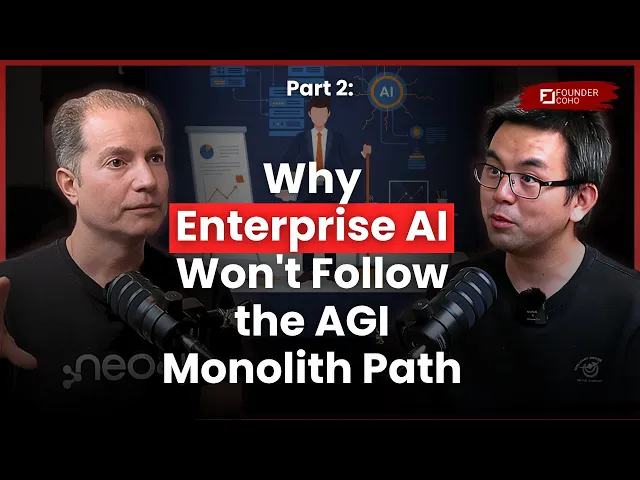
In this conversation, Philip Rathle offers a rare blend of technical wisdom and human perspective. He shares his take on the race toward AGI— why true intelligence must remain grounded in human judgment, transparency, and control. Philip opens up about his journey in product management, revealing the principles that shaped his leadership at Neo4j: balancing innovation with reliability, listening deeply to users, and defining success through quality. He also reflects on the discipline of mindfulness and how meditation helps him stay clear, decisive, and compassionate as a leader. From shaping global data standards to cultivating self-awareness, Philip shows that great technology begins with a grounded mind.
References
Philip Rathle – https://www.linkedin.com/in/prathle/
Jing Conan Wang (Host) – https://www.linkedin.com/in/jingconan/
FounderCoHo – https://www.linkedin.com/company/foundercoho
Timestamp
00:00 - Highlights
01:45 - Introduction and Interview Focus
03:35 - AGI Hype vs Enterprise Reality
06:48 - AI Risks with embodied AI
08:02 - The PM Mindset: CEO and Janitor
15:43 - Neo4j Product Philosophy
25:08 - Open Sourcing Cypher and Creating GQL Standard
27:44 - Balancing Roadmaps and Stakeholders
28:30 - Meditation as a Leadership Tool
29:37 - Strategy Meets Buddhist Practice
32:26 - Training Your Mind Like an Instrument
37:00 - Why Graphs Mirror Human Community
38:39 - The Power of Connection
42:04 - Advice for the Next Generation
42:29 - Outro
Full Transcript
You could stick an LLM inside of a robot that's able to interact and engage in the real world and say, go do whatever you want. And you could quickly end up with all kinds of undesirable things. Philip Rathle, Neo4j CTO, has a warning about AI everyone needs to hear, but his wisdom didn't come from algorithms, it came from doing the work no one else would do. Yes, it's true. You're ultimately accountable for your product. That's the CEO role. But then in order to make things happen, you sometimes need to go sweep the floor all by yourself 'cause there's no one else to do it. And learning to ask the right questions. Customer says, I need a big red button. Ask, well, why do you need a big red button? If you keep asking why, then you eventually get to the true root cause of the problem. And very often you discover, oh, the right answer isn't the way the customer imagined it. Years ago, Philip faced an impossible problem that would change everything. We couldn't figure out how to generalize that in a relational database. If Neo4j existed at the time, and if there had been graph databases in the early 2000s, then I might be doing something different. We basically punted the problem and said, this is too hard, we can't do it. That failure taught him the most important lesson about technology. It's important for us as humans to be able to retain control over when we delegate things to machines and not 'cause we can very easily have certain skills atrophy. Now he's discovered something that changes everything we know about data, AI and human connection. The research shows that if you're trying to predict someone's behavior and you have the choice between getting all the facts in the world about that person, you can choose to have not their friend's behavior, not their friend's friend's behavior, but their friend's friend's friend behavior. That is actually a better predictor than having all the facts in the world about that person. How connected are we as a species?
Joining me again is Philip Rathle, Chief Technology Officer at Neo4j, a leader who bridges technology and human insight. For more than a decade, Philip has helped define how the world understands connections in data, business, and people. He joined Neo4j in its early days and helped pioneer the graph database movement, guiding it from a bold startup idea to a global standard now used by the majority of Fortune 100 companies. With over 25 years of experience in enterprise data and product leadership, Philip combines technical mastery with philosophical depth, uniting innovation, clarity, and responsibility in every decision. Today, he's shaping how graph technology and AI work together to build systems that think and reason more like humans.
In this conversation, Philip Rathle offers a rare blend of technical wisdom and human perspective. He shares his take on the race toward AGI, why true intelligence must remain grounded in human judgment, transparency, and control. Philip opens up about his journey in product management, revealing the principles that shaped his leadership at Neo4j: balancing innovation with reliability, listening deeply to users, and defining success through quality. He also reflects on the discipline of mindfulness and how meditation helps him stay clear, decisive, and compassionate as a leader. From shaping global data standards to cultivating self-awareness, Philip shows that great technology begins with a grounded mind. Let us get started!
I am very curious about your takes about the roadmap of companies like OpenAI and Anthropic on the AGI, because they are really pushing forward that there's a monolithic model that would have the world's knowledge and can do the reasoning inside. It's like all in one box, and they're putting a lot of money on that, like stock market $500 billion here on that. What is the take on those?
I guess I'm simultaneously impressed more and more by what the latest models can do. But then at the same time, if I take off my consumer hat and look at what's happening inside the enterprise, the way companies make decisions and employ AI, it doesn't align with the way that pop culture and the media talks about AGI. We almost talk about AGI in some ways as if, well, there's some point beyond which machines are generally, broadly speaking, more intelligent than either one human or some total of all humans. At that point, we have some kind of obligation to listen to them or to do what they're telling us. So I think it's important for us as humans to be able to retain control over when we delegate things to machines and not, because we can very easily have certain skills atrophy. An example of where we've experienced atrophy is remembering phone numbers. I used to know all my friends and families' phone numbers when I was growing up. Now I can't even imagine remembering phone numbers. I used to land in a new city and look at a map and get directions. Now I just blindly follow the GPS. Those are trivial examples, that's fine. I'm okay with those because I visit a lot more places as a result and can interact with more people. I guess that's putting that track on pause. I come back to enterprises are at the end of the day on the hook for what any of their systems is doing and to the degree that there is AI inside, they're still going to retain the checks and balances and controls to make sure that the answers that come out are appropriate to the task. In that world, I just don't see any way where that's not going to evolve AI as a composite system as opposed to AI as like the AGI monolith, this mythic thing that we keep talking about.
Yeah, you mentioned a very important part and property that AI system needs to have is humans need to have control, can have the balance, can check the results. And you mentioned that in the enterprises, this is very, very important. And like you mentioned that LLM has been famous for lack of controls and explainability and that is what a lot of researchers spending a lot of efforts on that but definitely feels like a hard pass. Like you mentioned graph actually provide those properties very conveniently and people can use it like now.
That's right. That's right. By the way, I think where this whole thing could go off the rails is with embodied AI with robotics because you could stick an LLM inside of a robot that's able to interact and engage in the real world and say, go do whatever you want. You could quickly end up with all kinds of undesirable things happening. I do think there's some onus of responsibility there upon the companies that are shipping those. But back to graphs, there's definitely a case for having, let's say, a digital twin of the network of knowledge of the part of the world that your AI is dealing alongside an LLM for any kind of system.
Yeah, that's a fantastic journey and leads to the latest trend we have. I wanna dive into another theme of your career is product management. I know between your startup and Neo4j, you spent seven years in product management and ultimately leading a PM for a dozen relational database tools. Tell us more about how you get interested in a product manager role.
I really fell into it and I'd say I was doing product management as a consultant without knowing what that term meant in a role that was called solution architect. So solution architect is your sort of bridging business and technology. And I would go out and interview a bunch of business people and understand all of their goals, aspirations, vision, and then go back and look at what would it take to build those things and come up with things like opportunity matrices, which formalized how to prioritize what to build next. So early on, I was just attracted to intersectionality and intersectionality of business, technology, people, process caught me pretty early on. If data is involved, then it's got my name written on it. My sort of transition into product management was partly informed by this startup. So myself and seven colleagues after our, left our professional services company, bought back some IP that we'd built. Actually, we'd built a customer 360 system for United Airlines for a unified passenger view back in the day, 90s. This was in the late 90s. So kind of early days of WAP and early IVRs and so on, having a single touch point with web and other interfaces. And we went out and said, let's do a customer 360 product as a framework that's part product, part services. And so there I was CTO, but I was also essentially doing, you could say both technology and product definition work. And funny enough one of the top problems that came up with the airlines we were talking to and the other travel and transportation companies was not individual profile customer 360 but was corporate. And to solve corporate, their biggest problem was the fact that you had just all these different corporate hierarchies and every corporation had a different number of hierarchies that meant different things. And we couldn't figure out how to generalize that in a relational database. If Neo4j had existed at the time. And if there had been graph databases in the early 2000s, then I might be doing something different. We basically punted the problem and said, this is too hard, we can't do it. But I moved to Silicon Valley in 2005 and my first job here was working at a company called Embarcadero Technologies which had a suite of data and database products and so there I initially, I kind of worked my way into owning the product portfolio of a dozen or so database products and managing a small team, I think around five, five, six PMs. So that was my, just kind of following the natural path of doing what I like and where I felt I could add value.
And also you said that the product management fulfill your life lessons of just what it takes to get the obstacle out of way. Can you tell us more about that?
Yeah, I mean in PM oftentimes you're ultimately accountable for the success of your product. And if sales doesn't understand what your product is or the value or how to sell it, then, you know, it's really on you to go out and work with all the right people in the company, to work with sales directly, to work with enablements, to work with product marketing, to get other roles hired. But, you know, in the meantime, to just do things yourself, create some training or go out and there were times where I physically like lobbied for, let's just do a campaign and just one day let's have everybody sell this product and let's have every inside rep make 40 phone calls and let's just go at it. So, yeah, I think if PMs can just come at it with, I think two important skills. One is, understand the reason the customers are asking for things. So this is I like the five whys framework of customer says I need a big red button. Well, you have a choice. You can either go and build a big red button. Okay, but then what does that big red button do? Or you can ask, well, why do you need a big red button? Well, I need it because I keep running into this problem. Okay, well, when you run into that problem, like what's really happening, help me understand when and why that problem happens. And if you keep asking why, then you eventually get to the true root cause of the problem and very often you discover, the right answer isn't the way the customer imagined it. So in my silly example, they don't need a big red button, they need a blue button, they need a switch, don't need a button or a switch, they need something totally different. So that's one. Then the other is once you understand and have a vision and know where you're trying to get, then as an individual PM, just, you know, okay, here's the release date that I'm shooting for, here's the goal I'm shooting for. Let's just figure out all the things and if there aren't other people around to do it, I'll jump in and do it. And I'll make known the fact that I need to hire in new people if it's a significant enough role that it merits hiring someone.
Yeah, exactly. Yeah. So the product mindset actually is a very useful product for any role, like for any person in different role. I heard one book talk about the PM is basically mini CEO of each of the project.
Yes, and the mini janitor. I think CEO can get to people's heads. So yes, it's true. You're ultimately accountable for your product. That's the CEO role. But then in order to make things happen, you sometimes need to go sweep the floor all by yourself because there's no one else to do it. And I think another part of that mindset is to not feel like you're above doing any work. Like any work is good work as if it's contributing to the world. And I feel like that mindset can be really helpful, helpful in breaking down obstacles, helpful in breaking down one's ego as well.
Yeah, if you put it in a short way, what would it be your product philosophies like in Neo4j? And I know you are the CTO for Neo4j. Do you still wear product head as you are doing your job?
No, so I handed off product to my successor and good friend, Sidra Hasbe, who came from Google and ran the analytic products there. We still work super closely together and most of the team is the same team. Of course, it's grown in the last couple of years. Yes, some of the philosophy was with a database, you are entrusting, people are entrusting their data to you, your product, to run their business. So there are a bunch of service level agreements that you have that the database needs to be able to match. Like not having features that break when API breaking, when you have a new release, not making sure that our database as a service is up and available and that in your rush to get out new features, you don't accidentally break the way the ability for the database to back things up or to be able to remain available or to be able to guarantee that a transaction succeeded when the database said it succeeded. This all probably for people in the non-database were like, oh, of course, that's how databases work. It turns out when you're building a database, you realize that you have to work very hard in order to make the decisions and have a philosophy that supports this. Otherwise, you could easily move fast and break things, which might be okay at the higher levels of the stack. If you're building a tool that's non-mission-critical. So one was like an opinion around what the definition of done is and how much testing needs to happen at a low level. So you can tell from my answer, like the bar is extremely high, like there are literally hundreds of thousands of tests that run in an automated fashion before cutting a new release in the database. So there's a lot of investment there that's like below the water iceberg type stuff. But then the higher you get in the stack, the more it's okay to break certain kinds of things because it's just a part of the user experience that might be unfamiliar or annoyance, which is of course not great. You don't want to do that, but you also don't want to slow innovation too much at that level. Another one was because we are first the category pioneer leader, we're very clear on where we want to compete and where we don't. So for example, early on, salespeople loved to compete on query language. Neo4j had this query language called Cypher, which was way better than the three languages we supported prior to that and languages other people supported. But actually, if you envision a world 10 years out where there are many graph databases and many graph database companies, it'd be the worst nightmare for both a developer and for a CIO if each graph database has its own query language. So he said, let's take a page out of the SQL book.
Yeah.
And say, let's not compete there. In fact, let's open source and give away our query language because we've clearly stumbled across a query language that's high quality, works. While it's a crown jewel of our IP, it's called Cypher. In 2015, we opened that one up and that became the de facto career language for graphs. Then actually to continue down the sidebar, we said, well, wouldn't it speak meaningfully to the generational importance of graphs if we could get the same. If we could get a de jure standardization, so go to a well-known standards body. The best standards body for this would be the same one that developed SQL and is responsible for SQL, which is ISO. So we basically got into ISO, brought in our query language as input and said, graphs are an important enough model that for the first time since the SQL 87 standard or SQL 86 which became an ISO center 87. So first time in close to 40 years, like that actually merits a new database language.
Wow, wow. It's called what is it? GQL. And now GQL, not SQL.
Yeah, and we've actually been able to, as throughout the five-year process of bringing GQL into being, as part of the ISO committee, which is an international committee with many companies and players and countries represented, we were able to kind of go back and forth and adapt the language, adapt Cypher so that as GQL evolved, Cypher looked more and more like GQL. Of course GQL looks a lot like Cypher too. There are some other input languages, but for a non-standards person, SQL is GQL and Cypher are pretty close to indistinguishable. So for an average developer, you can think of Cypher as GQL. So this was another coming back to product principles. How do we develop our road? How do we know that our roadmap is calibrated properly in terms of investment? You should have like a, I like having a 60, 30, 20 rule roughly where, or 70, 20, 10 depending on the quarter of most of what you're working on is in the next release. And then the next amount is in what's coming next. But then you have 10 and 20% of these more moonshot kinds of long-term initiatives, like having a new international query language, which that was not a given, a real long shot, but that ended up succeeding. And I think that's really for the better of the space. Now, companies like us need to earn our business month after month, quarter after quarter, year after year, because you have vendor interchangeability, just like you do with SQL. That's actually the right thing for the business in the industry. And honestly, I feel better about operating a business in that way too. And let me give you just one, one or two more. Another one is, you know, oftentimes you have in any product that is highly used, you end up with a long backlog of different people asking for different kinds of things. And oftentimes those kinds of things can be in very, very different kinds of buckets, correlating with maybe things that are more ease of use, early learning journey, all the way down to, okay I'm in production and there are all these features I want around metrics and introspection and operability and so on, and then everything in between. What I came to realize is every stakeholder inside of our company touches customers and the community in different ways. So I came to think of them each as a different sensory appendage of the company and it became important for me and I think too for the trust and health of the PM organization and the larger organization to that everybody feels listened to. And that's different from us listening to everybody because I can listen and I can come up with what's the right prioritization for the business. And that might mean that I might ignore a certain department for like an entire year or two. But I find if you do that, people get really demoralized. And so one rule we ended up coming up with is let's as part of our road mapping process, let's make sure that there's a PM and a counterpart representing each other department. Support, customer success architects, pre-sales, sales, et cetera. And that each of those would come up with their list, top 10 list, and then with each quarter, you would at least tackle one thing on the top 10 list. It might not be number one, might be number 10, but that ensures that you force yourself to balance things in some way, and then people feel heard. You can come back and say, look, I couldn't do one through 10 for these reasons, but I did number 10 and I will do number five next quarter and so on. Another one is tension between adoption and commercialization, which when you're running an open source company, there's the question of, well, I could put 100% of all my features into open source. Adoption that will really work great with adoption but then nobody's going to have any reason to pay for the product and so very quickly you're not going to have a company which means that the open source community is going to get nothing because it all falls apart. So that's actually neither good for the community nor the company or the shareholders in the long term or the employees.
Finding the right balance is very important. So what is your philosophy? What should go opensource?
So the philosophy is if developer relations is telling me you're putting too much stuff in the paid version and sales are saying you're putting too much stuff in free version, then I've the right note. If there's equal dissatisfaction from both sides.
Equal dissatisfaction, both sides. That will be the right balance. That's right. Cool. Cool. Yeah. Thank you so much for sharing the philosophy for Neo4j. This is actually a wonderful profession. You put a lot of thoughts about how to run the company and tie it back to you mentioned earlier. It's like the product is the team. The product is the Neo4j as a company. Yeah. We also ship a great, awesome opensource software and solutions for the customers. And for the next part, I want to dive a little bit to your personal side as well. I know you do meditation for a long time. How do you think meditation help you to become a great leader?
Yeah, there's a lot I could say about that. So I'd say on the personal front, it started with a curiosity, so kind of my scientific orientation of wanting to be methodical and understand the external world of realizing that there's actually a path of scientific examination of myself internally, like being pointed inwards, starting with training the mind as a tool. So I initially got introduced to meditation through martial arts practice. I was studying Muay Thai and Tai Chi is complementary martial arts. That's a different topic on why those were complementary for me. And my Muay Thai teacher had taught meditation coming out of like the Thai Theravada forest tradition. And something I realized is, much in the same way that the body can be disciplined. In tandem with disciplining the body or disciplining the mind. And okay, what does that mean? And when I looked at who I want to be and who I want to manifest as a human being, I kind of had this idea of, well, if I aspire to having this set of qualities of being aware and awake and compassionate and firm, but not hard and understanding but not soft. You know, kind of, you know, there's a little bit of a yin-yang middle way in all of this. But then I saw that, you know, the way human beings are built is we tend to just be very reactive and we're not really taught in school that, hey, you're taught that you have a personality and at some level, each person has their own personality and you're born with it and that's great. But then at some level, there's an opportunity to look at the way our default OS runs and become, when you're angry, that's actually at some level a choice because you could choose to not be angry and you could choose to be happy about something else or you could choose to maybe redirect that in a productive way. And then as life goes on, you tend to just carry a lot of internal baggage, not realize it and carry it in your body. So I got into meditation as a way of really exploring and training the inner world. And it's become important and if not necessary to me to every year spend roughly a week to 10 days in one shot and to every week spend a few hours and every day spend minutes to maybe up to an hour just with the practice of sharpening the instrument, the mind, and then using that to contemplate the way my mind processes information and sort of direct it properly. If I think about ways that I relate that back to work, one of the things in the in the Theravada teachings is I can relate actually a strategy framework with the investigative framework. So there's a concept of investigation of phenomena, the Pali term for this, which is the language in the days of the Buddhas called Dhammavichaya. And then from that you can get clear seeing, which is called Vipassana. And then from that, one of the things that you can get is right action or right effort to Vira. And so that actually maps directly to my favorite strategy framework. And by the way, I'm very much for frameworks, but for creating the right framework at the right time based on first principles for whatever situation you have. Having said that, there's one of a few general frameworks that I like is Richard Rummelt's framework from his book, Good Strategy, Bad Strategy. Have you heard this one?
Yeah.
Basically, the book is like, bad strategy is what everyone thinks strategy is, which is getting up on stage and shouting loudly about some ambitious goal. He said, good strategy actually is, is first you analyze the space that you're looking at and question your assumptions and come up with a good framework and understanding around your basic assumptions, which equates with investigation of phenomena. Then is to come up with a guiding policy, which is not etched in stone, like here's what we must do. It's more here are the principles by which we operate, which gives you reasons for why you're operating so that when things change in the real world, which they always do, you can refer back to regarding principles to then come up with your actual, what he calls coherent action. So in my mind, like that, I learned the remote strategy much later, but that strategy resonated with me because it happens to rhyme with the same framework I'd learned and developed an experience through my meditation practice.
Yeah, so thanks for sharing. I'm definitely going to check and read that book as well. Such a good strategy. And the one thing I learned, gave me a very strong impression is that you mentioned about, is about improve the instrument, sharpen the instruments. Which is our mind. Like our mind is also an instrument, just like we need to practice on getting our music skills like we need to do practice to maintain that. Thinking and mind is the same.
That's right. It's the mind and more broadly, it's the whole psycho emotional system. So it's how our mind operates and how you feel, how you motivate. And then that actually is very tied in to the body and body feeling as well. So it's a whole body mind.
Exactly, I also do meditation practice myself. So what you mentioned is very resonating and especially about the inner world. It's about you just have this very objective observation of how this whole emotional process works and your whole body works. It gives you, in fact, more control.
Curious what kind of meditation do you practice and how has it helped you?
I think that I usually will spend like 10 to 20 minutes not to my everyday just like sitting there and just breathe and then observe the breeze how the how you're breathing in out and just observe this and detach yourself from where we are as if you aren't on the top and then just observing the thing and then that observe the every sauce you have we do have sauce on time until it gradually goes and become quiet and you get in the peace back. Yeah.
Yeah because our mind is a thought making machine and they come unprovoked. And you realize when you're trying to focus on your breath, say in a retreat, that your mind will invent the equivalent of like 10 full length motion picture movies in a one hour sitting and it'll just go so quickly and you have no control over it. Except that the control you can exert over it is actually deciding I'm going to focus on this, just something simple like the breath as an anchor, be master of my own destiny. And then that ends up being really useful in, yeah, back to sharpening the tool that the mind is a tool and wielding the mind as a skill.
Exactly and it's especially resonating to me because I need to practice to make my skills to trigger that whole observation processes that requires practice for me to have that skills and that is incredibly useful. It's almost like a neutral button whenever I'm in other process. For example, I'm in a kind of work situation, I have emotions on that. I know that this tool is available and I can just press that button and then I can very easily go to that process again because I have already developed the habit. And I can quickly reset myself to the neutral state. Yeah. Yeah. I found that has been incredibly helpful.
It's been fun to see it become more mainstream.
Yeah. Because it works. Initially, when I heard about this, was like, Buddhism is it's like, it's spiritual. I was, I was, I would never try that. But then I, I, one of my friend recommended this to me. I think you should try one. Or like at least a few times and I did try and then it worked. Just like you mentioned, because like, I feel, I couldn't put the word back to my, I feel like I have always a tool in my toolbox to help me to improve my emotional resilience and make me happy. And there's also a lot of other tools, for example, like make me improve my happiness generally, by just every like when back when I was working in Google I would need to take a like of 10 minute work from the bus stop to the building and while I was working over there I will practice to just observe a flower which will improve my appreciation of the knife. And that's, it turns out how I start every day. I just literally sit there. It only take five minutes before I walk into the buildings. There's a very beautiful flower, which nobody realized then. And I would just sit in front of them. I would just show my appreciation by just looking at the flower and then I'm pretty sure flower will also be happy, I'm going to be very happy. And everyone just asking me like, how did you get your marriage? I would just tell them to go out the door. There's like a flower. Like nobody really, it's a very small flower, like this small one. But then the beauty is that you can literally appreciate anything like that appreciate the fact that it's sunny, beautiful weather, great flower, squirrel. And then your, you just like whole energy level is totally different.
I love that story. The process of appreciation as one form of meditation is I have a teacher who had a center in Joshua Tree, Ruth Denison, and one of the things she would do before the meals at a retreat is she would get people in a circle and each person would name one contributing factor to be grateful for that resulted in the meal. So it's like the person that cooked it, the person that went shopping, the person that grew this, the person that grew that. The rain, the clouds, the sky, the sun, ultimately we're, the world is just this complex web or graph is what I mean.
Graph, yeah.
And understanding that we're part of an interconnected, interdependent system, man, like all the things that we have to be grateful for, it's, yeah, gratitude is a great and powerful place to be.
Exactly. Yeah. Yeah. I think, actually one thing you mentioned is also very relevant. Like all of your, you're saying a graph, like the word we're part of the graph. I think that's absolutely true because we are part of communities. Yeah. We get our meanings because the connections were made through our friends. Even a connection with you today, like is we are isolated nodes before, but then we're connected. Yeah. That's the beauty the beauty of the graph. The graph is essentially, it's like a in technical terms for community. It's the community of the data and it's so useful because we humans belongs to community. We crave for community. And, and every, like today during the conversations as we have the conversations, I realized one question on top of my mind is that I, why graph is so important. I definitely feel the exact same thing as a AI practice. And I realized every time I want to create a databases, I always feel no, I don't want to use spreadsheet, I don't want the relationship, it's so artificial. And then if I want to use no SQL database, I feel like I haven't get any help by having that database abstractions. I always find the graph is very useful in all the problems in the set up that we're doing. And I realized the reason is that we are building application for human to use. Because at the end, we're building for users. They, their knowledge, their life, are organized by communities and graphs around them. And just like you mentioned, because the purpose will build application for them. So the graph is the most natural ways of representing what they have in their mind. Yeah.
There's a book called Connected that was written by two sociologists at UC Irvine. The title of the book is, well, the title is Connected, the subtitle is how your friends and friends of friends, and I think friends of friends of friends, I think they go to a third, influence your behavior more than you know, or I'm butchering it a little bit. But the research shows that if you have the choice, if you're trying to predict someone's behavior and you have the choice between getting all the facts in the world about that person, except of course what that behavior is and then try to, you know, determine their behavior based on the facts. And then on the other hand, you can choose to have not their friend's behavior, not their friend's friend's behavior, but their friend's friend's friend's behavior. That is actually a better predictor than having all the facts in the world about that person. If you think about that, like that means that people, not only do I not know these people, my friends don't know these people and they influence my activity or at least predict whether causation, causality, more than things about me. That's pretty mind blowing. Like how connected are we as a species?
Exactly, Yeah, well said. We are very, very connected species. Yeah, it's such an awesome conversation. Really appreciate it. I just have one last question before we wrap up the session is that if some younger people come to you for advice, knife advices, what would be the one advice you give to them?
I'd say look to understand the bigger picture and then look to see what's within your capacity to do to make things better.
Thank you! Thank you so much for taking time to chat with us and sharing with the community. This is such a beautiful conversation. And now we connected. We're connected. I really enjoyed it too thanks for the invitation. Likewise. Thank you. Thank you so much.
Thanks for watching the full interview. If you got value from this conversation, please like drop a comment and subscribe to FounderCoHo. We've got more founder insights and deep dive interviews coming your way, so don't miss them. See you in the next one.