Interviews
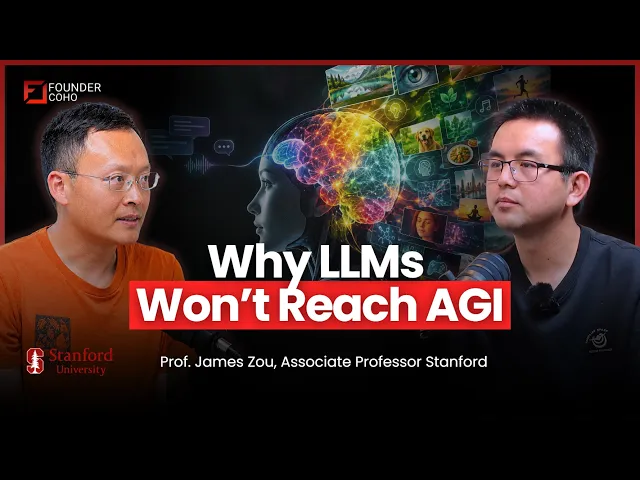
Professor James Zou, head of Stanford’s AI for Science Lab, and Faculty Director of Stanford AI for Health. His research pioneers Virtual Labs, the physics of agent societies, Agents4Science, Paper2Agent, and biological foundation models.

|
Associate Professor at Stanford
Takeaways:
1. Language is less than 1% of Intelligence: Text only captures a fraction of human brain activity. True AI superintelligence requires training directly on internal bodily and physiological signals, not just written text.
2. The Autonomous Virtual Lab (Nature) — Zou cloned his Stanford lab into an autonomous multi-agent hierarchy.
3. Physics Equations for AI Societies: Researchers used statistical physics to successfully predict whether AI agent communities will reach consensus or polarize.
4. Nobel-Reviewed AI Paper: A Nobel laureate reviewed an AI-authored paper on job markets and praised it as innovative and well-executed.
5. One Night of Sleep Predicts 130 Diseases: An AI model analyzing a single night of sleep data (brainwaves, heart rate, breathing) can predict risk for roughly 130 diseases years in advance.
6. "We Don't Need Papers Anymore": The Paper2Agent project converts static PDFs into interactive AI "virtual authors," making traditional research papers obsolete.
7. 10 Years to Nobel-Level AI Science: AI is predicted to make genuinely Nobel-worthy scientific breakthroughs within the next decade.
References
Prof. JamesZou’s Linkedin – https://www.linkedin.com/in/james-zou-2123a4133/
Prof. James Zou's X - https://x.com/james_y_zou
Website - https://www.james-zou.com/
Jing Conan Wang (Host) – https://www.linkedin.com/in/jingconan/
Timestamps
00:00 Intro & highlights
01:53 What "AI for Science" means: from tools to research partners
05:20 Teaching AI to be creative
07:21 Inside the Virtual Lab (Nature paper)
09:38 The risks: dual-use, bioweapons & over-reliance on AI
13:44 Rethinking papers: Paper-to-Agent & "virtual authors"
19:00 Sharing agents, the economics & a research cloud
25:22 The physics of agent societies: consensus vs. polarization
32:12 Sycophancy, agent personalities & scientific rigor
34:56 Test-time training & reducing agent bias
41:43 Detecting AI-written papers & the Agents4Science conference
45:24 When an AI paper met a Nobel laureate reviewer
47:35 Will AI win a Nobel? The future role of human scientists
51:20 SleepFM: predicting 130 diseases from one night's sleep
54:12 Why the body speaks a language LLMs can't hear
57:52 Is language really the path to AGI?
1:00:22 Data privacy for your biosignals
1:01:35 From lab to startup: FDA clearance & regulated markets
1:05:52 Advice for founders & a prediction for the next 6 months
Full Transcript
Cold Open
There's so much that's happening in your brain by the time a single word comes out of your mouth. There's already probably tens of thousands of tokens happening in your brain. But the downstream artifact we know is only less than 1% of the actual thoughts that happens here. Prof. James Zou is an Associate Professor at Stanford, where he leads the Stanford AI for Science Lab and serves as Faculty Director of Stanford AI for Health. His research pioneers Virtual Labs, the physics of agent societies, Agents4Science, Paper2Agent, and biological foundation models. His group develops healthcare algorithms with FDA clearance, millions of active users, and recognition from The New York Times' Good Tech. And now he's asking what happens when we train them on the other 99%? From one person one night, we can collect almost close to a hundred million tokens. From one night of sleep recordings, the model is actually able to predict the risks of about 130 different diseases in the future. Your body is probably your biggest mystery. And it isn't just the body he wants to rewrite. It's how science itself gets recorded. Why don't we reimagine maybe a different way of representing knowledge instead of millions of papers, we'll have millions of these virtual author agents. And all these agents can also talk to each other. We actually created over ten thousand different communities of agents. In some communities, they can start to reach a consensus about what to do. In other communities of agents, they become more polarized, very related to the human communities. Then an AI wrote a research paper — and a Nobel Prize winner reviewed it, not knowing what to expect. In addition to the AI reviewers, it was also reviewed by a Nobel Prize winner, when they reviewed this paper thought that this is actually a technically really well-done paper, quite interesting and innovative. Do you think we will see the day that AI will be able to get a Nobel Prize?
Probably within ten years where the AI will be doing research, making breakthroughs that will be of that quality.
What "AI for Science" means: from tools to research partners
Jing Conan Wang (FounderCoHo) :
Professor Zou, you had amazing careers in Stanford and done a lot with cutting edge research, bringing your knowledge to the frontiers of many domains, super honored to have you in FounderCoHo. I'm curious like for our audiences, like what are the key things you want our audience to remember from your past experiences?
James Zou :
Well, first, thank you for having me excited to participate in this podcast. I think a lot of my research that I do, right, so I lead to the AI for science lab here at Stanford, and we work on developing AI for quite diverse cutting-edge scientific discoveries, right? So most of our work is on like basically how can we create AI scientists that can in some sense like make new discoveries like we do as humans.
And I think a lot of that work is sort of drawn from my own experiences, right? from the last 20 years of like of doing science myself and doing both wet lab experiments and writing code to helping new algorithms. So in many ways we're trying to create AI scientists that sort of becomes like a mirror of ourselves.
Jing Conan Wang (FounderCoHo) :
Yeah, AI scientists is become so hot this year. I think I heard from many people, it's like maybe last year was engineer, AI engineer. But now this year within the couple next couple of years, the really the focal point will be AI scientists. And you have done a lot of amazing work in this field already. And and I know that you have spent a lot of efforts on the AI for science and if we take a step back, like the first wave of AI of science was largely about building powerful and specialized calculators. If we think about AlphaFold, it's basically solving very predictive problems of 3D protein structure. And recently we ended a much more ambitious phase, like moving from AI as a passive tools to really like AI as active co-partners that can do research together. I am very curious your take of the wave and the transition.
James Zou :
I think this is a really interesting and very exciting paradigm shift for how we think about AI. As you mentioned in the past, AI has been very useful, but mostly as a tool for tackling a very specific scientific problem. And if you think about it, the way that we use AI before is that some scientists have to start with a well-defined problem. I want to predict structures of proteins, or I want to analyze this data set. And then you have to come up with a data set, right? And then you figure out which tool to use, like maybe you read AlphaFold or some other tool. And then you also spend a lot of time to interpret the output from these different tools. So the AI tool, while it's very useful, but it's only a very small part of the overall research process. But over the past 12 months, with the rapid advances in the AI agents, right, so I think AI is no longer just a tool, but it's really becoming a scientist by itself. So the AI scientist, the agent can come up with its own questions, right, and then can design experiments, test those hypotheses,
collect its own data, analyze data, and in many cases it's also coming up with new ideas and new approaches that we haven't thought of this before. So I think that can be really exciting as a new way to basically try to reimagine what science looked like with all these AI scientist agents.
Teaching AI to be creative
Jing Conan Wang (FounderCoHo) :
You mentioned also a trend that is happening now is that we want to make AI more creative and used to be very passive. We come up with old ideas and we use AI as a tool to implement that. And it seems the trend is changing and AI is coming up with more ideas. Is there any interesting trend that you observe in this space?
James Zou :
Yeah, so I think you know a lot of the work that we're doing with my students at Stanford is on how do we try to make AI more creative as scientists. Right. I think creativity is something that's still also quite difficult to define, right? Because it's somewhat subjective and can be quite challenging for AI to develop. For example, if I ask the language model, right, to come up with 10 different ideas, maybe the first three will look somewhat different, but then it quickly become somewhat similar and repetitive. So I think that's actually one of interesting challenges is how do we train AI to be even more creative? And I think there are ways of doing this by drawing lessons that we learn from human creativity. For example, if you look throughout history, right, the way that scientists often make new discoveries, often it's come by making different kinds of analogies. Maybe you have a scientist working in biology, but they take some ideas from physics, right, and then take those analogies and to then solve those problems in biology.
So I think for humans, often a big source of our creativity comes from these different domains and taking analogies from these different domains. And that's something we're going to teach AI to do. In some of our work, we try to basically teach AI agents to explicitly look for analogies across very different fields. So let's say if the AI agent is working in physics, it would actually look in like finance, right, or economics, right? To look for solutions in those domains.
That could be analogous to the problem or related to the problem that it's tackling in physics. So I think that's sort of ways we can make the AI agents much more creative.
Inside the Virtual Lab (Nature paper)
Jing Conan Wang (FounderCoHo) :
And you work on these ideas and that recently actually got a Nature paper called the virtual lab. what what does virtual lab mean?
James Zou :
Yeah, so the virtual lab is where we created a team of AI scientist agents to function as a research lab to sort of mirror my physical lab at Stanford. Right. and the motivation for doing this is that you know, as a professor we have a lot of problems that we want to solve, but only very limited time. Right. And I thought it wouldn't be great if we have like a virtual version of ourselves that can work on all these other problems that we don't have the time to do in our time. So we created this virtual lab as a team of AI agents where there's a professor agent that runs the lab, and then different student agents with different expertise, you know, from data science to machine learning to immunology. And the agents have their own group meetings. We give them a budget, they can run some experiments. We also created for the agents a school, like a replica of Stanford, so they can go to the school to teach themselves how to become better researchers in their specific domains.
And one of the things we find quite interesting, as you mentioned, is that it's really through this collaboration among multiple agents, right, where they're able to the team is able to then tackle much more ambitious, more interesting projects than like a single agent is able to do by itself.
Jing Conan Wang (FounderCoHo) :
How did you get this idea and when you initially talk this idea to your colleagues, what's their reaction?
James Zou :
The people are generally quite excited to try these virtual labs. And our vision is that behind every researcher, behind every human researcher, they'll have their own team, their own virtual lab of AI scientists that can help them to make new discoveries. So we actually have a lot of colleagues here at Stanford and other places across many different domains who are now using the virtual lab to help to make new discoveries in Alzheimer's disease, in physics, in quantum computing, right, in astronomy, across many different domains.
The risks: dual-use, bioweapons & over-reliance on AI
Jing Conan Wang (FounderCoHo) :
I think the trend of like AI will be able to revolut the knowledge work has been a theme that happened in many fields. we have think this for codings and software engineers and the legals for lawyers and it there's also great potential for scientists. The next question I have is that for every breakthrough it has both positive and negative impact on the industry. Do you see any potential active impact and as we have we moved into more autonomous AI research and how could we design the system very responsibly to mitigate those
James Zou :
Yeah, it's it's a great question. I think there are definitely significant potentials for positive impact, but we also be mindful of some of the potential side effects, right? And potential negative results. I mean on the positive side, I think you know science is really can be extremely beneficial and transformative for all of humanities, right? If we have AI that can help up new medicines faster and quicker, that's really benefits all of us, right, by curing different diseases.
I think that's also one of the reasons why all the Frontier labs now are investing so much in scientific research, right? Because everybody I think has converged to this idea that science is really sort of the really the cutting edge, right, of humanity. And that means it's also the cutting edge of intelligence, right? So if we have more intelligent systems that can help to advance science, then that's going to be the biggest impact of AI.
I think the flip side is that science, like with all the powerful technologies, it can be we need to be very thoughtful of how we use it, right? so for example, the same technologies that can be used to design good medicines, right, that can also potentially be desired used to design viruses, right? So that's no there are these dual usage concerns. There's also these concerns about humans becoming overly reliant on AI. By that I mean like
let's say imagine like the next generation of human scientists, right? If we don't want it to be that you know they become so reliant on the AI that they don't really learn how to base the basic fundamentals of how to do good science. Because then if they lose that, then there's no way for the the humans to be able to provide guidance and oversight over these AI agents. So it's also really important for us to how to maintain that level of core expertise in human researchers without being overly reliant.
Jing Conan Wang (FounderCoHo) :
In many other areas, like for example in the coding areas, people have been talking about first writing code, but then it turns out cybersecurity is very important. The AI is so good at finding all the vulnerabilities and attack the system. Now every new model basically needs come with some fun story of how AI is breakout and do some damages. I'm curious especially for the scientific breakthroughs. What is the counterpart of this cyber security or security for the AI science?
James Zou :
I think one counterpart is that essentially the bioweapons, right? people can use AI to design potentially new kinds of weapons. and that can be quite challenging. Right. but there's also maybe even more real or like broader potential concerns, which is that science itself can be sort of flooded by AI generated results. Yeah. Right. And imagine if you have AI agents that advice like millions of papers every year, right? Then it's not gonna be possible for humans to keep track of all those papers. It's also gonna be very hard for us to judge which of these is going to be really good, like not really high quality innovation versus like some mistakes or some bad results.
Right. And I think that itself can be quite challenging and means that we need to as a scientific community try to rethink how we evaluate science, right? And what is a peer review process, what is a publication process when we have all these AI agents.
Rethinking papers: Paper-to-Agent & "virtual authors"
Jing Conan Wang (FounderCoHo) :
What would you think the scientific discovery process will look like five years from now?
James Zou :
Yeah, like you mentioned the papers, right? like papers itself, it's often something that's a very inefficient artifact of knowledge, right? Maybe like you have a team of researchers, they spent a lot of time, many years doing research, right? And then they try to capture that knowledge into you know, these words on a paper. But that paper is like a static artifact, right? By the time that the paper is published, maybe the knowledge has moved on, right? Has progressed. and
Also, if there are mistakes in the paper, then it's hard to correct or hard to maintain that.
And one of our thoughts is that like do we really need to have even papers anymore, right? or in other words, like why don't we reimagine maybe a different way of representing knowledge, right? So instead of having knowledge being sort of in these static artifacts like papers, why don't we convert all of these knowledge into dynamic and interactive, in some sense like living knowledge in the form of like knowledge agents, right? Where every discovery that's represented
By a knowledge agent that's responsible for making sure that discovery is robust and reproducible. And if the knowledge changes, right, then that agent then is also responsible for making sure that that discovery is getting updated. And those agents can also collaborate with other knowledge agents to make new discoveries. In that sense, the knowledge is not just passive papers anymore, but really dynamic, almost like virtual authors, right? And those can sort of propagate and collaborate and making sure that you can generate new discoveries.
Jing Conan Wang (FounderCoHo) :
I'm curious because you mentioned earlier when you work on the virtual labs, you basically copy these versions of scientists and make them to form labs and you also mentioned about a paper. So I'm curious curious about that is that using similar technology that you are converting some static knowledge into a virtual version of scientists.
James Zou :
We have this work that we call Paper to Agent, which will also be published in a few weeks, in Nature in a couple weeks. So the idea there is no basically we create a team of worker agents that converts automatically converts a paper into like a what we call a a virtual author, right? So the paper agent. And the way this works is that these worker agents will go into the virtual
Paper and any associated artifacts, which could be code or data. And these agents then essentially create a virtual environment, try to replicate the research process itself, right, that led to that paper. For example, these agents will try to reproduce the figures and results from that paper. And through that process, these agents actually learn a lot of the hands on details of how that you know how the research actually worked that led to that original paper. So that creates what we call like an MCP server, right? Automatically based on that paper, that captures
All the core insights, and based on that paper MCP, then we can also automatically create an agent that then becomes like the virtual author. So then going back to your example, right? So now then you can really talk to that virtual author, right? And that virtual author then would actually provide all the details about how the experiments were done. But beyond that, the virtual author can also help you then to can also collaborate with you, right? And then to apply that insights from that paper or the technologies to your data or to a new problem.
And we're also imagining now we can have this world where have instead of millions of papers, we'll have millions of these virtual author agents, right? The knowledge agents can also talk to each other. Maybe they'll find maybe agents from different papers can start to automatically collaborate to generate even new knowledge.
Jing Conan Wang (FounderCoHo) :
Very excited, looking for the reading of paper. Yeah.
James Zou :
It's called paper to agent and it's all open source. Yeah, so people that can use it, yeah.
Jing Conan Wang (FounderCoHo) :
One follow-up question I have on this is that you mentioned about this paper to AGENT technology, which are convert paper to a living system that has this knowledge. And we all know that the whole scientific discovery process for when we solve any problem, we usually will try many passes. And then we get some learnings as we try and then and later we cut all the exploratory passes and then summarize the final conclusion we have. That only contains a subset of information. There's a lot more information in the whole exploration processes. I'm curious like is your paper to agent also cover that process or is it like some other research projects that you use that can be helpful for that situation.
James Zou :
Yeah, that's a great question. so a part of why we really like the agents here is that they can the agents can actually explore many of these different trajectories in parallel, right? So maybe there are like ten different ways of analyzing the same data set. The agents can actually explore those all these ten different ways and then systematically inform us right how the different ways of analyzing this data set can lead to different conclusions. I think that can sort of expose many of these potential biases, right? Whether the results are cherry picked.
Right, where the analysis is robust. So all these concerns about reproducibility, about you know some of these studies can be help to be mitigated by with the help of these agents.
Sharing agents, the economics & a research cloud
Jing Conan Wang (FounderCoHo) :
So code is one way for people now sharing knowledge other than paper. How would you imagine people sharing this agent? Is that yeah, I'm curious. Is that some models? Is that some code? Yeah.
James Zou :
i think it's actually even easier to share agents than to share code, right? Because the the problem with code is that it you know it depends on a specific environment, right? maybe if you have like an older version of Python, it's really hard to like rerun those code, right? and code can also have bugs in them, right? The code itself is still like a static artifact. Right. so what we advocate is that every research project should have its own agent, right? And since with paper to agent, we actually enable people to actually automatically create.
these agents. And then we'll central host all those agents for free in a centralized place on Hugging Face. So then all those paper agents can sort of live in this virtual scientific community. And anybody can then talk to those paper agents to help to make sure the results and papers are reproducible.
Beyond that, those paper agents can also start to talk to each other, right? Because they have their own social community now. They can talk to other paper agents and start to see maybe, you know, two agents can form a new collaboration, right? And then start to generate new results.
Jing Conan Wang (FounderCoHo) :
For any living system it would require energy and require computation to run them. what do you think about the kind of the economics here? Because like the scientists they wouldn't it would be scientists who need to be responsible for the bills or the huggingface would be responsible for the bills.
James Zou :
Yeah, I think that's also something that's interesting. The first thing is that it's actually fairly efficient, I would say, cost efficient to create these paper agents. Right? It's usually for example, like less than a dollar or a couple of dollars for us to create an agent from one of these papers. Right. so that's I think that's already quite quite efficient.
And we had some partnerships with Anthropic, right, where they were actually supporting us to do this research and also to create many of these agents from all these papers that people put on the arXiv. So I think we could actually have a sustainable way to create and to maintain these agents. Like for example currently people will pay thousands of dollars to the journals to publish their papers. Of course, I think the journals still serve a very useful purpose. But the cost of actually creating these paper agents would be only a small fraction of the cost of all these publication fees.
Jing Conan Wang (FounderCoHo) :
That's also one thing I I wanted like dive deeper on to this because it feels to me there's like common infrastructure that will be the benefits of the whole scientific community. Like if there's some cloud, a research cloud dedicated for these purposes. Do you think, do you envision that something like this, like a public cloud, something for scientific community that will show up sometime down the road?
James Zou :
I think it's interesting. I think it could be quite useful, but it would be hard to get that organized, especially in the US. There's some, for example, some discussions about the US government side of can we first create like a government-sponsored research cloud or platform. but that's certainly moving very much more slowly than what how things are happening on the industry side. So what we're seeing increasingly is more like you know, people would
have a much more decentralized setup, right? Individuals would work on, you know, have their own compute or collaborate with companies, right? But I think something that would be very useful would be having like a platform where and the platform could be hosted on AWS or on GCP or any of these cloud providers, right? But then we have that in that platform, then millions of all these paper agents can live in that platform, right? And then they will be sustained there, right? And then all the communications and discussions and collaborations between these paper agents will be fully public, so it will be in the public domain. So then everybody would see what are the new discoveries that are being made.
Jing Conan Wang (FounderCoHo) :
It actually reminds me there's a there's a very broad trend in the startup community that they used to raise funds, the real money, now they raise tokens credits to run. So maybe in the future some of the research grant will be AWS credits or GCP credits.
James Zou :
No, I think it's true. I think it's really more about like you wanna have some credits for compute and for APIs and that's what's needed to maintain this kind of virtual science community.
Jing Conan Wang (FounderCoHo) :
when we have an agent and we know agent have their own idea, how do you make sure they do research? Not just chit chat with each other and waste the credits. What what is the incentives you provide to you to the agents to make sure they are they are doing research?
James Zou :
Yeah, I think this is kind of interesting. because we also have that question with humans, right? Like you have a team, you know, maybe you're the manager, you have a team of people working under you. How do you incentivize your team to work efficiently and work effectively rather than spending your after time drinking coffee or something? Right? so I think that comes down to like first how do we design a good environment that can incentivize teams, either human teams or AI teams or hybrid teams to work really effectively? And then also
Second is that how do we also study like the teamwork, right? Because like some teams work much more efficiently together, right, but other teams they fight with each other and then they don't get things done, right? So how do we basically almost study like the management science of AI, right? Have a good teamwork so that these AI agents can are able to collaborate well and also effectively tackle the problems that we're interested in.
The physics of agent societies: consensus vs. polarization
Jing Conan Wang (FounderCoHo) :
Yeah. You mentioned a great point which is the management science. So when a lot of people talking about working with agents, they are thinking about technology, they're thinking about messing up with code. But exactly like you mentioned, like dealing with agent or managing agents is very similar to managing people. And a lot of times like there's a lot of social dynamics like like what what a human to human collaboration will look like. and I also realize that you actually introduce a lot of interesting ideas in this research field of understanding the dynamics between agents. You actually introduced some concepts you use the physics to understand of behavior. how does that work?
James Zou :
The motivation for that is that you know I'm very interested in this new axis of scaling where where we scale up the number of agents that collaborate and work together. Right. So we're not just scaling up the size of an individual model, right, but we're actually scaling like how many agents are working on the project at the same time. And I think increasingly it we see a lot of cases where more and more agents start to interact, right? And then they start to work collaborating. To tackle harder problems. And I think the recent example of Hacking Face, you know, the hack, right, is also an example of this where you have maybe thousands of agents that created their own message board, right? They start to talk to each other and try to, you know,
Tackle some very challenging, impossible problems, and then those agents then decide that they can sort of find the solutions of those problems on hugging face, right? So that's why they sort of so they're almost like the self-organized activity. I think that's a really interesting example where as the agents start to talk to other agents, right? They start to form their own civilization, start to form their own community. And then that community of agents, that civilization of agents, can have all sorts of unexpected behaviors, right? Because they influence each other, right?
can sort go in different directions. So our idea is that can we actually use methods from physics, from statistical physics, to actually predict and forecast what is going to be the behavior of these civilizations of agents. So when you have many agents that collaborate, right, can we actually then have a model that can predict what is going to be that the behavior of all those agents?
And you might ask, you know, that seems like very difficult, right? Like how would you predict all these agents together? I think this is also where ideas from physics end up being very important, right? Because physics is very good at studying systems, complex systems, with many different components. Even if I look at this table, right, it has all these many large numbers of atoms, right? So physics can tell us how to model the structure of those collective community of atoms in the form of this table. So that's using these tools like this statistical physics and Boltzmann distribution all that.
So we show that we can actually take those tools and extend and apply them to this new complex system where the individual components are individual agents, right? And the interaction between the agents are given by how the agents can talk to each other. And then we can then use that and show that this can actually forecast the behaviors of that community of agents.
Jing Conan Wang (FounderCoHo) :
So did you design some experiment and simulate it?
James Zou :
Yeah, so we actually created some over ten thousand different communities of agents. So each community would have its own group of agents, they have their own social network, right? And each community would give the agent some task, right? Tasks could be like solving a math problem or debate about this political topic. And it was that community of agents then would actually then evolve, right, their opinions over time. But then when the agents talk to each other, they can then evolve their opinions and positions. And then across all these over 10,000 different communities of agents, we showed that there's some actually common patterns which enabled us to actually build these physics type laws, right, that can then help to predict what's going to be the evolution of these communities of agents.
Jing Conan Wang (FounderCoHo) :
that's very, very interesting. So ten thousand communities involved in the virtual world. And you mentioned while you realize some patterns. What are those patterns?
James Zou :
because each community is sort of like its own little universe of agents, right? and for example, we can see that in some communities, right, maybe initially the agents have different opinions, right? I can ask them a topic about let's say clean energy or something, maybe initially the agents have different opinions, but over time this as the agents talk to each other, then they can start to reach a consensus about what to do. In other communities of agents, they become more polarized, right?
Maybe like because of initially the agents have different opinions, but as they debate, they become even more polarized. They have they do not converge, but they actually diverge. Right? And that's also something that's very related to the human communities, right? Like the US you know becomes more polarized, but other countries can become more you know more reaching a consensus.
Jing Conan Wang (FounderCoHo) :
What do you think the reasons that drive some community of the agents to be more polarized versus more consensus?
James Zou :
So that's exactly what we try to understand and predict using these physics tools. So we basically find that the agents also respond to what we call like social pressure from other agents, right? Which is sort of analogous to how humans respond to pressures on their colleagues, their friends, their family. But agents also feel somewhat of agent social pressure. And they're also basically trying to adapt their actions, their opinions, in a way try to minimize social pressure or minimize social energy. So that ends up becoming how we can then predict whether a given agent is going to change their behavior or a given community is going to split or become more coherent.
Jing Conan Wang (FounderCoHo) :
so we can understand what social pressure means for humans, right? We want to make other don't let other people down. We want to just like live the expectations of our friends and families. I'm very, very curious, like what does what exactly mean for social pressure or social energy for agents? Does the agent have any like internal mechanism tracking social energy?
James Zou :
Basically in our experiments, when we have a community, right, then we have a social network of agents, right? So which agent can talk to each other agents, and they also talk to each other along their social networks, right? they basically can speak to other agents and we see all of their conversations, right? And we also see that agents basically respond to conversations from their neighbors, similar to how humans might respond. because again, these models are basically often trained to imitate human preferences and human behaviors, so then they also start to respond to social pressures in ways that we might respond to social pressures.
But we also find there's some differences between agents and humans. Of course, for one thing is that the agents, they have their personalities it's easier for us to change their personalities, right? We can actually have agents imitate different kinds of personas. You can't really do that with your humans very easily, but we can actually do that with agents.
Sycophancy, agent personalities & scientific rigor
Jing Conan Wang (FounderCoHo) :
what do you think has caused this like difference? Like why sometimes they are different, why sometimes they are similar?
James Zou :
Yeah, I think some of that arises from how we train these models and the reward that we use to train these models. for example, often these models are trained to elicit more approval from humans, which can lead to what's called sycophantic behaviors, in the sense that these models can try to very hard to really please the human users because that's how they can generate more reward or higher reward.
And that can lead to these kind of inconsistent behaviors where the agents are not willing to push back against the human, right? They say, you're absolutely right, even when the human might be wrong. And maybe that's okay in some settings, and maybe that's actually useful even in things like if you want to have a personal assistant agent, then you know you want the agent to really be very clear in following the human instructions. But that can also be a problem in science, right? Because in science, you want the agents, the scientist agents, to be more aggressive.
They don't you don't want them to compromise the truth, right? You want them to basically try to not worry so much about hurting the feelings of other AI or other humans, but really try to find what is the best solution. So that's also where we find it useful to try to optimize or change the personalities of the agents to be more rigorous and less compromised.
Test-time training & reducing agent bias
Jing Conan Wang (FounderCoHo) :
do you think we need to train models with different characteristics or we need we just need to have different harness with our existing foundational foundation models?
James Zou :
Yeah, I think both the model training itself and also the harness layer are very important. Right. we've also done some work where we try to train the base model through reinforcement learning. So one example of this is that the existing models, right, they're often not trained or not optimized to make new discoveries, right? Because if you think about it, like these models are all trained to be very reliable because that's how they can get more reward and higher signals. But in science, sometimes it's okay to fail 99% of the time as long as you get one success. But in most of the time, when we train the models, you want them to be successful 99% of the time, right? And only have failed once. So there's some mismatch between how we currently train the models in the standard labs and also what we want the models to do. So we developed this technology, the technique that we call sort of test time training right for explicitly to encourage the models to learn how to make new discoveries. So that's where we actually train the base model to so that the model then can try to be more adventurous, right? or be more creative and try to take these higher risk ideas. So that's more on the model training side.
We've also done a lot of work on the hardness side because we find that you know part of the harness is is like what is the how the agents can interact with other agents, right? And that sort of goes back to the ideas of the teamwork, and that's also can be very useful in improving the the efficiency of the science.
Jing Conan Wang (FounderCoHo) :
Can you elaborate a little bit about this test time training? what's the idea behind it? What's the difference between test time training and a post training?
James Zou :
When we do post training, right, then we typically train the model, we still train the same base model for a variety of different tasks. For example, you do post-training so that the model can do well on all sorts of different coding tasks or all sorts of different writing tasks.
And then after it's trained, right, then you actually apply them. That's what we call like the test settings, right? You can apply them to different test problems. And for each individual problem, the model doesn't change anymore, right? And with test time training, right, what we're doing is then for each new problem, right, in the process of the model trying to solve that problem, we can do additional trainings, right, so that the model actually learned how to solve that specific problem better. So then that becomes like almost like a very Problem specific training for the model. So it goes that's why sort of the step after even post-training.
Jing Conan Wang (FounderCoHo) :
In the valley everyone is talking about self-improvement agent, the recursive like intelligence. is test time training similar to that ideas? What would be the similarity and the difference?
James Zou :
I think it's quite related. For example, a lot of people are interested in like how do we enable more like continual learning. You can view test time training as sort of one technique for continual learning, right? So if I view like my entire life, right, as one big long test, right, one trajectory, then essentially I want to keep continuing to update my parameters throughout the course of my life, right? Throughout the course of this trajectory. So that's basically the the similar idea to test time training is that then and we're actually continuing to update the model based on new things that it learned during this trajectory.
Jing Conan Wang (FounderCoHo) :
I'm also curious since you spend a lot of time about training the models such that it is more suitable to be a virtual scientist. What are the common challenges you face?
James Zou :
Science has certain objective components, right? Like maybe things that are that are can be verified, like if you write this program, is it correct or incorrect? But there are also many other parts of science that's hard to verify, right? like for example, even ideas about how creative is a particular scientific idea, right? Or how interesting is something, right? That notion of interesting or how creative or novelty is
quite subjective because it can differ from different scientists. But that's a very important part of the scientific process. So the one of the big things that challenges that we try to work on is like how do we also capture these subjective elements that cannot be easily verified.
Jing Conan Wang (FounderCoHo) :
Did do some work on to make this type of problem easier or more verifiable?
James Zou :
Yeah, so I think there's a few things there. Like first is that a lot of science requires I mean ultimate verification in science often come from doing some sort of wet lab experiments. So that in that sense that you know the nature right becomes like the ultimate verifier. So you can design something, you have a hypothesis, and you need to do an actual experiment in the world to see if that's true or not. So that's where we also work with a lot of collaborators and also works with some of these collaborate with some of these automated labs so that we can then pretty quickly verify the designs from the agents.
Jing Conan Wang (FounderCoHo) :
A lot of times like verifying the scientific results is very hard even for us as humans. because even we humans have all biased for the results. And when we do like use agent to do scientific research, what do you think were good ways to reduce the bias of the agents, make the results being less bias and more useful?
James Zou :
As you mentioned, that human scientists, we all have our own biases, right? Like maybe I have some preconceived ideas and that changes how I analyze the data set or the problem. one of the things we mentioned with AI that we can do is that I can actually change all the personalities of the AI agents. So one thing we find useful is that let's say if I want to analyze a data set, right, well I will actually then create a thousand different agents. Each of those agents will have a different prior, different bias.
Right, but they will all analyze the same data set in parallel, right? Then I can then see how and it can sometimes the agents then will often reach different conclusions, right? But then we can see how do the different prior and how the biases of agents actually change their conclusions. So then that becomes a much more robust way of doing empirical analysis compared to if I just have like a single person who analyzes the data set and then see the final result, but I don't know how much is that influenced by that person's bias.
Jing Conan Wang (FounderCoHo) :
Is there any framework for us to setting up the system in a right way?
James Zou :
Yeah, so we created this framework which is also open source, it's called agentic bootstrap. Right. So the idea there is it's quite intuitive, is that you know for a given problem, we would automatically create, you know, thousands of different agents with different biases. And the way we create that is that those agents then would essentially we have like we draw data from human populations and people have done all sorts of like opinion surveys, right? So we take all these human real human populations as a starting point.
And then basically create the agents' personas to simulate those human populations. Once we created all these different agents with their own different biases, then we set them to basically to tackle the same task, right? And then we can track how the different biases affect the decisions made by those agents and how all of that then affect their final analysis and discoveries.
Detecting AI-written papers & the Agents4Science conference
Jing Conan Wang (FounderCoHo) :
So AI definitely has a lot of impacts on the current scientific discovery processes, including paper review process or some other processes. What do you think are the big changes that will happen because of this?
James Zou :
many people, many scientists are already using AI to both to help them to do research and help them to review papers. Even if they don't tell you, but we know that they are using it. And the reason why we know this is that we've actually done a lot of these linguistics analysis, right? Where we took all these papers and we also take the reviews that are all publicly available. And because we can actually detect from the writing styles, right, what fraction of the paper is written by AI versus by human, then we can actually quantify and see that, like if you look at the papers from the last few months, right, the amount of AI usage has gone up quite a bit compared to papers from last year or the year before. So we can see this really rapid increase just in how much of the paper is actually written by AI versus by human.
Jing Conan Wang (FounderCoHo) :
That's pretty cool. So you build a model to detect when the paper is written by AI.
James Zou :
Yes, yeah, we have a statistical model that sort of basically estimates what fraction of all these papers as is written by AI versus by human. so we see from that yes, like there's no question that a lot of people are already using AI both to write reviews but also to write papers.
Right. and then to your point is that's there's then a big mismatch, right? Because on the one hand, people are already using AI. On the other hand, most of the existing journals, they don't recognize the use of AI, right? They don't allow you to use AI where they don't they try to discourage people from using AI. So that's like a very big mismatch. Right. and for us, no there's some
real questions around like how useful or what's the best way of to use AI right as research assistant and also as assistant to help with peer review. So that's why we organize this conference called Agents for Science, where we sort of flip everything around and say, okay, for this conference, right, for the first time, both the authors and also the reviewers are AI agents, right? So you have to be an AI to submit to the conference. And then every paper will be also be reviewed by other AI agents. And all of this will be out in the open so then we as a community can study how what are the strengths and limitations of AI, both as authors and also as reviewers.
Jing Conan Wang (FounderCoHo) :
Is this like a virtual conference or is it like a
James Zou :
it's a fully virtual conference and all the no, we actually received over three hundred submissions from different AI agents. and then every submission they will we also will be reviewed by three different AI reviewer agents, right from Gemini, GPT, and Anthropic. We also recruited actually some human experts to help to assess these papers so that we can study the concordance between the human reviewers and also the AI reviewers.
Jing Conan Wang (FounderCoHo) :
Is this conference like organized yearly or have the similar process of like some agent gonna present the papers or
James Zou :
So we had the first iteration last year in 2025, and I think it was quite successful. And from these 300 plus submissions, I think there were around like 30 or 40 papers that were actually accepted in the conference. And then we actually then had like a virtual online conference, one-day conference, where these accepted papers are presented, right? We also had human experts to come in and talk about what's their experience reviewing these ai papers whats their experience working with ai on these projects.
When an AI paper met a Nobel laureate reviewer
Jing Conan Wang (FounderCoHo) :
So there will be actually like a workshop or like a virtual conference in which humans are attending. Is that right?.
James Zou :
Yes. Humans can attend too. Yes.
Jing Conan Wang (FounderCoHo) :
And you mentioned about you organized it in 2025 and there's 30 papers accepted. can you show us like one or two examples of the interesting ideas that come from agents?
James Zou :
Yeah. I think actually one paper is quite interesting. It's actually like a social science paper, right? So the first author is an AI agent, and then they had human collaborators from Upwork, which is a startup company.
Jing Conan Wang (FounderCoHo) :
From Upwork?
James Zou :
Yeah. and what this paper did and the AI came up with the idea for the project is to basically study job markets. Right. So it would actually use other AI to simulate both sides of the job market. So you know basically simulate workers who are looking for jobs and also simulate companies that are looking for workers, try to hire. So basically the simulation was the different agents and then we use that job market simulation to basically study the impact of different policies. what makes the job market more efficient or less efficient.
So this paper was accepted in the conference. It was actually, in addition to the AI reviewers, it was also reviewed by a human expert who is actually a Nobel Prize winner in economics. And
this economist expert actually, when they reviewed this paper, thought then wrote in the review that this is actually a technically really well-done paper, and the idea, right, of simulating the both sides of the job market with AI is actually quite interesting and innovative. So that I think to us is also quite a high bar, right? You have a Nobel Prize winner who really says, like here the AI is actually doing something quite innovative.
Jing Conan Wang (FounderCoHo) :
Related to that you mentioned about those like some human authors coming like in the paper. Did agent like recruit those additional authors or..
James Zou :
Yeah, so we one of the things we did is that for every submission we there to be a very clear, detailed record of for every stage of the research, right? Who came up with the idea, is it AI or human, who ran the experiments, right? Is it AI or human who wrote the paper? How much is it written by AI or by human? So then so we can have a detailed documentation of what exactly is the collaboration pattern between AI and human. Right. I think for this particular one about the job markets, I think if I recall, it's actually the AI that came up with the idea for the project.
Will AI win a Nobel? The future role of human scientists
Jing Conan Wang (FounderCoHo) :
Do you think we will see the day that AI will be able to get a Nobel Prize?
James Zou :
I think maybe there are two different factors here. One is that will people ever give a Nobel Prize to an AI? I think maybe that might take much longer. and for various reasons, some valid reasons people might say, okay, Nobel Prize should be reserved for humans, right? so that might take much longer. But there's this other component of you know, when do we think that AI can do research that's of the quality, right? Of something that's similar to something that would be really impactful.
As to win a Nobel Prize or some high, really high quality research. But I think that will happen much faster, right? probably within ten years in some fields, right, where the AI will be doing research, making breakthroughs that will be of that quality.
Jing Conan Wang (FounderCoHo) :
From what do you see, what are i like in these areas where AI doing scientific research, what are what are the some key like hot ideas that currently you see that likely will become a thing like the next year or so?
James Zou :
Yeah, I mean I think the the ideas of for example like using AI for peer review, right to help review papers, I think that's already becoming more and more mainstream, right? We actually did a collaboration with ICLR, which is one of the largest AI conferences, right? Where
In our collaboration, we actually you know used AI assistance to help to provide feedback to twenty thousand reviews, to twenty thousand not to all these different reviewers. So I think it's already gaining more and more mainstream acceptance that yes, we should definitely be starting to use AI in the scientific process to help us to review papers and to help us to improve the quality of these work.
Jing Conan Wang (FounderCoHo) :
As AI has become more and more advanced in doing scientific research, what would be the role of human in this in this new world? Like would it be similar, be collaborating with AI, would it be doing a different role, supervising it? What do you think the the the definition of a scientist will well were involved in this new world?
James Zou :
Hopefully, I think the AI would help us to do better research, right? It would also give us more time so that humans can focus on the more interesting and creative parts of research that we mentioned that because of taste or subjective elements, it often still benefits from human experience and human feedback. So the AI can help to do more of the now the technical aspects where the human can be more like the directors or sort of guide to the overall directions of the research.
Jing Conan Wang (FounderCoHo) :
I'm curious your take about if you just like just try and describe what a good taste for scientific discovery, what what does it mean for for good taste?
James Zou :
That's often sort of the key thing that separates what's a really good scientist from a competent scientist. Right. It's often like they're all equally capable of solving problems, but it's more about deciding which problems to solve and what questions to ask. And I think the last part, like asking good questions, is probably one of the important parts of taste. Because if you look at the current AI models, they're all very good at answering questions, right? They're all trained to answer questions. But they're not really trained to ask questions, right? But to be really good at doing science, right, you are into it's actually even more important to figure out how to ask questions than to answer questions.
SleepFM: predicting 130 diseases from one night's sleep
Jing Conan Wang (FounderCoHo) :
So the next part I actually want to dive into another fascinating research you did. so you did this research about featuring a sleep model which analyzing just a single night of recordings and are able to predict the disease. That's that sounds like magical. what is what is the idea behind it?
James Zou :
so what we did there is that we created what we call sleep FM or sleep foundation model, right? So what it's doing is that it's taking all these different physiological recordings during sleep. For example, we take your brain activity waves, your heart waves, your muscle movements,
your breathing patterns, right? And then combine all of that signals together to try to learn a representation that captures the overall health status of this individual over the eight hours of sleep. And what we found is
That from that representation, from one night of sleep recordings, the model is actually able to actually predict the risks of about 130 different diseases in the future. So these are diseases that maybe the person might get five years out, or 10 years in the future, but they don't really have those diseases at the time of the sleep recording.
So to us this was actually really exciting because this shows that and then you know sleep can become this really very valuable window into a person's health, right? And then from that window, which we have every night, then we can actually forecast and predict how the risks of this person for developing dementia, Alzheimer's, right, different kidney disease, all sorts of conditions.
Jing Conan Wang (FounderCoHo) :
what made you study to like pay attention to sleep?
James Zou :
Sleep is probably the most important human activity. We all spent basically about one third of our life sleeping, from a baby until you're you know, until you get old. We spent a good part of our life asleep.
the second thing is that there are all sorts of interesting activities that happen to you when you're sleeping, right? For example, all sorts of memories gets consolidated. There's a big part of your body gets repaired when you sleep, right? so sleep is also an really important maintenance process, almost like this is the process where your body has to repair itself every night, which is why sleep is so critical, right? If you go a few nights without sleep, then the person you know is really in a very bad shape. And the third part is that Sleep is also
the easiest time for people to collect data about themselves. Because you have if you have all these wearables, it's actually not that convenient during the day, right? Because you're moving around, you're running, you're talking to people, it's hard to actually collect data. But if you're sleeping, right, often you know I can put on these different wearables and watches and rings. It doesn't bother me so much, right? So I can actually collect a lot of data because I'm not moving around so much. So that's why it's such a I think a golden opportunity to study.
Why the body speaks a language LLMs can't hear
Jing Conan Wang (FounderCoHo) :
This data format is very different than what we typically understand a foundation model but it's not a text, it's not like images images. what what are the challenges that you face when you are using this new type of data format?
James Zou :
Yeah, I think this is actually a very rich kind of data and it's very different from text and images, right? so first is that the data is actually extremely rich. Basically, from one person one night, we can collect, I would say, almost probably close to a hundred million tokens.
Because if you think about it like you have eight hours, right? And every second we can collect, you know, probably like over a hundred different measurements just from one channel, right? But then you have many different channels. So even if you do the brain recordings, you can often have many different channels recording from different parts of the brain. You have your heart channel, you have the different muscle movements, you also have like you know, many different channels. So if you think about it, the data is actually extremely rich, in some sense, much more than the data you generate from text. Which means that the kinds of standard transformers and language models that people use for processing text is not efficient enough to process this kind of physiological biosignals. The data is actually even too large to be processed. So the standard transformers, the context window is too large. So we actually developed our own new architectures, like hybrid architectures, that combines both convolution with transformer blocks, right, and also with the different kinds of learning objectives that enable us to learn much more efficient representations about sleep.
There's so much that's happening in your brain by the time a single word comes out of your mouth, right? There are all sorts of neural activities, different parts of you know firings. By the time that one token's produced in text, there's already probably tens of thousands of tokens happening in your brain, right?
Is language really the path to AGI?
Jing Conan Wang (FounderCoHo) :
That actually reminds me some observation I had and also many people have this opinion, like including like I know that the Demis Hassabis from deepmind. He has opinion of that the language is very, very limited representation of information. Exactly like you mentioned. We probably are processing like tens of millions of Tokens in our brain, but when we speak it out, it may be only 1% or even less than 1% of tokens are communicated. So a huge amount of knowledge are never communicated. And yet we are in the eras everyone is talking about large language models. Do you think that the language is the way for us to get to AGI? Or is is the language the only path to get into the super intelligence or AGI.
James Zou :
I mean I would say that language certainly is very important, contains a lot of information. But the written language, right, or the language that's actually gets produced, it's a very small fraction of the thoughts and things that happen, right? Just think about how many things you're thinking about right now that you're not speaking because I'm speaking, right? So you're thinking about all these things, but it's not actually producing tokens, right? so I think there's actually that there's a
That's why these kinds of physiological and neural signals are so fascinating, right? Because they really capture all the upstream signals before words are formed and before words are get produced. The current paradigm of training LLMs is all training on this downstream artifact. But the downstream artifact we know is only less than 1% of the actual thoughts that happens here. One of the things I'm interested in is can we actually train from this upstream signal and create much more powerful models than things that are the large language models which is only trained on the downstream words.
Jing Conan Wang (FounderCoHo) :
That will be a huge breakthrough if we are able to get the the raw data, which is much more than what it's like you mentioned, written language. One thing I would like to follow up on that eventually you create these hybrid models that are able to handle all this data collector during the sleep. Do you see this model has more general pattern in which we can use to analyze non written language or some other data format or it's more specifically sleep.
James Zou :
Yeah, so our thesis is that we can try to learn the language about human body, right? by training on all of these signals, right? And the language of our human body then would also tell us a lot of new things, right? In this case we should teach us about disease risks. But there are also many other things. we actually have a new project will be coming out in a few days where we now have
increase the size right to now we train this model over from over two million hours of all these different recordings. And we show that now that model is able to learn transfer to other settings, right, to wearables, right, to these home devices and it's able to teach us a lot of really interesting things.
Jing Conan Wang (FounderCoHo) :
I know a lot of us talking about large language models, some of us talk about word models, trying to understand of the world. But do we understand ourselves? Do we understand our body?
James Zou :
Yeah, I think in many cases your body is probably your biggest mystery, right? Like all of us have experiences, like you know, we wake up some days and we feel very tired, even though we slept eight hours. Other days we wake up we feel very energetic, right? But you don't really understand why. So in our body is a big mystery and our hope with this these kind of foundation models is that we can then learn the language of our own body and help us to interpret and modulate our body.
Data privacy for your biosignals
Jing Conan Wang (FounderCoHo) :
The next question I want to follow up about is the the data privacy because for any any AI technology breakthrough always comes with like we're gonna connect more of the data and how the data will be handled and stored and I think that already happened into the other areas like recording. Do we have recordings and so on so forth. I'm curious that as the technology that you invent become more and more mature, there will be more people starting to record their kind of sleep patterns or the body patterns. How do you think this will change the people's like the data privacy is for their own biosensor biosensor data? Yeah.
James Zou :
I think first is that there are already a lot of people who are wearing wearables, right? There are like hundreds of millions of different rings and wearables, smartwatches that people are already wearing. And part is that people I think often do feel comfortable that as long as they own the devices and as long as the data stays locally on those devices, right, then they feel comfortable about that. They also feel comfortable in some cases to share that data, right? so that the data can then be used for like scientific discoveries of other applications. As long as its used responsibly and it's you know it's even better if the data can help to then go come back to that person and then help to improve the wellness of that individual.
From lab to startup: FDA clearance & regulated markets
Jing Conan Wang (FounderCoHo) :
I know that you have been also applying a lot of technology into the startup world. is there any ideas that you actually are turning that into real technology that we can get benefit?
James Zou :
We've also spun out several companies based on the research done at my lab at Stanford. Maybe I'll just highlight one example that's relevant here, which is we talk about all these different physiological recordings. So we actually have a company called InVision, which is basically taking these ultrasound videos of people's heart, and we show that we can actually predict different cardiovascular and heart-related diseases.
Diseases from these ultrasound videos. And that's really important because these cardiovascular issues is actually the number one cause of deaths, right, in the US and in many other countries. And I think InVision has actually received several FDA approvals or clearances that are cleared to actually predict these different cardiovascular diseases based on these ultrasound videos. So I think that's one example of how we try to take the research we do in the lab and then developed into a product broadly used.
Jing Conan Wang (FounderCoHo) :
What is the biggest difference between doing research and turning a research into a real world technology?
James Zou :
I think probably the biggest one big things we learned, especially in the commercialization side, is the importance of having the great team of people to do that. And now we're and I'm super fortunate that for example for this InVision part, I had a previous student and also a former postdoc, David, who's MD, right, he's a cardiologist, he's a real expert in this domain. I had a previous PhD student, Brian is a computer science student who's very good at the technology side, then they actually form like the perfect team, right, together with some of the other people then to to help to drive this forward, to take it all the way through FDA and through the commercialization process. Right. That's something that's often requires a level of dedication and patience much more than like a research project, right, or even writing a research paper, which is something you can do in a few months, but taking it through the FDA would be like, you know, it's like a multi-year process.
Jing Conan Wang (FounderCoHo) :
People is very, very important as we build a startup or build organizations. and it actually relates to the early topic we talked about. Like it used to be scientists were more focused on like writing papers. Maybe going forward when we have the agents, we need to also do some of the management science about managing the agents just like as we do build startups.
James Zou :
Yeah, but I agree with you. I do think that increasingly the way that we measure impact for research is no longer in papers or just in papers, right? But it's really in what are the you know, how is our research being used right in the broader ecosystem.
Jing Conan Wang (FounderCoHo) :
You mentioned about this FDA processes which took years to do. I think this is very important for especially for the health, but the experience is very generalizable for any highly regulated industry. I'm very curious about your journey that goes through the whole process like how long does it take, what were the biggest challenges you face, how did you overcome it?
James Zou :
It did take quite a long time, partly because there's also quite a lot of regulations, right, in terms of what documents you have to submit. And we actually you know hired some quite good consultants who have a lot experiences with the FDA to help the team to go through that process. but I think that's also a place where like AI itself can be quite useful, right? Like a lot of those time that in the past have taken a long time like preparing these documents. I think agents can be very good at doing that and help to do that very quickly.
Advice for founders & a prediction for the next 6 months
Jing Conan Wang (FounderCoHo) :
What are the some of the most exciting ideas that you see that that it you see is like has the potentials to become great startups?
James Zou :
I do think that there's a lot of potential in connecting these kinds of wearables right with AI because there's especially if we get to like wearables that can cover many different organs, different modalities, because that generates as we say like huge amount of very rich data, right, from the brain, from the heart, from different parts of the body, and you know, training models, right, that can learn the language of the body from all of that, I think is really one tremendous opportunity.
Jing Conan Wang (FounderCoHo) :
I'm curious your advice is to the newer generation of scientists who want to be entrepreneurs who want to be actually turning some of the ideas they have into into startups or into new technology that other people can use.
James Zou :
One general advice I have to also to my own students, right, is to try to get a sense of like what are things that people are not working on right now but we think that will be feasible and become important in two years.
Right. because if there are a lot of people already working on something, then the space is quite crowded and then no it's not that interesting for us to try to do something incremental. Right. so I think it's good it's important to develop like a way to to do forecasts, right, and see what are some of the new problems.
New technologies that currently are not available, but it's on the cusp of becoming available in a time scale of like one or two years, and then try to develop the deep insights and expertise for those problems.
Jing Conan Wang (FounderCoHo) :
if you make one prediction of what will happen in the next six months either in your field or in general in the AI field. So what would be one prediction that we'll make?
James Zou :
I think the next six months, I mean AI is currently already seeing tremendous breakthroughs in math, right? In now we're seeing like on a daily basis, so old math problems, conjectures getting solved by AI. Right. I think in six months this will continue in math, but also starts to branch into other areas like physics and statistics and economics and other domains.
I think in many areas of science, you know, in ten years or even in twenty years, like it would be completely different, right, with AI. And I think the human scientists also have a very different role. I think we'll probably get into this situation in ten years where AI will be making a lot of new discoveries by itself, right? And then the role of the human scientists will be more like how to interpret those discoveries and explain those discoveries.
To other humans. So it's almost acting as an interpreter of AI rather than try to make new discoveries by ourselves.
Jing Conan Wang (FounderCoHo) :
I think that would be a very exciting future. Like basically new ideas come out on its own or by agents and we just become evaluators.
James Zou :
Yeah we've become evaluators, judges and interpreters of these new ideas.
Jing Conan Wang (FounderCoHo) :
So basically it will branch out many other domains in six months. Yeah. Awesome. Yeah, would love to have you come back. when after six months to check is that is that become the reality just like what Doreamon that you mentioned become reality. Yeah. And looking forward to hearing your prediction then.
James Zou :
Yeah, I'm happy to
Jing Conan Wang (FounderCoHo) :
Yeah, thank you. Thank you very much. That was so much fun. Yeah, thank you. Thank you. Thank you very much. Yeah.