Interviews
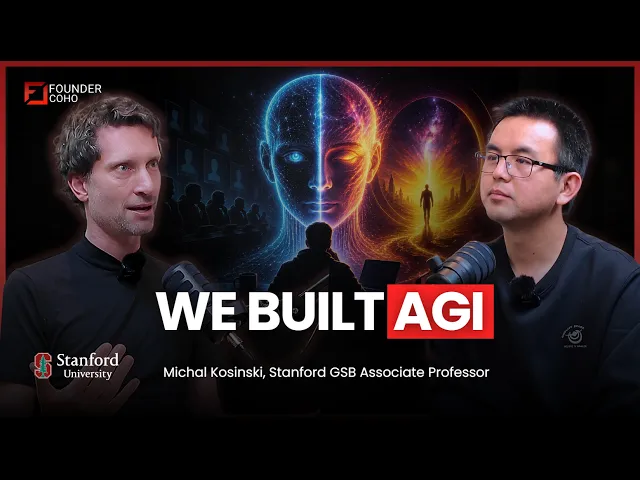
Professor Kosinski explores why next-word prediction gives rise to reasoning, perspective-taking, and Theory of Mind, what recent LLM breakthroughs reveal about machine cognition, and why understanding AI increasingly requires the tools of psychology

|
Stanford Professor | Frontier AI Evaluation, AI and Human Psychology, Psychometrics I Public Speaker
Professor Michal Kosinski, Associate Professor of Organizational Behavior at Stanford Graduate School of Business and one of the world's leading computational psychologists. Among the top 1% of most-cited scholars globally, his research spans psychology, data science, and AI—from predicting human behavior through digital footprints to pioneering work on Theory of Mind in Large Language Models, helping redefine how we evaluate machine intelligence.
Can AI truly understand what humans think, feel, and believe? Professor Kosinski explores why next-word prediction gives rise to reasoning, perspective-taking, and Theory of Mind, what recent LLM breakthroughs reveal about machine cognition, and why understanding AI increasingly requires the tools of psychology—not just computer science. He also discusses the implications for AGI, human communication, and the future of society.
References
Prof. Michal Kosinski's Linkedin – https://www.linkedin.com/in/kosinskimichal/
Prof. Michal Kosinski's Website - https://www.michalkosinski.com/
Jing Conan Wang (Host) – https://www.linkedin.com/in/jingconan/
FounderCoHo – https://www.linkedin.com/company/foundercoho
Timestamp
00:00 Highlights and Intro
02:31 Theory of Mind & What Makes Humans Unique
04:50 The Turing Test and Why AI Already Passed It
10:28 Why Large Language Models Are More Than Language
18:56 Multimodal AI and the Future of AI Capabilities
24:20 Has AGI Already Arrived?
27:55 Open Source AI, Regulation & Global Competition
31:54 AI Risks, Safety & Existential Threats
39:55 How AI Will Transform Science and Society
46:27 Closing/outro
Full Transcript
Computers are more convincingly humans than humans are.
The very survival of our species depends on whether we manage to regulate this technology.
Michal Kosinski is a Stanford GSB professor whose research bridges human and artificial cognition. He regularly advises government agencies and leading companies on AI's ethical and practical implications.
His research put large language models to the test on theory of mind, the human ability to infer what others are thinking, making him one of the first to seriously ask whether reasoning and even consciousness might be emerging inside these machines. People have this really remarkable ability to accept a new technology or a new discovery. Something that just a few years before would be alike to magic, believed completely impossible, and then just look at it and just say, aha, and move on.
It's kind of easy to forget how the things we take for granted today were seen as borderline impossible just a few years back. Which raises the question nobody wants to answer.
It's actually not in the interest of those very powerful big tech companies to admit that what we're dealing with is AGI. We know that new models are too dangerous to release.
I'm a scientist. I'm surrounded by scientists. I'm not convinced that there's many better scientists than Claude Opus 4.8. I'm already doubting whether you have better human scientists than that.
Because intelligence doesn't come with a direction. We need to be very mindful about how we're going to develop and foster in what kind of capabilities we should develop, what we should slow down so that we don't become like a bootloader of AI and put our own species into extinction.
What is your take in which area we should pay more attention to, be more mindful, which area we should double down and spend more energy and resource on?
I'm Jing. As a founder myself, I learned something about this journey. The best way to build a startup is not to read a manual, but to learn from your fellow founder stories. That is the reason why we compile those unfiltered raw founder stories and share with you in this channel. Before we dive in, I have a small favor to ask from you. If you find value in conversations in this channel, please hit subscribe button and turn on
notifications. It helps us keep the mission going. And this will be the only favor I will ever ask of you.
Really great to have you come back to continue our conversation. So last time we had a wonderful conversation about privacy, and the episode actually went two weeks back and it was very well received. And last time we ran out of time, so we didn't get to chat another very important topic. I know you're very, very passionate about it, the AI. So we'd love to help you with your take on that. I know that you have done a lot of great works in AI, including some work on theory of mind and how it applies to LLMs. Can you walk us through a little bit about what is the theory of mind?
Theory of mind is a lay belief that we all have, and actually we humans all have, and we have it instinctively, meaning we don't even have to try to have it. And this belief is that others also have minds. And now, on the surface, it may sound like it's just something very basic and simple. But in fact, we seem to be unique in the animal kingdom to be able to automatically, instinctively and instantly kind of assume and predict what other brains are thinking. So essentially it seems that our brains are not only thinking for ourselves, but we also continuously and automatically see the world or try to see the world as much as possible through other people's eyes. And you can see how it's extremely useful for survival. And successful functioning in the social environment, essentially being able not only to see the world through your own perspective, but also take the perspective of others.
On the one hand it's very interesting that we're only the species that has kind of the mind, or conscious. But maybe we're not. Maybe we have another species soon. Related to some of the AI topics like that, I know there was also a lot of discussion over the past few decades about that. There's also Turing tests. Everyone was talking about a couple of years ago, about passing the Turing test. Regarding that, what do you think is the difference between theory of mind tasks and Turing tests?
I'm actually not sure if there's a direct connection. So Turing test is a test proposed by Alan Turing. And he argued that we can really talk about intelligence, or I think he even said consciousness in the machines, if there comes a moment when a human is not able to distinguish whether they are talking with another human or with a machine. Now it seemed to Turing, if I remember correctly, that consciousness essentially is so key to how we are and how we behave and especially how we express ourselves in language, that the only way to essentially achieve that, to fool another human and convince them they're talking with a human, when they're in reality talking with a machine, is when this machine will be truly intelligent and maybe even conscious.
And many skeptics, people who essentially thought, well, there's nothing to see here, you know, those are just stochastic parrots, that's just this technology is just simply, you know, repeating or recreating things from the training data. There's just nothing really interesting here. They were for the longest time saying, look, Turing test is not being passed by the machines. Now it has changed a few years ago, and it has changed so rapidly, people didn't even notice. We had this huge test for like fifty years or sixty years or seventy years that the machines couldn't pass. And suddenly not only they passed it, but they outcompeted us at this test, meaning that currently a human judge, when they are asked whether they're talking with a computer or a human, they're more likely to say they're talking with a human than when they are talking with a computer. So computers are more convincingly human than humans are.
You mentioned actually a great point. So Turing test was such a big thing in the whole field for many decades until like three years back. And now right now it feels like our daily topic, it's so easy so everyone can pass the Turing test. What do you think has happened?
Well, people have this really remarkable ability to accept a new technology or a new discovery, something that just a few years before would be alike to magic and believed completely impossible, and then just look at it and just say, aha, and move on without really spending much time pondering on it. You know, our cell phones are like this. Those are supercomputers in our pockets that allow you to connect with anybody on the entire planet instantly. If you were told that technology like this would exist in early 90s or late 80s, and that it would contain this supercomputer inside, you would say, come on, it's science fiction, it's never going to happen. And then we have it, and we kind of accept it as just being there.
The same applies to large language models and other AI models. People believe something is impossible and then it comes and we immediately accept it and stop even being surprised by it. And by the way, maybe that's just a condition to operate successfully and efficiently in the society. Well, if it works, let's stop being mind-blown by it. But it's kind of easy to forget how the things we take for granted today were seen as borderline impossible just a few years back.
And I think it's important, you know, Jing, it's important to extrapolate from this. Meaning, what we think now that a bunch of things are absolutely impossible and completely ridiculous. Take, you know, machine consciousness. And let's just learn from history. These things that we are surrounded by today would be seen as preposterous, impossible just a few years back. Now, there's this, I believe, a very simple generative process that people seem to be missing. Namely, and it's even in the name of large language models, right? We call them large language models as if those things were modeling language only. And they're not. Humans use language to convey products of very complex processes. We convey our knowledge, we convey the descriptions of the real world around us.
We convey the products of our reasoning, of our empathy, of our emotions, of our consciousness. If you believe that consciousness really defines in some way who we are and how we behave, if you think that conscious beings, essentially when they express themselves, that the consciousness gets expressed in how we talk about stuff. Now, if you train a machine to predict the next word in a sentence of a person that reasons, now, in order to be good at this task, in order to be good at predicting the next word in a sentence of a reasoning person, the machine needs to start modeling reasoning as well. It needs to start modeling empathy, emotion, consciousness, maybe. Why not? And it sounds preposterous, and people kind of disagree about this and get really upset. You can lose your job if you start claiming that a machine may be conscious. And yet, I don't really see why people see it as impossible.
Yeah, exactly. I think that like you mentioned, a lot of things that we used to think are magical, after we have it, it becomes part of our life. I want to also hear your takes about what happens to this large language model technology, like you mentioned, is very, very powerful and it becomes part of our everyday life already. So what are exactly the things that make large language models so special that can allow us to pass Turing tests so easily? What is your take on this?
Well, as the model is becoming increasingly complex, it's just becoming increasingly good at predicting the next word in a sentence that a human would have generated. And by the way, this is just the beginning, because those models are not only taught to repeat after humans, but also, as I mentioned before, they need to start developing processes that mimic human reasoning, that mimic human emotion, mimic human consciousness, mimic human empathy, and all sorts of other processes, right? But it's not the end, right? So people say, okay, no, those models now are kind of speaking like a human would. But those models have huge advantages over us. One advantage is they don't really get tired that easily. The other advantage is they can have millions of conversations simultaneously and read an amount of training text that is just absolutely unimaginable to a human. So even if we argued, and I'm by the way not sure if this is a still valid argument, even if we argue that biological brains, such as the ones that humans have, are just better at learning. You know, we learn from fewer examples. You don't need to read a trillion books or two social media posts to be able to function, right? We come pre-equipped with instincts, our brains are not randomly wired. We are born with brains that are predisposing us to be social creatures that build and use tools and so on. Whereas those models they start as a random, more or less, neural network. So it could be that we learn more quickly, but those models are tireless.
They can read through much more stuff much more quickly. And then they have those advantages that are kind of unimaginable to humans. It's just hard to imagine. So let me give you an example. When we read text, or when we listen to a story, we listen to a story kind of word by word, sentence by sentence, or read the story word by word, or sentence by sentence. Actually, kids read like letter by letter and then they compose words out of it. Then better readers read word by word and then create sentences out of it. Now, very good readers actually see the sentence, like intake a sentence as a kind of one unit of information. They read sentence by sentence, especially with shorter sentences. Now, models go further than that. They can look simultaneously at one million, ten million, and this is just the beginning, tokens at the same time. They read a book not in a linear fashion like we, you know, line by line, sentence by sentence. They read the book all at once at the same time. And this enables them to see things, to perceive things in ways that are absolutely unimaginable to humans. Now, let me give you, because in humans there could be a parallel that we will kind of intuitively get, which is vision.
Vision is a much older sense for humans, or ability of information intake capability, than text. So we evolved to be able to essentially look at the scene containing millions and millions of data points and ingest it all at once. So you can look at the lawn in front of you or a forest in front of you and you can spot a little moving thing just somewhere in a corner with a corner of your eye. You can essentially have this ability to ingest the scene all at once. Now, this is how models perceive very long text, text that can go up to 10 million tokens or words at the same time.
You actually mentioned such a great point, which is that a lot of people talk about large language models as if it's only about language. But there was actually much more fundamental paradigms happening here. And in the beginning of this conversation you mentioned about the large language model is used to predict the next word, token by token. That's a very, very simple task but that is more like a proxy task for machines to learn like big patterns, kind of reasoning, consciousness, even some capability humans are not able to do, like for example reading ten thousand books in parallel.
This is not an easy task, predicting the next word in a sentence. It may seem like an easy task, but this sentence may have been generated by a genius, you know, a physicist that is a genius as well. Now, to predict the next word in their sentence, you need to somehow model a bit of this genius. Especially if you have not seen this sentence before. If you have seen this sentence before, you can just kind of repeat from your memory. But if you have not seen this sentence before, and we can now prove that models are, for example, generating mathematical proofs, generating logical explanation of events that we humans have never been able to explain before. Now, once again, if you want to predict the next word in a person that is reasoning, you better develop an ability to reason yourself. This will make this task much easier. And now, once you have the ability to reason, you can now extrapolate it to problems and tasks that you have never seen in your training data. And now, unlike humans, those models can learn simultaneously from millions of conversations and by reading millions of books. And then people point to another difference. They say, well, humans can touch something. They can hear it, they can see it, hence they perceive the reality in a somewhat richer way than models can. And look, this is true at some level, but by the way, it might be that seeing the tree and understanding the tree are not the same thing. It could be that reading a lot about many different trees gives you a better understanding of what a tree is than seeing it, that creates illusions and maybe motivates you to kind of superficially process the object that is called a tree.
And also, there's another place where this reasoning breaks, of kind of alleged superiority of humans because we can touch things or see things. So, first of all, increasingly those models are also trained with visual data. And they can control robotic arms, so they can also touch things through touch-like sensors. But even putting this aside, your brain has never seen anything directly, has never touched anything directly. Your brain is sitting in a black box and receiving chemical and electrical signals from other sensors. And in this way, your brain is very similar to a large language model that is also sitting in a black box and it's a black box itself and doesn't really perceive the world directly but receives information about the world through numbers in its case, right? And what's actually very important, it doesn't really see the words. It just sees numbers, numbers that represent the words.
As you mentioned earlier, people started to put more of visual information so that they can understand more robotic tasks and actually do the physical kind of tasks on that. What is your take of this trend? Like it's starting with solving some visual tasks like ImageNet and then we started to solve next word prediction and now we come to do more visual tasks again.
Well, my understanding is that visual problems seemed easier to people in the machine learning community simply because you have some matrix, of actually three matrices of red, green, blue colors, and they are whatever thousand by thousand pixels large, and each matrix contains some value for a given color. So that sounded like a more tractable problem than words, where words seem to be more difficult on the surface of it, represented than colors. And they interact, it seemed, to people in a more complex way than colors can and so on. So that's why the initial research was mostly focused on images.
Now it turns out that words can be represented very much like pixels by vectors of numbers. And we have those multidimensional embedding spaces now where each word essentially is converted into a vector of numbers, which numbers represent the meaning of this word, and then we can compose sentences, you can essentially represent the entire text, like a paragraph of text, essentially as a matrix where each row or column, depending on how you want to represent it, is essentially a vector describing one word. And it turns out that those problems seem to be very, very well processed by transformer-like models. And by the way, folks, let's not forget that if we're impressed by how AI is dealing with language at the moment, let's not forget this is just the beginning. These are baby models, these are prototypes. They are powerful and we're all using them, and they code better than humans and they write novels in a fraction of a second, and they can solve problems we cannot solve. But this is 2018 when GPT-1 got published. It's not even 10 years.
The progress here is exponential. The new models are two times better, typically two to three times better than previous models. It's just increasingly also difficult to see, and this is because new GPT-5.6 is not a better language user on the surface than GPT-4, even. It is, but not that much. This is because GPT-4 already was a great language model, that the kind of basic use of language was already amazing. But now what happens is all of those even more important and even more impressive abilities that are in the background. Now, a person generating language is not just putting words together so they grammatically sound and kind of that they match in terms of meaning. But they also reason and they empathize and they recall knowledge and they are strategic in how to communicate with person A versus person B. So there are all of those skills that underlie language that now models are gaining essentially a lot of function there. They're improving dramatically. But if you just want to ask it to help you make pasta or advise you on how to write a better email to your boss or whatnot, there, even GPT-4 is already close to maximum quality. So most people don't even see how much improvement there is.
And by the way, we know it from the human world as well. Look, I know very little about physics. So for me, both the Nobel Prize winner in physics and the person who just finished a PhD in physics, they're both kind of God level. I cannot really distinguish between them easily in a conversation, only the awards can prove to me that one of them is any better. And we kind of spectate in this moment with large language models, where the tasks that humans intuitively can judge the models on, you know, how well they write an email, they are so past this stage that an average person cannot really tell how good they are. The creators of those models are constantly surprised by those emergent capabilities that appeared in those models, despite the fact that nobody has ever engineered those capabilities directly into the models. And this is because, folks, a very simple training function, predict the next word in a sentence. So that's a simple function, but it's an extremely complex task, can lead to emergence of unexpected novel capabilities. Some of them mirror capabilities of humans. But interestingly, some of those capabilities may be beyond human understanding or human comprehension.
Related to that, there's a lot of discussions about whether large language models is the paradigm that can lead to AGI that can solve every software intelligence.
It's mind-blowing to me that people don't really see GPT-4 as AGI. I actually had a chance to talk with Shane Legg, who is the person that came up with the term AGI. And at DeepMind, he's now running a team thinking about the post-AGI world. And you ask him, and you say, well, maybe AGI will come in a year or two or three. But then I asked him, look, go back in time to the time when you came up with the term AGI. Would GPT-4 meet your threshold of AGI? And he's like, yeah, totally, totally. But now that we cross this threshold, it's like with the Turing test and like with the mobile phone. We are facing a magical technology, technology that would seem magical and supernatural to people just a few years earlier.
And we say, no, it's just totally normal. And it's probably not AGI, because if it was AGI, then we would have to cope with consequences. Look, Jing, it's actually not in the interests of those very powerful big tech companies to admit that what we're dealing with is AGI. Because it opens up very difficult questions about the future of humankind, about our safety. So they're very careful not to claim it's AGI, because it's kind of a discussion they don't really want to have. And then also, by the way, it's kind of a useless discussion because we know that new models are too dangerous to release. Trump administration stopped Anthropic and now OpenAI from releasing their newest models. And well, going back to the original question, if you don't think that GPT-4 is AGI, then please define AGI for me. And I'm not challenging you because maybe you actually agree, but I'm challenging the listeners to define AGI in a way that GPT-4 or 5 is not kind of past the threshold.
I think the AGI's definition has changed a lot. But like original definition for AGI, we already crossed the milestone. Like Turing test. I think for Turing tests we passed that, we don't want to talk about it. For AGI we're past it, now we're redefining it.
Yeah, and we just say, well, let's define AGI as something that models will do in the future, but we don't even know exactly what it is, but clearly not today.
One follow-up question related to that, because you mentioned about they are starting to have more and more awareness of the danger of AI. For example, the recent models of Anthropic and GPT and they no longer released directly to the public. Now it's like internal preview first. And the trend actually also started much earlier, starting even from GPT-3. In early days, all the models, including the weights and training methods, they're all publicly available. Anyone can replicate and use it. From GPT-3, the model has become kind of less publicly available, in citations of the danger of the models. What do you think of the trend here? It's like in the future are we gonna not be able to see or use the latest version of the model? What do you think will happen?
Well, we've seen this before. It turns out, take Linux, for example. It turns out that long term open source technology has an edge over closed source technology. And actually has edge both in terms of safety, but also in terms of development, how advanced it becomes. And I think it relates not only to open weights, a lot of Chinese models, for example, are open. So not only their adoption increases, and as their adoption increases, people start debugging and suggesting improvements. But there's also another process that will start happening, which is some models promise that if you use them, then your data will not be used in retraining and improving the next version of the model. And then increasingly we'll see publishers that say, well, we can give you access to our GPU at a low price or to our model, be it closed weights model, but your data is going to be used after some anonymization in retraining of the model. And now, guess which of the models will start progressing faster. Now, a lot of my work focuses on protection of privacy. So by the way, I'm not saying it is something necessarily good or positive, but it seems logical to me that those models that will have access to more training data, those models developing the new versions will gain function more quickly.
What do you think of the timeline here? When will that happen?
Well, it's hard to say, actually, because there's a lot of politics as well involved. As you can see, the governments are stepping in and they are slowing down releases of models. Now, some of the models and releases you can control, like the US government can control Anthropic or OpenAI, which by the way will give an edge to models that are not under control of American government. And now, by the way, I'm not making an argument that the control should go away. I think this is an extremely dangerous technology that, if anything, we should probably try to control more than we control at the moment. But control is a kind of a complex issue with a lot of trade-offs. Example is Europe. Europe, where I come from, is arguably better at policy making to control technology. And the result of that was that the development of the technology has nearly entirely moved away from Europe. And now Europeans have a great privacy regulation and AI act and so on. And yet the development of those new technologies has just moved to other places. And it might be that now, as the American government is stepping down to control new AI technology, which by the way is probably the right thing to do, but what will happen is the development of this technology, companies that develop this technology, money that is invested in development of this technology, talent that wants to perhaps irresponsibly build an even more powerful model, this would just all move somewhere away from Uncle Sam and what Uncle Sam can do. So by the way, I think that essentially global agreement and global regulation and probably control over processing units that can be used in training new models, that's probably, and I'm saying it very cautiously because I know also the downsides of regulation, but that's probably what we should be looking at.
I think there was a trade-off between regulations or free development of the technology. I think it's not unique to AI and all previous generations of technology had been through this. Initially it was more bottom up and then there's very little role of regulation of government, but over time the government will step in and have more and more say to the technology. And take a step back. I know that this is very, very powerful technology. And as a human society, when we have this new technology, we need to be very mindful about how we're gonna develop and foster what kind of technology, what kind of capability we should develop, what we should slow down, so that we don't become like a bootloader of AI and put our own species into extinction. So what is your take about the regulations or development of AI, like in which area we should pay more attention to, be more mindful, which area we should double down and spend more energy and resource on?
Well, I think that's just an extremely complex subject that we should be talking more about because I agree with you that likely the survival, the very survival of our species, depends on whether we manage to regulate this technology. Now, there are other very dangerous technologies, like nuclear weapons. It's just that until today, the development of nuclear weapons is a process that only nation states can embark on. And those are the organizations that you can exert some level of pressure on, though, as the example of North Korea shows, the control is not perfect as well. Now the problem with AI is that it's increasingly easy to develop. Now, let's not forget that we're training those models on GPUs which were not designed for large language models. They were designed for very different tasks. Now, people estimate that new generation of processors that we just started developing very recently with LLMs in mind, those processors can speed up the development of the models or reduce the price by the factor of 10 or 100,000, meaning that a model that costs you know 400 million dollars to develop today in terms of electricity, the biggest models, probably that's an exaggeration, probably one hundred million dollars, divided by one hundred thousand, and the cost becomes trivial. And you can do it in your basement, essentially. So that's the first point. The accessibility of this technology is becoming increasingly easy.
And also, let's not forget that sometimes we do not really need super intelligence to harm us very badly, right? Superintelligence is powerful and dangerous. But low intelligence that spreads really quickly and it's very stubborn and it's good at some simple task that is really annoying to us is also very dangerous. You know, viruses are not very intelligent. There's not much information content in the RNA or DNA of the virus compared with the complexity of Homo sapiens. And yet those little buggers can be really, really good at making our lives shorter or miserable. Imagine a virus equivalent, computer virus equivalent. Not a Python code or whatever code that spreads from a computer to another computer, but imagine an AI evolving, a little AI virus that also kind of messes with our computers in more creative ways than just kind of switching them off. By the way, even in biology, a virus that kills you quickly is not a good virus. It will stop spreading really quickly because it kills its hosts. A best virus is the virus that kind of remains undetected and lives with you for the longest time as it keeps spreading.
But that's not the only danger. This technology is becoming more easily available. Intelligence is extremely dangerous, as humans prove. We are a very dangerous species to ourselves and other species. But then these models are also so useful that it becomes virtually unthinkable that we would be now willing to give them up because they bring so many benefits. They will help us cure cancer and our lives will be more meaningful and easier, and companies will make more money and we'll have to do less work and so on, and we'll have better entertainment and better teachers and better medicine. There's so much advantage coming from those models, it's just difficult to imagine giving them up. But let's not forget that a model that can come up with a cure for cancer can come up with a virus or a biological weapon. There are two sides to intelligence.
But that's not the end of it. Even if those models never do anything hostile towards us, that would be, by the way, crazy because intelligence just sometimes turns against other intelligent forms of life. But if nobody uses it against us, because even if AI doesn't turn hostile on its own, doesn't do something misaligned and vicious and damaging to us, then somebody may try to use AI in this way. But even if you put this aside, okay, nobody ever uses AI to harm other humans. And the AI itself does nothing ever to harm other humans. This is already unthinkable. If this technology is so good, we will start, and we do already rely on it more and more with a broader range of things that we humans want to achieve and what we humans need for survival. Our communication networks will be increasingly run by it, our software will be written by it, our farming machines will be run by it, our teaching and education and medicine will be done by those wonderful machines. The problem is that those machines are also fairly delicate. To deprive humans of the technology of electricity or fire or producing metals, that would have to be a kind of a civilization-ending calamity to really take away this technology. And surely some people would survive that could recreate parts of it. We went through this in our human history before. But a computer virus, a radiation storm on the sun could fry CPUs, GPUs, and deprive us of this technology that we'll be increasingly relying on, and would take us decades to get back to where we were, especially that we won't have those AI helpers anymore with us. And this is just kind of the most benign problems. Now think about AI driven drones and AI driven weapons, other weapons that we are increasingly surrounded by.
Related to that, I am actually thinking about one thing you mentioned earlier, like this new technology has made a lot of things which were unthinkable before, thinkable. And there's a lot of great examples. We have seen it can write beautiful articles, it can read tens of thousands of books in parallel. And most of the students now use it for doing exercise now. What are the most exciting applicational things that you think AI will unlock for us in the next like few years?
Well, one is that it will replace scientists. By the way, we have been training scientists for quite some time to put aside their judgment, which is imperfect, and replace it with statistical methods, which is just much better and much more objective. Define the question and then use algorithms to try to collect data and use algorithms to try to answer this question. And even when you're collecting the data, follow an algorithm of the proper method of collecting data to essentially minimize your human biases and corruptibility and your willingness to bend the rules just to get a good result that will get you published. Now, LLMs are kind of direct extension of what we have been doing in science, meaning they are much better at following protocols. They are much less tiresome. They don't have an ego. So if they make a mistake, they will easily accept that they made a mistake if another LLM tells them they made a mistake. They can work tirelessly. They can use statistical methods. They can write software to answer questions. They are great at doing research. They can read enormous amounts of stuff very quickly. And they kind of know quite a lot about everything, just even based on the training, because they read so much in the training. Meaning they are essentially a better version of a human scientist, right?
And at the beginning, human scientists may still want to say, well, we would like to know more about how to treat cancer or do XYZ, and then spin off hundreds of thousands, possibly, of virtual scientists. And by the way, there's another interesting point here. Even if you don't believe that an artificial scientist is going to be better than a human one, and I'm a scientist, I'm surrounded by scientists, I'm not convinced that there's many better scientists than Claude Opus 4.8, right? I'm already doubting whether you have better human scientists than that. But there's also quality in quantity. If you spin off 100,000 scientists to try to attack a question, to try to run a study, even if many of them produce bad work that will be discounted in some review process, automated review process, just kind of sometimes by sheer luck, as with human scientists, those models stumble upon some solution or some approach or some way of handling the problem, then another 99,000 models have not thought of. So there's also in science and in many other disciplines, there's also a benefit of just trying repetitively many, many, many times. So there's also some quality in quantity.
So automated science is one of the implications. But another interesting implication is, Jing, that I think that language largely is going to be replaced by language models. Meaning we'll still use language to have a chat, to communicate with, to groom each other essentially, to say how much we like each other, to gossip, to ask for news about family and friends. But when it comes to conveying information that matters for our occupational life or for the survival of our species, or when it comes to educating ourselves, teaching each other how to use a machine or how to function in a particular environment, here large language models would take over as language. Meaning, if I want to write an email to you, even today, I would write five bullet points, or dictate five bullet points to my robot, and then the robot would translate them into a beautiful long English essay. Now, hopefully, you are not going to be reading this essay because Gmail, by the way, will just summarize it for you in five bullet points. But now, as those models get better, my bullet points and your bullet points will go further apart. Because your bullet points may be in a different language. But also your bullet points may start referring to some experiences that you had that I don't have, but the models know about them. The model, for example, can say, hey, Michal is just trying to convey this thing that you very well know and you already discussed it with your partner yesterday. Right? I have no idea what you discussed with your partner yesterday, but the model and you would know.
So what's happening here is that my bullet points start drifting away from your bullet points. And then the models will use some acronyms that only you and the model understand. And maybe we'll start using some dialects that only you and the model can relate to. So what will happen, and by the way, that's great because the information we pass way more effectively. We can skip a lot of fluff and we can add context when it's missing. But it also increasingly means that I will not be able to even verify how my bullet points are translated into your bullet points. I will have to trust this black box of the language model that it's conveying the information I want it to convey. Because it'll be just so good at it. It would make no sense. And then we'll lose practice. We'll essentially lose the ability because we'll not be practicing to write those essays and to read those essays. This will become the model translating from my bullet points into your bullet points. And there's one other kind of killer feature there that I think will make sure that this is happening, even if we don't want it and even if we shouldn't do it. Which is, currently information spreads through social network in a kind of meshy way. It hops from one person to another person. And in this context, it's very often lost in translation. It disappears, it gets mistranslated. But here, if we all talk through the central model, if we, Jing, have a conversation about something, translated by the model, then the model knows. So whoever ever needs this piece of information will get it immediately. So the information can spread through humanity at super speed.
Really great to chat with you. It's fun to have this continued conversation with AI. There's a lot of breakthroughs happening and we would love to have more conversation here, your take, when we see the outcomes of those developments.
Thank you so much for having me, Jing.
Thank you. Thank you very much. Have a great one. Thank you.
Thank you.
Thanks for watching the full interview. Don't forget to subscribe to our YouTube Channel and turn on notifications so you never miss the next one.