Interviews
Mark explains why today’s web and AI landscape remains largely a “single-player experience,” and why the next major unlock is “productive serendipity”—agents navigating the digital world to create meaningful connections and opportunities.

|
Founder & Chairman of Zynga
Mark Pincus, founder of Zynga, pioneer of social gaming, and author of Life at the Speed of Play, is a visionary product builder who made one of the earliest investments in Facebook. His work has shaped digital social interaction—from early networks like Tribe.net to engagement metrics like Zynga’s Active Social Network (ASN). His product philosophy, centered on “productive serendipity” and the “Proven Better New” framework, offers a powerful lens for understanding consumer behavior.
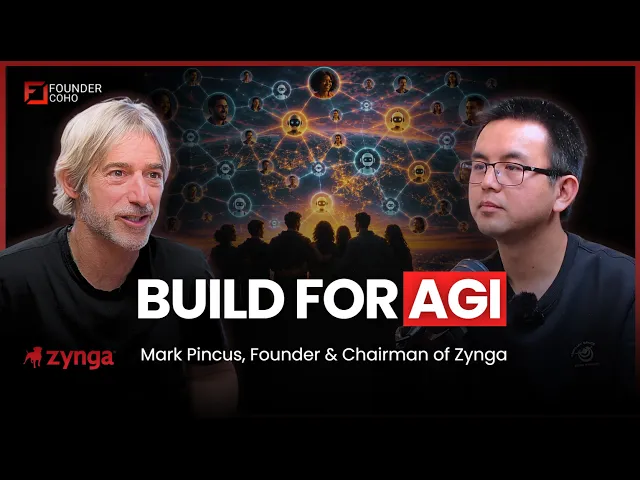
In this conversation, Mark explains why today’s web and AI landscape remains largely a “single-player experience,” and why the next major unlock is “productive serendipity”—agents navigating the digital world to create meaningful connections and opportunities. Drawing on years of product building and experimentation at Zynga, Mark explains why short-term metrics can be misleading and why lasting product success comes from building long-term user equity. He also explores “killing hope” in product development and what it will take to build consumer AI that genuinely improves human relationships.
References
Mark's Linkedin – https://www.linkedin.com/in/markpincus/
Mark's X - https://x.com/markpinc
Life At the Speed of Play - https://www.lifeatthespeedofplay.com/
Jing Conan Wang (Host) – https://www.linkedin.com/in/jingconan/
FounderCoHo – https://www.linkedin.com/company/foundercoho
Timestamps
00:00 - Highlight and Introduction
03:00 - Finding the "Instinct Vein" & The Cocktail Party Metaphor
07:50 - Why the Web Remains Single-Player and Text-Based
13:27 - Agentic Productivity & The Dynamic Social Membrane
16:00 - Designing for Productive Serendipity
18:15 - Presence with Context: From AOL to Social Gaming
21:01 - How Shared Experiences Level Up Real-World Friendships
22:16 - Active Social Network (ASN): Zynga's 80% Retention Metric
25:04 - The $280B Social Gaming Opportunity & Latent Demand
29:23 - Counterintuitive Retention: Energy Mechanics & Session Caps
33:58 - The Focus Group of One & Finding Product Adrenaline
38:40 - Life at the Speed of Play: A New Mindset
40:59 - Proven Better New: How to De-Risk Innovation
49:55 - How to Measure and Feel True Product Heat
01:01:02 - Building Internet Treasures for the Smartphone Home Screen
01:02:28 - Trusting Founder Conviction Across 18-Month Horizons
01:05:39 - Navigating Consumer AI Uncertainty & Twitchy Testing
01:23:15 - The Consumer Market Generational Opening & Distribution
Full Transcript
Welcome to FounderCoho Podcast. I'm your host, Jing Conan Wang. Today we're joined by Mark Pincus, founder of Zynga, pioneers of social gaming, and author of the new book, Life and Speed of Play. Mark, welcome to the show.
Thank you. And I love that you have a whiteboard behind you. So you're that's a sign to me of a product maker.
yes, yes. I used to draw so many ideas on the back. I later was actually also putting a lot of memories of my family photos together with my product ideas.
Certain boards, you know, you really like get to something like vision or a certain use case or something. And then I like to leave that on the board, you know, so it's kind of it has some persistence. That's why I think, you know, having boards three deep, you know, having more like 12 boards or 15 boards, like I like to say then you want the boards to start talking to each other.
Exactly. I like the way you say that boards started talking to each other. And I also like it mentioned about persistence because I actually experienced the same way. I was a AI researcher background. I never did product. In fact, when I started my founder journey four years ago, I have zero knowledge of product building. I was like, product what is that? and then I started to go and started building a product myself, but then realized that
Product is such a deep repo of knowledge. It's like a almost like a philosophy. And it's very different than a lot of times about engineering. And a key thing here is like you mentioned, is actually persist your ideas. I'm curious, how you get a product, Ideas.
I mean, it's such a good question, like where I guess when I think about my best product ideas, it's more like it's there's some some broader instinct that's haunted me for years. And it just
Like I and I call them like instinct veins. And I'm always kinda like looking for that. Like, is the world ready for that? Is there a product I can get to out of that? And so like a big one for me, I say is the cocktail party. It's like we all are looking for the cocktail party. And we kind of had it on Facebook and then we had it on Instagram. And in a way we had it on Napster and in a way now it's like there is a part of a cocktail party, like everyone's hanging out on GPT or Claude, but it's a single player experience. And so it's not really a cocktail, the cocktail party is more outside of that experience. You’re all hang out on that, you're sharing it, talking about it. so you know, for me it's like that's like a big instinct vein. but it's like
I'm looking for that, I'm looking for the chessboard to be looking for the right position on the chessboard like for instance, right now, I think it's becoming more and more obvious that there's going to be a new form of
social networking that is in partnership with our agents, right? That we're going to have agents and they're going to be out doing things on our behalf. And at some point, I think someone's gonna figure out how to have the agents surfacing leads for us and giving us more kind of productivity around that.
But it's not clear yet how, you know, and so it's the chessboard's not exactly right. And some someone's, I'm sure a lot of people are working on it. Someone's gonna figure out at least a piece of that, and then we're all gonna say, aha. So that's how that's how I think about it. It's like it's like the world's always kind of in an imperfect state. And do we have a vision of what perfect could be? And like but then if we do, it's like, but
It's not clear how to get to that better state.
I think the product building journey, like you mentioned, is a very fuzzy journey. You don't exactly know where the destination is. You probably get some ideas and explore it and tweak it. Have fun in the journey. A lot of the work you do is about the social, it's about bringing people together, having fun, cocktail party.
And then you also mentioned about right now a lot of the experience we have on AI is a single player game. You just literally open the web or client, whatever it is, just like type and you just like silently spend hours.
that is still the web experience, right? We're 30 years into this and it hasn't changed, right? you're still by yourself quietly. Maybe you've moved from quietly being on Google to quietly being on GPT, but it is this very cerebral, single player, quiet, research-like, text-based experience. And I don't think I would have believed 20 years ago that we'd still be in looking at a browser that hasn't changed really. I mean I thought it'd be a lot rowdier, you know?
We have already have internet for thirty years, forty years already. Like the experience we have nowadays is kind of almost the same with like nineteen nineties. We open up browsers, a website, we type something and like typing and then we are like mostly not interacting with other real humans.
You have so much experience of building the products across so many decades. I'm curious your take on why why this happens to be like that?
Its hard to argue with consumer behavior because in our own ways, we act efficiently. And part of it is that we really appreciate how asynchronous it is. And we really appreciate that we get to use found moments now with our phone and
And we really hate being tied down to a calendar or a meeting. It's stifling. It's like there's something oppressive. It's like, okay, I gotta be on this thing at this time. And and it kind of interrupts our flow state. But I don't know, but if but at the same time, we appreciate social serendipity. Like if I could just kind of run into you at some kind of online cooler.
And we could have an interesting conversation. That I've always kind of got a found moment for that. But I don't, but if it's like, Mark, do you want to meet online at this time? I'm like, no, no, I I've got kids and work and I'm juggling and it never fits in. So I I can't really say, I mean, the reason that my first game, I social game I did was poker was I said, I wanna have this always online bar.
Where if your friend is there, we will just drop you in at a table together and have this live serendipity, and people love that. but it wasn't as popular as like words with friends, where you take your turn and then I'm on a plane an hour later and I take my turn. And you know, that's there is this it's funny, as much as we had multiplayer in our games.
The highest engagement was people acting as single player. And so I think the web is similar that we like our single player, we like our time. But I guess, you know, and there was a brief moment during the pandemic that Clubhouse was a thing, right? And we're like, okay, that's a different internet experience. That's live and it's it is rowdier and louder, and we wanted that in that moment, but then it went away.
So we kind of have to watch what people are doing, where their behavior is going, and not ignore that. But at the same time, we need to kind of be looking for these other clues and these other moments and testing them and saying, maybe this is it, you know. you know, I mean there's Roblox where at least kids want to be in the same place.
We could do this whole pod on, you know, when and how are we gonna get to multiplayer and all of this stuff. But it also is surprising that we're still text-based when voice is getting this good. I mean, I think Reed wrote a whole post I think called Voice Pilled, like two years ago. And there was a moment, you remember like 18 months ago that we all said, the whole thing's gonna be voice.
And it wasn't. We're still doing this. I mean, we're still, you know, in a web browser typing. You know, we like our we like our typing. I mean, I use voice as a better data entry, but then I still read the output. I don't prefer, you know, the voice AI.
Yeah, there's something there is something about asymmetry or sorry, asynchronous. There's also asymmetry, but asynchronous that no one talks about, but that might be the killer app behind all this, it might be just the that we really like asynchronous because, and we want to multitask, right? Like I'm laying in bed, I my kids, I put my littles to bed, they're asleep, but I'm still in bed with them. I can quietly open my phone and do something, right? But it can't make noise, it can't be on a schedule.
And that is this kind of that is a lot of productivity. I mean, so you know, I think we gotta follow the thread of productivity. And I don't know that rowdy live synchronous enhances productivity. I do believe I I'm shocked that at this point nobody has cracked the code on agentic productivity. I mean, that one is surprising to me, right? Like, wouldn't you have thought by now, I had this concept that our avatar would be roaming the earth while we're not there, going to a hundred cocktail parties a night and coming back with good leads. And I don't see that. I don't know about you, but you know, and I think someone could even like kind of fake that. And if you heard about it, right? Like, remember like Moltbot and
I think there is something about this agentic networking that feels futuristic and cool. And I think someone even, I think Boltbot and some of these kind of faked it a little bit, and that was enough to get our interest. So, you know, I'm a little surprised on that one. But it's also gotta like do a better job of lead generation or it's a gimmick, right?
and there's something behind I call the social membrane, which no one has advanced either, which is can we take this intelligence and the understanding it has of us, the personalization, so that it can do a better job of dynamic social networking, of changing the membrane of trust and attention in any context, in any situation, and being right and saying, you know, I'm gonna share, I'm gonna take a risk and share a little bit more right now with Jing about what Mark's doing.
And get a little bit more back from Jing's agent than just this the kind of public persona, the character AI, you know, version of us is too static. And I think it kind of lost its allure. I think it for it to have adrenaline, I think it's got to it's gotta be juicy, you know, it's gotta share a little bit of it's gotta be a little edgy, like it's sharing Mark and Jing's locations with each other or something about our calendar or, you know, it's gotta get a little edgy, I think, and a little risky.
And then also I think there's a many other aspects of humanity that we care about. Like creativity, serendipity, connection. And so I don't think that AI should need us to a like a working machine or like we have a hundreds of agents that is working, but they need us approval. Second level need my computer.
Yes. yeah, then it's right. Then you're a systems manager and there's more systems. But then it's like, well what if what if it was a combination, a hybrid, and what if what the agents were doing was using your live time better? And what if they're scouring these other live conversations and they're coming back to you and they're like, Jing, there's a thing going on right now.
that I think you might be interested in. Like there's a live conference and they're talking about
These topics that I know you're trying to figure out, you know, this might it's like unscheduled, it's like surfacing more serendipity moments, you know, giving you productivity around your serendipity. So it's like, okay, I'm not gonna sit through these boring conferences, it's going to, and when it hits things, topics, and people that are fundamentally interesting, maybe it's asking for your attention.
productivity for your serendipity. It actually works so well because if we think about even when we join events on an offline connection, we often have a lot of serendipity. But number one bottleneck for that is tower time. We can only join one event, one particular time and an location. but the
the the AI or the or technology actually can create a world in which that we can be here and now and focus but our agent can go and do an exploration for us. It can live in a world that we never thought about. Bring those new insights and serendipity back to us, our real life. And this actually also is I feel is a course for games. Because the games essentially provide one thing that people can leave like
in fantasy world or new world that cannot be in a real world. And our life in the real world sometimes could be very limiting. We have our obligations, we have our commitment, we have to be joining this meeting, talking to this person at this particular time. What if I can do A B C and hundreds of things a time? Which was not possible, but now maybe there's a chance and a path to lead there.
I mean this gets back to ideas I've had for years. Ever like even going all the way back to AOL's Instant Messenger, and what I saw the possibility for on Facebook, which is like presence with a purpose or with context. And instead of it became stupid to just say Jing is online now, right? Mark is online, because we're always online.
So, okay, but you know, in 2000, in the late 90s, it was like, Jing's on AOL right now, so am I. Let's talk, right? But now that makes no sense. But if we went to the next level of context, if it told me Jing is in this poker game right now, and I could drop in with you, and I'm like, you know what? I got five minutes right now. I'm just gonna drop in and play a few hands.
And it becomes a form of networking, right? Because it's like, yeah, you know, I've wanted to meet Jing and I'm gonna like drop in on his poker game, and maybe I'll be annoying, maybe I won't be, but it's almost like again, it's this like productive serendipity, but and maybe you don't want that to happen, so you turn that off. You're like, hey, I don't wanna broadcast the world that I'm playing poker because I don't feel like having a bunch of people drop in with me.
Or maybe you're like, this poking, this game would be more fun if people I knew dropped in. So I'm kind of turning on the green light. And now a lot of people's agents are aware of your activity because you're okay with that and you're open to that serendipity. You know, there's so many more opportunities for.
Better social. And I don't see any innovation or at all. I mean, it's for whatever reason, I mean, consumer is difficult. You know, there's a small number of gigantic consumer companies. But I would have fun. I wish that I had a lab full of you know AI researchers like you and kind of people thinking about social just doing these experiments.
as I was doing my consumer product, I realized that building a consumer product is about conveying an experience through a product. I think the way you put in like productive serendipity is actually a such good summary of the feeling of I think a good consumer product. It's like they need to feel productive.
another way, another word we can use for productive that that Reid Hoffman has brought up with me so much is can and this was this was the core innovation focus of Zynga is can we improve a relationship in your life? Can we help you meet a new person? And Bing and I used to say, can we move you into a different bucket? You know, can we through this shared experience or the way you interacted in it, can we improve your friendship? Can we level up your friendship? You know, and we said the highest level is that that they would come pick you up at the airport or help you move, you know, to a new apartment.
And the lowest level is they would like your post, you know, or be willing to be your online friend, but not see you in person. And we're like, okay, how do we move you from an online-only friend to an in-person friend to a good friend? And not that we move you, but we give you enough of this shared life experience and enough dimensions that you could legitimately you know, improve your relationship. And that is kind of socially productive.
We had a metric at Zynga that we obsessed around that has never been used in the wild outside of Zynga. It's not even used at Zynga anymore today. It's at, and it was called ASN. And what we did was we measured your active social network. And what that meant was how many people did you have a social round trip with? Like I take a turn and you take a turn back.
I gift you, you gift me back. I share a part you need to advance in this game, and you share a part. And it turned out that if we got you from a zero ASN in a game to a one, there was an 80% chance we saw you in the next month. And if we got you to a four ASN, which either meant four round trips with the same person or round trips with four people, there was
An 80% chance that we saw you 22 out of the next 30 days, so in the next month. we had you, we had you hooked. And and that kind of gets to it because there's, you know, I like your post, you like mine, I comment, you comment back. There's this.
Camaraderie, this building of a relationship. and you can game it. And the Zynga PMs gamed it. And I'm not sure it's so bad to game it because whatever we do to convince you to bump into this person again and have a round-trip interaction, you know, you do start to build more, you know, social equity together.
I can see this is a actually such a effective brilliant idea. Why the industry doesn't adopt it now?
Zynga doesn't even use it today. And it's because the social has gotten very fragmented and very difficult. everybody was logged in in the same place and on the Facebook social graph. So it was very, very easy to track it. And now if you and I were like, okay, hey, let's make a poker game, let's make a social poker game and put it out in the app store, you know, the people coming into our game are not coming from the same social graph. It'd be one thing if we're like, this is snap poker, this is telegram poker.
But unless they were coming from the same social source and social pool, social graph, I think it's very difficult to create that social liquidity and that common social graph in order to have a high probability that someone else at the poker table has a social connection to you. More likely it's a bunch of strangers. It's back.
The world has gone backwards to pre-2007, pre-Zynga. it's why it's difficult, but I think this is the biggest Easter egg I could give your listeners, okay? The biggest Easter egg is social gaming.
It's a 200 gaming's 283 billion. There's three billion people a day. They're spending more time in games than all of social media. Okay? It's amazing. And the games are boring. And the games are not social. And
Nobody is innovating on any social dimension. Nobody is innovating on anything that relates to the real world. There's a little bit around money. There's now casual games of skill for money, like Triumph. and that's a little bit of a dimensionality because people care about the real world. No one is innovating on using your real identity. And why? Because it's not obvious.
It's broken. It's hard. But the real thing that you say, how do I get to a product idea? Do we believe the world wants this? I believe there's a latent demand for people to be social, to improve relationships.
I think there's a latent demand for us to give ourselves permission to play, to play games together. But it's gotta be really, really easy and obvious. You gotta trip over it. It's not the kind of demand that you wake up in the morning and you're like, I'm gonna go look for a game to play. I'm gonna go invite my friends in, I'm gonna create and host the cocktail party. If it was already there and you had five minutes and you just clicked in and you had a great social experience, like
When we're on Facebook, I believe everyone would do it, but it's not. So anyway, yes, I it's the biggest. And I think when someone cracks this, gaming's gonna go from 280 billion to a trillion dollars. I mean, I think it's gonna be so much bigger and so much more relevant and interesting. And the more things change, the more they stay the same. So, you know, if someone's agent is scanning through
This transcript of this, maybe they will pick up on this Easter egg and some AI researcher, you know, I think Noam, I think his name is Noam at what's his name? He's like the top reason researcher at OpenAI. He's a closet gamer, you know. We need him to say he's made enough money to open AI and now he wants to, you know, solve something bigger for the world.
Related to the metrics mentioned about actually what you shared is actually connecting with my experience because I started with Google experience, working on algorithms and we also have a different metrics. I was improving the YouTube home recommendations. the metric then was not ASN. The metric then was total time you spent on the platform. Just engagement. And over time as I was working there, I realized a metric has
Just engagement, right? Yeah.
As such a big impact on the product. It basically shaped everyone's gonna like you mentioned great games and optimize this metrics. And because the total engagement time was the only metrics that any algorithm engineer or product managers in the YouTube is focusing on, and I think not just YouTube, but many other recommendation-based algorithms, they have a tendency to cutting people's ties because they almost don't want people to connect. They want people to connect with the algorithm.
So the algorithm can own the distribution. If people connect with each other, the algorithm no longer have this powers being able to determine what is saying and who you connect. And as a as a siding fact that it breaks the social dynamics. For example, in YouTube we never had any serious social because whenever we roll out any social feature, it does not necessarily like people made a connection and leave YouTube. They they go to other places. Yeah.
Yeah, that's interesting. I mean, there's two counterintuitive points for me that come up when you s when I hear you say that. One is we found at Zynga that that when we limited your session time, we extended your retention. So made you leave. So we created an energy mechanic and we targeted you having a session of 30 to 45 minutes. We didn't let you eat so much candy that you felt sick.
And and it was very counterintuitive. We you ran out of energy, you had to leave. Now that became our number one revenue driver because people who didn't want to leave bought energy. That was also unintended. But it also extended the retention in the game because we actually were like, hey, go outside, go do something else, and you'll feel better about this experience. So that was, I don't know if that.
never came up at YouTube. The other counterintuitive was community always over-delivered. Whenever we gave any any possible way for people to meet strangers and talk to them, it would blow up like way beyond what anybody thought. But because we couldn't monetize that community, nobody wanted to do it. So they just, they, they thought it was like wasted engagement.
I started to realize that you can't systematize or even train for intuition and taste, whatever people call it today. And and we we had a value put on the wall of surprise and delight because we said, Okay, at the end of the day, we want to over-deliver on quality for our users.
And surprise and delight isn't easy to to measure. And the absence of surprise and delight is even harder to measure. there was a case study I did with Stanford on Farmville, when Farmville 2 hit a point that all of its metrics started to sag.
And the PM said, the game is over. And excuse me. And they said, we can't, there's no reason to keep investing it. We should do a new game. And every year with the MBAs at Stanford, I have them vote, you know, what do you do in this moment? Do you do, you know, Farmville 3?
Do you just do a totally different game? Do you go to mobile? Or do you kind of double down on quality? And it's amazing, the least votes are doubling down on quality. And it's what we did. And we just doubled down on quality, and we made one great feature that kind of over-delivered on surprise and delight. And it just re-gained the trust.
Of the users and all of our metrics turned around and got better. when I came back to Zynga as CEO in 2015, and all of our metrics were sagging, and our app reviews and ratings were in the low threes, I just sat down with the teams every week, every product meeting. I literally started every meeting with what will our players thank us for.
.
I my friend Marcus Siegel made a neon sign. So it was the first thing you saw when you walked into work. What will our players thank us for? And that was the mantra of the turnaround because amazingly, when we just read the reviews and started addressing their biggest complaints, bugs, pop-ups.
Mm.
the metrics just turned around. You know, when as the app reviews came back into the fours, the metrics, the engagement, the retention, revenues, everything just turned around. And
Yeah. Yeah.
It's very difficult for someone who is just focused on metrics to make those decisions because they're irrational from a metrics point of view. You can't, there's no cause and effect of I'm gonna fix these bugs, I'm gonna stop having so many pop-ups, you know, and somehow.
I'm gonna start to see all my metrics improve. You know, it's the PM mindset, the traditional core. I'm gonna build this feature, it's gonna drive this metric, I'm gonna test this, it doesn't work. And you know, so it's like a new muscle, and it's just again, it's non-intuitive from a metrics point of view.
But it's but it's my lived experience and and I don't know how to systematize that. I don't know how to, you know, train for that. It's I don't.
and so much of this product making journey is about our gut. And it's about getting good at using yourself as the focus group of one and and watching how you do this experience and what you're drawn to and being really keeping the virgin state of that, you know, never making yourself use your app or another app or but saying, wow.
I'm finding myself addicted to this thing. I'm drawn to this. What's in that? You know, and I talk a lot about adrenaline. Like I like it when there's something in this experience that gives me some adrenaline. And
And that's hard to get to. life is kind of boring and routine and lacking in adrenaline. And that's why some people are adrenaline junkies and they, you know, in their free time they go skydiving and you know, do crazy shit because in their day-to-day life it's lacking that. But but then when you see something edgy in the one of these experiences that you're not expecting,
That can be what, you know, Bing and I called an OMFG moment. Like, I can't believe someone just did this in my weather app,
And the more boring and rote and routine this shit is, the more opportunity there is. I say we're trying to find a vein. Like, there's no more veins. Like, sorry to use like a drug addict as a analogy, but it's like we've gotten so bored and we just know, okay, yep, now they're gonna show me another fucking pop-up. Now they're gonna try to get me to hit a paywall. Now they're and then when you
Break that chain in some way and do something that you're not supposed to do, that non-sequitur gets a new part of it, hits a different part of people's brain. And it's like I wrote all of the text links for Zynga games, promoting game ads in the beginning because I had fun just like playing with, well, what happens if I misspell this? What happens if I just
use whatever they're seeing on social media or what happens if it and make it really clear there's a human doing this? Bad grammar or just whatever it was like would come to me. I just in a flow of consciousness just try it and that's what would work the best. Because it's like there's
It's not corporate. You're not trying to like manipulate me. You're just there's someone on the other side that I can I can picture Jing. I can picture Mark. even billboards on 101, I find if you if it doesn't make sense, like even because they did something stupid,
It hits my brain in a different place. It's like a puzzle I can't solve. Like, wait, I don't even get that ad. But if I don't get it, it gets more of my attention than if I do get it.
I think as part of my journey of like doing being a researcher now, also content creator, I realize the number one thing, to basically do a great content, also the product is similar, is being memorable, being different. Yeah.
that's why like being edgy. I call it Frankenstein in your product. Just putting things in place that nobody has ever tried and no one would. Just weird mashups of like you know, I'm gonna combine a dating app with a chess app. And and you've gotta get a high enough rating to even be in this dating pool. I mean, just remember when there was a mobile game, I think it was called like like Flappy Birds or something. And they made it so brutally hard, nobody almost nobody could advance. You know, that got all of our attention because it was brutally hard, right? It's not supposed to be hard. You're supposed to like
yeah, flappy bird, yeah.
Give me a dopamine hit and s every so often let me advance, right? And theirs was just brutally hard and everyone failed. And that got our attention, you know. So yeah, I I there is this whole zone to do just just go and do things you're not supposed to do. You know what I mean?
I know you have been putting a lot of thoughts on the writings. You actually write a book to share people your p philosophies of how to build products, it's called Life at the Speed of Play. tell us more, like why you come up with this title.
In some ways, it's both a mindset of how I think we should approach product making our product making mind. Like I think it should be fun and playful and not this like hard, intentional, heavy thing. if you're not into your product this week, pay attention to that. Don't be on this death march.
so it's both a mindset. I also think it's where we are heading as a culture, in it's my version of the metaverse. It's blurring the lines between the offline and the online, the digital and the analog, the virtual and the real. And I think we're heading to this place that we won't know is this.
Am I in a game right now because I could have a real business here? Or am I in a real business because it's very gamified? I think it's all just going to all the lines I think are going to be beautifully blurred in a way that also makes you know life more fun, fun more real. And in the first place I think we're seeing is bringing money in, like gambling, like.
Kalshi, Polymarket, you know, you can gamble on anything now. But I also think that I think it's going to be a big dimensional unlock in games. I think games are boring right now, and I think when you all of a sudden you're in a game and you can start to create a business in that game and sell your
Higher level weapons to lower level people, or but I think I just think it's gonna be a more dimensional, more interesting surface. And so anyway, so I called the book Life of the Speed of Play because I wanted the book to convey this vibe and not just a few frameworks.
I know that you did mention some framework, although you didn't put the title, that you have this framework called Proven Better New. And for generating and validating product ideas, like I think you probably use your whiteboard for that processes as well. can you tell us more about what is the proven better new framework?
So the premise of my, I'd say, this whole product philosophy and approach, we have winning instincts and losing ideas, and that we're really drawn to this gut instinct that we have.
And that's what keeps us going. But we usually just try one product idea on top of that. And that product idea is probably wrong. It's almost never that the first product idea nails it. And so I said.
Let's prosecute these instincts with a kind of scientific framework called Proven Better New. And the idea behind that is let's isolate where we want to innovate. What is this spark of a new thing that is occurring to you
Now let's de-risk this idea. Let's narrow down the zone that we want to test.
And then all the zones we don't want to test, let's copy what's proven. Let's not get you know false negative signals. If I just made everything new, I'm like, okay, I'm just gonna like have a chess game and you play that for a while and then a dating thing pops up, that's going to fail. Instead, if I either take the approach that I'm gonna copy what's proven about dating apps, or what's proven about chess apps, or poker, whatever I'm doing.
And I'm going to, I'm not gonna fail because I tried to invent a chess app no one's ever seen before, or a dating app no one's ever seen before. I believe we have a responsibility to get a PhD in what's proven before I have the right to try to create one more inch of innovation in that category. If I didn't bother to look at dating apps,
The likelihood of me getting it right is, you know, zero.
I really encourage people to do Proven Better New to get over this icky feeling in our stomach that we're not supposed to copy, that that's plagiarizing, that that's stealing.
We actually it's the opposite. We do if we care about delivering, you know, true innovative products in for the mass market, we ought to start with the products that they love and you know and innovate from there. That's that's my pitch to and and it's like a cheat code because you literally will change your odds of success.
it's very related to the scientific discovery process, which is like you need to do a lot of literature review, copy whatever the previous people have done.
Yes. Right? If you were gonna go do a new LLM, you're not gonna just start from scratch. You're gonna go to the edge and take all of that where that body of work stands today, and then add something new. New is the new idea that's unproven and will probably fail, but it's your innovation zone.
I think that in the Silicon Valley, there's like this whole philosophy, you have to be original. Like Peter Thiel . famously proposed, like don't copy your neighbors. And what would you tell to founders who feel the pressure? Like they have to be or completely original.
one of the great things about Peter Thiel, his book Zero to One and his talks, or me, is that everything we say is paradoxical, verging on hypocritical. And so where Peter said that, Peter also said, look for your moral arbitrage, right? Well
It's kind of a moral arbitrage to go and copy people. So you're like, well, Peter Thiel would say I should do that too. But how does he say I should do both? You know? so the, I guess as someone with a lot of lived experience as a product maker, I have deep respect for someone.
Who's brilliant at this craft, which is the magic trick. And the magic trick is they went and copied, perfectly copied, what was out there that was the state of the art. And then they added their novel new thing. And it was so novel that Apple is the best in the world at doing proven better new.
Microsoft is actually kind of bad at it. They're bad at the magic trick, right? Because they're known for copying. You know, Zuck is kind of bad at it because everyone looks and says Zuck's just copying Twitter to threads. He's just copying, you know, he stole Snapchat stories. If he were better at the craft, and he's very good at it, he's very successful. But if he were even better at it, it would feel novel and new, even though he's copying.
And Apple, you know, I'd say Steve Jobs was the best at it.
Yeah, I think I he mentioned about the great artist steal. I still remember.
I'm trying to remember the quote, which apparently is originally from Picasso, but has been attributed to Steve Jobs. And I think he said, you know, like great artists steal, great artists copy and the masters steal.
So related to that you also mentioned about how to find the product ideas. I think Garry Tan asked you like how you know the idea has a heat before you have proven the works. What does heat feel to to you?
there's so many ways to measure or feel heat. There's in your gut, you use this product. Like, how did you feel the first time you used GPT? How did you feel the first time you used the iPhone? How did you feel the first time you used a web browser? There's this magic, this like adrenaline, this
This the first time I was in a Tesla, like touch those moments. Like there's a certain magic that you feel. And then how do you feel when you realize that you're addicted to this product? That you're just you know you're gonna use this every day. When did you know you're gonna use Google every day for the rest of your life? When did you get to wow, I'm noticing that I'm on Twitter not just every day but all the time. I'm drawn, if I've got this extra time to Twitter, that all of those are kind of subjective personal signs of heat. Metrics can show heat.
The first time I used Napster, I felt the heat. But then when I saw Napster's metrics, that 60% of its users signed on every day, I'm like, that's heat. The first time I used and saw the metrics of Facebook when they were only in four schools, 60%, it might have been 80% of their users signed on every day. The first time I saw Raya's metrics, 60% of their users logged on every day, and it's still true. So there's the you
Start to have pattern recognition for heat. Well, okay, when 60% of your users log on every day, that's a real sign of heat. And what we tend to do is we look at heat and we try to manufacture it from a relative standpoint. Oh this clicked five times more than the rest of my ideas.
You know, I've moved my day thirty retention from seven percent to ten percent. Like the world the world gives zero fucks. Sorry, that's not heat. That's improvement, but that dog don't hunt. Like that's not real heat. You would like to call it heat. You know, that's a B plus at best. It's a B minus, you know, it's a C.
The problem is we usually don't have heat. And so we, when you're asking, do I have heat? You don't have heat. Jing, if you asked me, here's this woman, and there's all these great things about her. Do you think this is my person? Do you think it's true love? I'm like, sorry, Jing, that's not your love. If you're asking, it's not, right? If you're asking, do you think I have heat? You don't have heat.
Also you mentioned about the most of it's more common the product wouldn't have heat. It's actually very real the product has heat. And you also talk about the kill hope before hope kills you. And how do you know it's time to kill a product or kill idea?
Well, the first thing is to kill hope. People mistake hope with optimism. They, you know, they mistake hope with confidence. you can be optimistic. I'm optimistic. You can express confidence without being in a place of hope. Hope is a dangerous place. Hope is hope is belief without proof.
It's belief without reason. it's confidence without reason of confidence. I can say, Jing, I think you kick ass. I believe in the process that we're doing. And I believe if we keep doing this, that there's a good chance we're gonna get to something real together. Okay, that's
Confident-ish, it's belief. But but if I said, look, I'm betting it all on this with you Jing because I know we're gonna succeed. I I know this product is ultimately gonna succeed, that's hope. And and the danger of hope is
What I'm doing is my ego, my narrative, my story is now taking place of reality. Hope is not based in reality. We have to live in this weird place that we are very much in reality. We are listening to the world. You know, we are learning all the time and course adjusting based on reality. We're watching ourselves, we're watching how people are responding. We want to be reality-based all the time.
And it doesn't mean we don't go after bold things. Doesn't mean we don't stick with bold North Stars, even though they're lacking the reality that they're going to work. That's okay. Do moonshots, but be based in reality.
And that's why if you take this approach that all new fails, you won't be disappointed. You won't be in a hope place. It doesn't mean you shouldn't do new, but it means if I assume all new fails, I'm gonna act differently. I'm gonna first look at what's working in the world, because that's free R&D. Everyone else is out there trying shit against something close to my idea.
I'm stupid not to learn from maybe the one place that something new worked.
From your experience is there any one product you feel you didn't kill soon enough?
yeah, lots. I mean, I just killed this. I write in the book about dot earth and the my version of the metaverse and my life of the speed of play. And you know, we got kind of too much funding. A crypto company gave us a $20 million development grant, so we didn't have to be that resourceful, that in touch with reality.
We went really deep on building this whole tool set, a browser-based game engine. And we I all the time I was writing this book, I wasn't listening to my own advice. And I wasn't forcing us to ship something and see how it did. And I kept going on with hope. and we should have killed it, pivoted it.
so many times. And we did make pivots, but we didn't force ourselves to ship. and and I was as guilty as everybody else, as guilty as the people I was writing the book for. So that's why my approach to the book is to say I'm a peer of yours, not a professor of yours.
You know, I definitely didn't kill and pivot tribe.net early enough. You know, one of the first social networks where I didn't manage to fail when everything worked. but yeah, I probably could tell you so many, so many stories.
And you put all those hot one lessons and wisdoms into the book. So that is this book it has like tens of millions of dollars values of wisdom inside.
Lots of failure in it. Yeah. Yeah.
Jing Conan Wang:
also related to another topic, I know a lot of like AI startups are talking about ARR, 30-day ARR. I even heard people launch seven days and they talk about ARR.
but you have always been pointing to like three hundred six sixty five days of retention, year retention as a lost up metrics. like you mentioned earlier, l like view really in the long term. what lessons that taught you that short term hype is a trap on how did you come up with this philosophy? Yeah.
you're saying what are the lessons where just focusing on short-term metrics led you to a wrong product or okay. One example I don't think was in the book was in our game YoVille. I don't think this is in the book, but we we did local optimization and we had something called the bakery, and you had to go and if you went and worked in the bakery every day,
And it was like a harvest mechanic. And if you came back the next day to pull your stuff out of the oven, we would give you a huge coin reward. And in the short term, it increased engagement, increased retention, but it wasn't fun. And it started to sag over time and hurt long-term retention because everyone was doing that, but they weren't having fun. So that was an example where.
It peaked your early metrics, but it didn't help. It hurt your long-term metrics. you know, I think when we're designing products, there's a mindset of our users. And are you are we creating a product that you could imagine yourself using a year from now?
Or is it just a caffeine hit? And I think that matters. I think that if first of all I go after a kind of product, let's say a weather app, okay, do you believe that you will use a weather app a year from now? Probably yes. So from the start, I'm picking something that at least the category has long-term retention.
Now do I convince you in some way that my weather app
Is something worth committing to, and that maybe you'll use it a year from now. Now I could try to have like a lottery attached to it, a slot machine. I can say every day you use my weather app, you have a chance to win a million dollars. Okay, that's like a caffeine hit. or I could have something that you're building equity in the app that that over time
I'm tracking the places that you've been and building a story for you. Maybe I'm also accumulating pictures that you took, and I'm starting to in some way show you stories about the places you've been and the weather extreme weather you've been in and what the pictures were of those moments. I don't know, but but
I've got to build equity for with you over time, social equity, personal equity, you know, so that you feel invested. And the longer you've used my weather app, the more you feel invested in that. you know what I mean? And and and I've got to deliver on the short-term engagement because one thing Zynga learned early on is that.
You know, it's it's necessary but not sufficient. I need it turns out if you're using my app multiple times a day, four, five, six times a day, you're more likely to be using my app tomorrow. And if you're using my app every day, you're more likely to be using it a year from now. However,
I could game that in a way that you burn out on it and you do use it every day for a month and never again. And a perfect example of that was our game Draw Something. We bought OMG Pop. They were the number one downloaded app for the first 90 days of 2012. Okay. We looked brilliant for a minute. The problem, their game Draw Something, it was magical at first.
But what it became a homework assignment because as you had more and more games with more friends.
You came back and you saw a list of 15 pictures you had to draw. And you're just like, shit, how am I gonna draw 15 pictures that look creative? And it was a shelf moment. And so that was a perfect example of magic at first, using it all the time, using it every day, but you built negative equity in our product to the point that you just, it was a shelf moment.
I think framework I learned from this conversation is actually you need to design product so people can invest in your product, to build equity in your product that will lead to long term kind of engagement because they invested in your product as well. Yeah.
I like to think of what what we're after is we want to be on the homepage of your phone. And that is such a verified place to live. and we want to be internet treasures, services people can't remember life before or imagine life without. And in order to do that, we gotta be part of your digital life stack. We can't
Bet that we're gonna come up with a behavior that you never have done before. That dog is not gonna hunt. Sorry, do not bet on that. We gotta take something that you already do every day and make it more magical and make it bring add dimensionality to it that you never imagined before. Make it blow your fucking mind. Oh my God, I had no idea the weather app could be so cool and lead to so much. And it became a way for me to maybe it there's a social cocktail party around the weather app. And if all my friends are using the same weather app, it's giving me insight into their locations and I'm touching other people, you know.
I think the more you take a boring app that people use every day, the podcast app, the generic apps, like we gotta look at, you know, look at our homepage and say, what's generic, what's boring? Okay, I've got notes, photos, clock, camera.
Settings. I mean, first of all, it's half empty. And second of all, the half that's full, it's almost all generic apps. That tells me the future hasn't been invented yet, right? I don't believe in five years that that's gonna look like that.
Yeah, I'm pretty sure that will inspire our audiences to be one of the founders to pursue the idea, may make our homepage of the app more fun.
Yeah, and if they do think they're building an internet treasure, you know, they should tweet out at me at @markpinc because I'm interested in everyone pursuing this, you know. I am trying to figure it out all the time too.
So another question related to that, I think you mentioned earlier that we're gonna trust our instinct over over over data. And instinct is very, very important. Gas is very important. How did you come to this principle and what are the some examples of the instincts you did not persecute but became a great idea?
The biggest one was social networking, right? So I had this instinct. It started with Napster. And then in 2002, I spent all this time brainstorming with Reid Hoffman about Web 2.0, this idea of the data being free, and the idea of a web of people, not pages, and humans as the most relevant, highest relevancy filter instead of Google's page rank. And that led both of us to invest in Friendster, him to found LinkedIn, me to found tribe. I had
My biggest, deepest instincts have always ended up being much bigger than I ever could have imagined. If you told me in 2002 or 2003 how big social networking and social media would be today, I wouldn't believe you. I mean, that I voted with my own dollars because I was lucky enough to put in the first money in Facebook. I invested $38,000 and I sold, you know, in the IPO after.
IPO and I pretty much don't own any meta stock today, right? So I there's so many examples in the stock market where I haven't really followed my own instincts. I bought into Bitcoin very, very early at like $242 and I sold it at $800. so there's lots and lots of opportunities. I mean, examples from the investment stock market startups where
I was right, I was really early, but but I didn't stick with my conviction. in the in the world of building and startups, you know, social gaming and casual gaming is much, much bigger than I ever imagined. Whenever I've had a a big deep instinct, it's been right, but much bigger than I thought. And
And it's good to learn yourself and like what are you good at? Where is your zone of seeing the future? And I had this coach, Bill Campbell, who passed away, and he said, Mark, you're a brilliant 18-month thinker. That is your thing. He said, You're one of the best 18-month thinkers I've ever met. And his point was, I could predict where the mass market was gonna be in 18 months.
And it's pretty much whatever I'm doing now is where they're gonna be in 18 months. I happen to just, for whatever reason, be at the early edge of the mass market. I'm kind of dumb enough. I I don't care about the tech enough. and I use dumb in a loving way. they shouldn't have to be smart about technology. but
But yeah, so I think that's my superpower is having a good sense of like what they're gonna be doing in eighteen months.
A lot of times the job of founders is actually being a time traveller, leaving sixteen months from now and bring everyone together with the journey.
Our job is to come from the future back to today and what is it that people are doing that you can't believe?
Gary Tan had a beautiful future exercise to say, okay, if we close our eyes and we imagine that they're that all tokens are free and we can squander tokens, how would we think differently about all of these consumer services?
we are in a very interesting period of time in which everything changes like almost day by day. Almost every day there's a like groundbreaking news happening and a lot of the founders are feeling a sense of unsure, uncertainty, what's going ahead? Like what will happen? So a lot of them's like they would have some ideas but they are not sure they're right.
Yes.
And what is your advice to founders who might feel unsure now?
Well, if you're unsure and uncertain, you're in good company because especially in consumer, nothing is figured out. I mean, there's very, very few examples of other than GPT of AI breaking through at the consumer level. I'd say sit in that uncertainty, be that's what
that's what a new platform change looks like. There's it's the world's full of uncertainty. No one's figured it out. And it means test a lot. I would advise I tell founders
Really spend 80% your time looking outside. What is everyone else do? What is anyone else doing that's interesting, that's working? Where are ideas I've had being tried, failing, working in some small way? Not 80% of your time in a lab just working on your own thing, because it's not figured out. and be twitchy. You know, I talk in the book about Emmett Shear.
And they would change ideas every three days, you know, before they got to Twitch. you know, listen to yourself, be look at, you know, keep moving to what is what's interesting and and keep coming back to what is working. Like I feel magic in mid-journey.
To me, that's a magical experience. They mid-journey makes me look more creative and tasteful than I am. When I made my partner Hillary's logo, she feels like her mission in this world is to be the trash collector.
In whatever form that is, doing waste management. And she said she identifies with a vulture. And I made this, I got on Mid Journey and made the logo for her. And it's a vulture flying over a city and it's green and it's a round patch.
And she's like, my God, you're amazing. But I did that on Midjourney in you know 15 or 20 minutes just with some prompts. So I can redesign rooms on Midjourney and they're amazing. I don't know exactly why Midjourney does such a better job than GPT or Gemini, but but it does. So there's some taste in there that they infused.
But I find it magical. And I'm like, okay, there's not that many consumer experiences in AI that I find that magical. And so I'm paying attention to that. yeah, and and and looking. And and I would just say to people, like it the hardest thing is sometimes you have to go slow to go fast. And you should be, I'd say, edgy, don't sleep at night.
Have anxiety, try lots of stuff, but but don't feel like you're in a hurry to go and get your startup funded because you have FOMO and everyone's doing it all around you. I don't see that many good ideas being taken. I mean, it's all enterprise, you know.
Jing Co nan Wang (01:29:08.291)
We're still in the era of exploration. I think figuring out what is really the the the ideas that will make the our experience with AI more fun, less boring. I think in the in the book you also mentioned about you always pick two types of goals. One small habit that is one hundred percent in your control and one massive bet. so why do founders need to have a small controllable habit?.
that's true. I think I wrote up front in the book of life, like in your own life planning, like what are my goals for this next year? it's also true when you set goals for yourself as a product maker or a startup, like OKRs, whatever.
You should think about how much of this goal is in my control and how much isn't. Because if all you do is pick moonshots that are completely out of your control, you don't have a positive feedback loop, and it can be a beatdown. And if you just pick things that are completely in your control but don't represent big moonshots in life, then
you you you also won't be as inspired. And so my advice is hey, pick something to do this year that you wouldn't have done. Elective surgery. for me I I I'm shifting around my seat a lot because I've messed up my disc in my back. So I probably in this next year should should sign up for some kind of serious elective surgery to fix my back.
That's 100% in my control. It's partnering with my future self. I will thank myself for stopping what I'm doing and fixing my back. That's big. At the same time, pick something that's kind of a reach that's like, okay, I want to get to one breakthrough consumer product this year. It's not in my control. The shots on goal are.
As long as I know I really went for it and I'm aligned with that goal and I'm not full of shit. I'm not just and that's the thing, you'll look in your book and be like, You were full of shit last year, Jing. You were full of shit for the last three years. You and I know.
You wrote these goals and you and I know that you didn't do shit against those goals, okay? But you I'll tell you, you won't get mad at yourself for missing those goals. If you really went for it and you're like, you know what? Like, I went for dot earth, but I don't think I think I could have done it better, but I did go for it. So I'm not full of shit. Like this process is working. I have accountability to myself. You know, I'm signing up for things. It it's
It's such a process of can we willfully control our brains and our personalities? Or are we just are we living life or is life living us? Are we passive consumers of our lives? Am I just passively on this ride and I just believe in fate? You know, if it's not meant to be, it's not meant to be.
That's not why we became founders. We didn't believe in fate. I don't think so. If we believed in fate, why go through all that pain and risk? The fate's gonna make it happen, it's gonna make it happen. So I am going to consciously, I'm gonna be a protagonist in my own life. I am driving this car. I am going to pick.
The destination, I'm gonna commit to drive towards it every day. And I may not get to the destination, and that's okay, but I'm moving my ability to execute. I'm I'm convinced by the end of the year that I can sign up for something and I have the discipline to to work against it.
Exactly. It's like a playground or experiment field for you to practice the skills of being proactive and control your life, regardless of the the big bad one, what happened in the other part. It's in I also personally feel it's very, very crucial. And the last question I I I'm very curious about is like you mentioned a couple of times of about consumer market. Everyone is doing enterprise now. As a consumer founder myself, I actually experienced that.
When I was doing my consumer startup ideas, I talked to VC, I realized the majority of the VC in the valley has always convict trying to convince you to go to enterprise AI. certain ties, sell the two big SP five hundred. And right now it leaks looks like there are much less consumer startups compared with enterprise. and a lot of the consumer founder friends I had was like very kind of like
I'm sure states for that as well. And so you mentioned about that this is also exactly the reason why there's like a consumer vaccine that's probably it's generational opening for founders. Why do you hold that opinion?
Well, most of the time consumers not investable. You know, there was like the dot com and like anything.com was getting funded and shouldn't have been. So there was like a brief moment of a gold rush around consumer. There's been these moments. There was Facebook in MySpace opening up the aperture on distribution. There was early iPhone where consumer apps could find a home.
But for the most most eras, consumer hasn't felt investable, and it's because distribution isn't there. And you need distribution for there to be a rich and robust consumer ecosystem. otherwise, it's just too expensive, too hard.
Consumer is more investable today because consumers will spend money and so you can have a return on you know ad spend or ROAS. But that's why the games industry exists today.
But it's it's very difficult. AI is not a platform in the sense of traditional platforms. It is not today providing distribution. It's not a new distribution surface. It might be maybe we're gonna get to a point that there's going to be, you know, you know, SEO, SEM for AI, or or that they will have an app ecosystem. But but it doesn't exist at the moment.
And it makes it an interesting time to try consumer because it's less competitive, less funded, but it also makes it you know risky time and it's probably less risky to pursue your consumer thing as a prosumer thing or an enterprise thing than just to go out.
and do consumer. And if you do, you really, really have to start with testing and try to solve your distribution loop before you invest deeply. And and the build it and they will come is you know a losing strategy.
I'm curious, like I know there's a lot of consumer founders in our audience as well.
What would be your advice to them to figure it out? What would be a strategy to figure out the distribution?
Well, first of all, spend 80% of your time looking for who has broken through on consumer distribution. There's
Apps that have gotten to an early return on ad spend so they can afford ads. Great, learn from them. There are apps that have broken through on social media with influencer models and figured out how to drive virality that way on Discord. I would try to look for anyone who's broken through and try to emulate them. What are the lessons from them? I would try to
Figure out how do we use AI. Let's say you have an ad-driven approach or a social media approach.
How do we use AI? How is anyone else using AI to test for more veins, for more moments that could break through? And how do I I'd really focus on the top of the funnel first? I'm gonna steal Mark's weather app idea. Great. How do you condense that into an ad? How do you condense that into a social media post? How do you condense that into a message from a friend to a friend? How do we test that first before we bother building that.
And I think the smartest people I know in consumer are proving some level of you know ability to get through at the top of the funnel before they're building anything. And they're not overcommitting to what they're building. but it's a time to be super, super resourceful. The smartest people I see there's people who are like buying old defunct apps from the App Store that still have an audience and a fan base, and they're resuscitating those. you know, there's you gotta be clever, and I would look at where someone's already clever first, like proven, find the proven distribution first, please. don't start with new.
Yeah, proven, better, new. Yeah. cool. Another related question, I think we talked in the beginning of these conversations about the social and I think it's like you have said the social has no adrenaline. It's like not as popular as before, right? So but AI is changing everything. And how do you imagine AI is gonna change socials?
well again I'd say I have a belief, not a hope, I have a belief that it will change social. I have conviction that it will. I have a few kind of ideas how, but my ideas are worth as much as yours or your listeners. until anything's proven out. One maxim I have is the more things change, the more they stay the same. Some of the smartest
experiments I see are people who are copying early social apps that worked on Facebook, like Honesty Box or Truth Box.
These or crush, you know, that are like, okay, now it used to be like a friend said something about you, and before we'll let you know the answer, you gotta tell us something about six other friends. Very like teenage gossipy apps. There's a few people who are using AI as this in-between more intelligent, snarky broker.
That's like, hey, I've got some rumors. There's a rumor about this big funding. And, you know, I'm talking to all your friends, and they've shared some things, but you gotta give me some juice before I'll, you know, give me some dirt before I share anything with you. And I think it's almost like my social membrane I was talking about earlier, that I think the more that we use this intelligence and dynamism.
And the fact that it can interact with a lot of us, I just think that feels like the right zone, but apply that against things that have worked in the past. You know, gossip apps, dating apps. just look for these things, you know, that are proven in the past, not proven now.
I know some of the folks inside OpenAI told me and and games, they were shocked that there was like a Tamagotchi like take care of a pet app that was blowing up on OpenAI.
You know, go back and copy my early games, go back and copy, you know, but with an AI twist. people want to play with GPT. They want to play with Claude. Even if they're doing this inside their enterprise, they really want to have fun. And I would encourage you to look at things that have worked in the past and and bring them forward and try them again now. You know, first look at what's working.
If you can't find anything working, try things that have worked in the past, copy those, you know, exhaust all that before you try something no one's ever seen before.
you call yourself an AI optimist. Like you have been living through so many iterations of the web, right? So all the ways to first like nineteen nineties and the social media waves and all this. And what do you think are different in this AI wave and how do you compare this wave to the previous waves?
Well the the part that I think that that optimism, hype, troth of despair, then long term adoption with each one we've gone through that but it's been faster curves each time. You know, there was mobile, then there was the internet, web one point then web two point z you know, social, mobile, now AI. So
I I think we're going through those curves just faster and faster, but we're always gonna go through that curve. you can bet that long term AI is going to exceed our wildest dreams. So so the hype, even though the the hype won't deliver in the short term, it'll overdeliver in the long term. You can set your sales by that. That's just always true. it's
There's always the doomsayers in the beginning of every new platform. And AI is also going to massively expand our economy, create millions and millions of new jobs, way better jobs than we have today, massively increase everyone's standard of living. It's just like the internet has. The internet didn't take away any jobs. Not even e-commerce. Even retail jobs are up. I mean
You would have thought, like, who's still going to a fucking mall? But they are, right? So the more things change, the more they stay the same. but every new platform is different, and you've got to figure it out. And that's why my book, I call it Landing on a New Planet, and and it's quirky and weird, and and it's you gotta be organic to that platform, and there's gonna be a new culture around AI and norms, and
And we we those are being invented still. And and you just you can't come in knowing. And in a lot of ways, it's worse to be me. It's worse to be the older guy with this lived experience who thinks I can apply old lessons and you're better off being a kid, an 18-year-old or a kid right out of college, because it's easier to be native to that platform than it is to come from another platform.
Exactly, yeah. I think what it shell is very resonating. I think it will be very helpful for our audience as well. And we are in an unprecedented period of time which we see so many technology progresses, but also a lot of things are similar. Like I think one thing we need to like hold the long term beliefs, embrace it, the learning. I think our audience will be like immensely benefited from the conversation, learn from you from the conversation today.
Thank you so much for spending time with us. really, really fun conversation.