Interviews
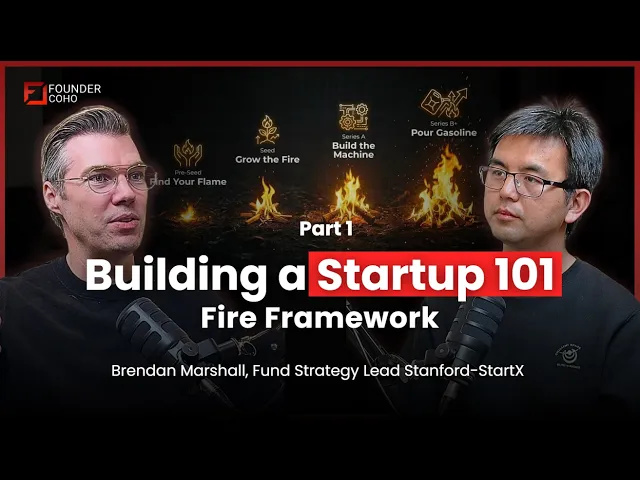
How do you build a resilient business in the age of rapid AI disruption? In this session, Brendan Marshall breaks down his “Build the Fire” framework, explaining how to focus limited resources on the feedback loops that define success.

|
Managing Director @ Stanford-StartX, Ex-CEO & Cofounder @ Flow (acq.)
Brendan Marshall, a two-time founder and a central figure in the Silicon Valley ecosystem. Brendan is the Managing Director at StartX, Stanford’s non-profit accelerator, where he has mentored hundreds of founders over the past decade. His entrepreneurial track record includes founding Kitchit, which earned him a spot on Forbes 30 Under 30, and Flow, a venture infrastructure platform recently acquired by Apex. A Stanford MBA and Kauffman Fellow, Brendan is the creator of the "Build the Fire" framework, a disciplined methodology for navigating the "zero-to-one" phase of startup growth. Drawing on his roots in Hollywood, he bridges the gap between compelling narrative and pragmatic, data-driven execution.
How do you build a resilient business in the age of rapid AI disruption? In this session, Brendan Marshall breaks down his “Build the Fire” framework, explaining how to focus limited resources on the feedback loops that define success. He warns against the "gasoline trap"—raising massive capital before a core engine is proven—and emphasizes the founder's role in operationalizing ambiguity.We explore the "Founder Fingerprint," Brendan's philosophy on leveraging unique human identity and data to create value that AI giants cannot easily replicate. From mastering the "art of the discovery interview" to building a culture as a "belief system," Brendan provides a masterclass on turning a visionary story into a market-leading reality.
References
Brendan’s Linkedin – https://www.linkedin.com/in/brendantmarshall/
Brendan’s Website – https://www.brendanmarshall.com/
Jing Conan Wang (Host) – https://www.linkedin.com/in/jingconan/
FounderCoHo – https://www.linkedin.com/company/foundercoho
Timestamp
00:00 - Highlight
02:38 - Founders' Stories and the Importance of Narrative
09:23 - The Build the Fire Framework for Startups
18:33 - Identifying Problems and Customer Discovery
28:51 - Turning Conversations into Actionable Insights
35:05 - Creating Jobs and Structuring Startups
42:52 - Raising Capital and Building Relationships with Investors
52:21 - Navigating Competitive Markets and Growth Stages
1:02:24 - Understanding Your Unique Value Proposition
1:04:24 - Outro
Full Interview
What separates founders who build real businesses — from those who just build the appearance of one?
Building a company, you have to tell a very compelling story. It's a very strong narrative — a reason for existing. For people to come and join, for investors to invest, for you to differentiate in the market.
Brendan Marshall. A Two-time Founder, Made Forbes 30 Under 30. Spent six years building fund infrastructure for GPs and LPs. Now Leads Fund Strategy at StartX, Stanford's nonprofit accelerator. A Kauffman Fellow and Stanford MBA. He's worked with hundreds of founders. And he keeps coming back to one question.
The question is — how do you focus your limited resources, your time and energy — as much as possible — to make that feedback loop go as fast as possible — to create progress — to compound into something where you actually have a business.
There is a first component — which is really understanding what people call founder-market fit.
The more aligned that is — the easier your job becomes as a founder because you are naturally impassioned with this idea of — okay, I want to solve this problem because it's part of who I am.
I think the most common mistake is for people to not go and learn as much as possible from their customers or potential customers from the market.
The discovery piece of really being open they could take you in something totally different and new. That is gold for you. Those are the insights that you want.
Because the moment you stop listening — is the moment you start building the wrong thing.
If you lose sight of what is the core business — and how this thing works — it's very easy to waste resources — and confuse a very big fire — for a very big business.
You are building yourself a home — or a prison — depending on how you build your company — and who you build it for.
the founders that have gone on to build DecaCorn companies, they are very clear in what business they're in.
In the age of AI — one advantage still can't be replicated.
I think fundamentally — one common thing for a founder's job — is to turn ambiguity into job description — so that other people can do their job.
If you actually figure out your fingerprint and what makes you unique — it's very hard for Anthropic, OpenAI, any of these companies to replicate that — because you have your own fingerprints, so to speak.
I'm Jing. As a founder myself, I learned something about this journey. The best way to build a startup is not to read a manual, but to learn from your fellow founder stories. Before we dive in, I have a small favor to ask from you. If you find value in conversations in this channel, please hit subscribe button and turn on notifications. It helps us keep the mission going. And this will be the only favor I will ever ask of you.
Please subscribe and turn on notification so you never miss the next one.
Hi, Brendan. So excited to chat with you again. And we have been talking a lot in the StartX and in previous conversation on it's the first time we're in the FounderCoHo podcast and talking. Thank you and welcome to the FounderCoHo podcast.
Thanks for having me. You're always doing wonderful things for the community of founders and I'm really excited to be here.
Thank you. I would like to start with your early days. And you have incredible stories.
I heard you selling Lemonades in a celebrity neighborhood.
I'm turning on Wayback. Yeah, I mean, growing up, there is a lot of the typical childhood stuff and things that you'd see that entrepreneurs typically do, which is they try to start
little businesses. I grew up in Los Angeles in a place called Malibu, which has a lot of people who are in the entertainment business, so a lot of celebrities. And so I would be selling my lemonade to folks like Janet Jackson.
Or rather her security guards and or like David Duchovny or just kind of like these funny characters that you would see on television. So it was they're just kind of funny stories that were tied to that and same with the car wash business that I had where you know just washing these different people's cars but the entrepreneur aspect
Was kind of a highlight or a common thread. So yeah, it was a funny place growing up, some of this stuff is familiar in terms of being an entrepreneur as a kid.
Yeah, how does growing up in a celebrity neighborhood affect your entrepreneurial journey?
Yeah, I think there's a real power of telling a story in Hollywood. I mean that is what it does really well. And then there's characters who play that story, which are the actors and how they fit into that. And so I saw a lot of people playing those roles. It is, I'd say, a different kind of culture than San Francisco in the sense that it's, I won't say less curious, but it's less curious about what's behind the veil, so to speak. So I think in terms of the story and how we live in these stories and the roles that people play, that was really powerful and stuck with me. Building a company, you have to tell a very compelling story. It's a very strong narrative, a reason for existing, for people to come and join, for investors to invest, for you to differentiate in the market. So I think one of the biggest parts of my childhood was understanding that firsthand.
Yeah, you mentioned a great point about telling the story and also narrative because I also like a lot of people started realize that like that's very very important for building startup as well like how do you control a narrative how to create a like a tell a good story of your business and the vision ahead like like you mentioned it used to be more more a thing of Hollywood, but I think it's starting getting to the Silicon Valley as well.
Absolutely. I think as humanity is run on stories and narratives, I certainly see the world that way. With a company, you're starting with trying to solve a problem, right? a very basic level. Hopefully, if that's valuable to the market, you get paid for that and you have a business.
The story when you're just as your sole founder, then you go find other founders, you start building this thing, has to begin there and your view of the world and what the future looks like. So you need to function in being a storyteller from day one, both to convince yourself that something is valuable that doesn't yet exist in the world, but also to convince others. So I think it's inherent in the job, so to speak.
I think what you mentioned reminds me an interview Jensen Huang had a couple of days ago. He mentioned about he's basically shaping the belief system of people around him. His employee, his investors, his partners. By the time when he's in the boardroom, when he's doing something, everyone will feel so obvious. That is the thing they should do. But he didn't work beforehand
He called it shaping the belief system of people around him, but I think it's similar to what he mentioned about the storytelling.
Absolutely. I think we can definitely go, I love going down the philosophical aspects of building companies and just life. So I'm happy to talk about this as much as you'd like. You are building a belief system. Your culture is a belief system. You're trying to build an environment where people can be their most productive and find the right people for that. I think the
you know, having the belief system before people believe there is a process that happens. And we've talked about this at StartX and some of the exercises that we've done with this process of how do you build your fire. And you have, again, a vision, a story around this big fire that you're going to build. But it starts with that first match that you're trying to kindle. And so there's a process of building that over.
I'd say one of the most important things that is very difficult, it sounds very simple, but when you build the story, you are forming a sense of reality and you're trying to bring people into that. And there is this trade-off between being dogmatic about your story and holding that ground and not breaking no matter what.
and also evolving with what you find along the way and iterating with the market or the customers or something that's happening and you have to incorporate that reality into your story. And so there's this balance between holding this as a belief system, as a narrative, as this is what the future looks like and also being very pragmatic about how that narrative can adapt to everything it learns along the way and incorporate that without losing its essence and thesis and vision.
Exactly, yeah, it's like evolving, it's a life system.
So it's, you’re building a belief system in a world that's not black and white, but you're trying to create that black and white certainty. And how do you balance that? that's, have the best leaders, the best founders, the best storytellers are able to do that.
You briefly mentioned about the build the fire framework and we talked in the StartX, I think this is one of most insightful framework I've heard about in startup building. Our audiences might not be familiar with that. Would you mind sharing more about that framework?
Yeah Absolutely. there's a lot of people talk about obsessing over customers, executing really quickly, being very focused. And I've been a founder twice. I sold my last company last year. I've gone through that process. I've been a mentor and advisor.
and judge at StartX for over a decade. So I've worked with hundreds of founders. And so the pattern that shows up again and again is this, basically you have a feedback loop. And the question is, and we'll walk through that, the question is how do you focus your limited resources, your time and energy as much as possible to make that feedback loop go as fast as possible to create progress, to compound into something where you actually have a business.
And so I think a fire is a great analogy because what I see, I've done firsthand is, well, there a couple, I mean, plenty of mistakes. We'll start with what you should do and then we can talk about the other things. But when you start a fire, you're kindling, you're starting with very small bits. So this is your initial thesis. These are when you're first talking to your customers. And you light a match, you're trying to figure out if there's a fit, if you can actually build something here. And...
maybe you get lucky in that first strike of the match and the thing starts going and you have your fire and everything's great. More often than not, you need to iterate. Something went wrong. And so the mistake people can make is just starting a new fire, kind of throwing everything out, not learning, really understanding what the market is saying or ignoring what the market is saying.
being overly stubborn on why the fire didn't start. So again, that's the vision with certainty and then saying, well, the market told me something, but the market's wrong and the customers are wrong. And so basically not incorporating what you're learning into the next time you try to light that match. And so one aspect is how do you iterate through that? Every time you light the match, you're trying to start this fire in a very focused way.
You want to learn from that as much as you can to inform, okay, maybe we should use different pieces, meaning we should talk to different customers. Maybe we should assemble them differently. Maybe we should bring in a different kind of match, what have you. I mean, we can bring this analogy. We're trying to keep it very simple. But the idea is that you have this very focused learning process and you're only focused on starting the fire.
Another mistake people can make is putting a lot of gasoline on it thinking that they've started a fire when it goes really big, which is the Venture game. And we'll get to that in a moment as well. So once you have that fire and you're trying to, it's lit.
The next stage is really focusing on why that happened, why was it working? What are the insights that you just built around that? Take those insights and inform what do you do next with making that fire bigger? So as that grows and grows, it can be difficult and distracting because you have your core thing of what's going and what's working, but then you see all these other things that could work.
And so you can get very distracted to be, well, I can build 10 fires right now instead of just focusing on this one. And the discipline that you want is to just keep focusing on that one thing and to compound that one thing because that becomes your advantage. And that's what will continue to grow.
So we can keep talking about this as the analogy. I think the big takeaway from it is this idea that you are starting with a very focused process, very small, intentionally small process, and you are trying to be very disciplined about how you learn about your process of starting that, very focused in expanding on what is the insights that you're getting from each cycle to make that fire bigger over time. And really to get that to a
critical scale before you even consider starting another fire. Those would be kind of the highlights of that.
Yeah, it's super insightful and in fact, I heard you talk about this framework like a half a year ago. I couldn't like forgot about it. I even just went for a camping trip to light the campfire just recording what you talk about and also having this like a visual analogy is incredibly helpful in the startup building processes.
And I’ll put in the way it’s like it's not just like ignite the a campfire it's actually in very windy days and I often time I when I do my startup I realize similar things like when you build a little bit momentum it's all about feedback like how fast you can build a feedback
and sometimes you build a little bit feedback, the fire seems to be ongoing, and if you get distracted, it's like I can do other things. And then it's actually another wind coming, bloop, blows your fire. And then with something working, they're how to double down on the feedback and getting bigger. And also there's a lot of like try and learn.
Once I learned is actually that metaphor I use is I try to ignite that the whole woods first it doesn't work it doesn't work because it's such a big vision yeah it requires a lot of
like the initial file to burn it, so it doesn't work. But you couldn't forget about it. You have to grab some leaves and grab some other things to burn a small fire, make it work. Put it beneath, protect it, make it a small file to be a little bit bigger, big enough so they can ignite the bigger wood. And when the bigger wood is on, you are kind of safer. But the whole process, maybe you try once, this is not a good initial material.
and try a different one. There's a lot of experimentation needed on that.
Absolutely. as you focus on it, you'll have the idea that you're feeding it more and more into the wood aspect. That starts getting into the investor aspect. And so the other insight from the fire is that you want to feed your business. You want to feed the business that's serving the market. And that you have insights that you've been building in a very focused way so you understand how your fire works, why it's burning, why it should grow, how it's growing.
And then it’s much easier to bring in capital to give you more fuel to grow that. Because you have those insights that you've learned and gone through all those reps. So your clarity on how this thing works. Because once you bring in all that extra wood, or eventually when you get to the growth stage, gasoline, if you want to say that, to really make it go big.
if you lose sight of what is the core business and how this thing works, it's very easy to waste resources and confuse a very big fire for a very big business.
Sounds very resonating. Like you put gasoline or lightening oil on this, like, boom, suddenly there's a big fire. It's easy, easy. The problem for that is that it's just like ignite the whole wood on the surface. It doesn't create enough density or intensities that can break into the internal part, which I think is about, do you really have a product that solves a particular problem for a particular audience?
It is better to solve the problem with a subset of audiences but do it very well than trying to build a lot of lights to have solution for everyone.
Yeah, I mean, there's different symptoms of this. You could say, you know, as long as you raise more more money, it feels like you have a big business. If you acquire really bad customers, but you have a lot of customers in the door, it feels like a really big business. And so again, it just goes into, I'm talking about a lot of the signals of what to watch out for. But the fundamentals again, and just kind of rehashing this, is that process of a feedback loop, learning as much as possible in a very focused way and growing.
and extrapolating that as fast as possible. And then that role of how venture capital or investors can come in to support that growth
Since we're talking about this framework and which has been very useful I actually would like to dive deeper a little bit on that and especially for a lot of our audiences they are in the very beginning part of this journey and it's like maybe some of them even don't got a wood yet, right and then they want to Figure out a way to ignite one part of that like getting to a particular segments. You know identify the problems It works them to spend all the resources doing that
How would you approach this?
Yeah. Look, I think the most common mistake, because I think it's just uncomfortable, is for people to not go and learn as much as possible from their customers or potential customers from the market. So you have a lot of smart people, a lot of smart people coming from Stanford, who, and outside of Stanford, but I'm just saying kind of the ecosystem of StartX that I see a lot of, who have not done the discomfort of going and talking to 100 potential customers and users.
to not get kind of the clipboard version of sketching out things before you build something. To really get out, you might have an initial thesis, but to get an understanding of like, how does this actually work? How could this work? Versus, hey, I have this really cool neat idea that I thought of myself, the world's gonna want this. That might be the case, but you save yourself a lot of time and headache by going and validating that in a very direct way. And so I think when people are first starting out,
There is a first component of this which is really understanding what people call it founder market fit. What is the unique attributes of this person as a founder, their history, their insights, their core competencies, and how does that map to this problem that they see in the world that they wanna solve? And then.
That's the first part, that's the soul searching aspect. And the more aligned that is, the easier your job becomes as a founder, because you are naturally impassioned with this idea of, okay, I wanna solve this problem because it's part of who I am. And you want that to be authentic, not just for the investors, but for your own sake.
So that helps narrow the field of what you might work on if you want to start something. And then the second piece is what we just talked about, the most common thing, which is just then really get out there and talk to people and start iterating.
Yeah, what I hear you talked about is that you kind of do this initial search process in both from your internal signal, but very importantly external signal. The internal is more kind of like understanding yourself. What is your true passion? Like ask if I spend 10 years of my life in this problem, would I feel burned out? Would I feel happy? Generally, that will be a very broad like like would you like more to
Improve productivity of the people or would you like to make people more happier or fun? I think the very broad area that is for the internal signal and then Prioritize and focus on talking to people that you want to serve for and understand their true pains
Related that another question I have is that a lot of founders they heard about advices, but I want to talk to customers and But oftentimes it there's a lot of noise happening like if you talk to people and a hundred people's oftentimes like you know be a lot of conversation you feel like Yeah, there's a lot of information. How do people turn those conversations into actually and plan was to vetting ideas..
Sure. So there is certainly an art to doing that and there's, you when we talk about the face-to-face of talking to people and knowing customers, there's obviously a digital way of doing that as well. I mean, there's different forms, but the idea is that you have...
enough of a window in interaction with that world that if you talk to 100 people, there's something emotive that comes back around. If they have a pain point, it's not hand wavy. It's I have a real pain point, a headache, or I'm really stuck, there's a signal that comes from that. And so part of the learning process, and there's so much literature, videos, what have you about this, is to, and part of it just comes from practice, don't assume that the first
time you do a round of interviews, if you're first getting started, that you're going be naturally good at that, or that you're going to catch everything. I would really try to leverage all these amazing tools that we have.
With the transcripts and you know there's stuff that even reads emotions and voices that are really interesting to help assist and provide leverage for the process but I would again take that as like you are also going on this first chapter where you're trying to learn how to do that well.
There should be an insight that comes, and we're using the hundred as an example. There are probably 10 to 20 folks that had something that felt like a real headache. And it's okay to just focus on those 20. So this is a small example of you want to find the hottest part of the flame. Like you don't need to solve for the whole hundred. What you want to do is a clear signal. And if they said something that you would absolutely hate doing,
as a founder, as a person and hate building a company that way, I wouldn't force yourself into that box because you are building yourself a home or a prison depending on how you build your company and who you build it for. So you wanna make sure that there's some level of alignment or coherence between what you're building or what the problem you're solving and who you are.
So I don't know, I'm curious your take if you're seeing folks who get stuck in the process or people talking about getting stuck when they go and speak to people in the interview, because I think there's a bit of a practice, but typically there's some kind of...
emotion that's coming up with those users that provide the signal, or if it's in that first prototype of what they're actually building to help solve that issue. I don't know if there's either one of those or you're seeing pain points or if that's just something they're learning about across the board.
I think after I heard your framework, actually put it into practice and doing a lot of this. One thing I learned about is this emotion thing you talk about. I tried all these transcription tools and I have tried it at one point trying to record all the videos and store in my Google Drive and have people analyzing, but then I realized this is the part where AI cannot do very well yet because it's not about summarizing and what they say.
In fact you should forget what they say because they often were pointing the wrong direction. One thingI found very useful is two things are very useful. One is the emotions, which the person when they’re talking, whether they generally feels the pain, which you can see from their expression. And I found that usually in person talk is way much better than video talk.
The message usually doesn't convey a lot of these things. But when you talk to a person, you will say that there's a lot of time people like they try to be nice with you. And it was like, yes, I brainstorm my idea. What if you can do this? I will use it. And then I would just like read a little gesture. And it's like, let's just pretend to be nice. And I offer them value before they were trying to offer help, which is, which is good. But then that’s not the useful. The, the, the one that is more useful is like this one.
the person is obviously frustrated. Something like that. Then I'm very, interested in how I sort of what is the reason for that. That's one thing. The second thing I found is useful is that I realized there's a distinction between discovery and sales. In the sales, you are trying to convince them your solution is kind of the best solution.
So you wanted to like actually act proactively follow up after you the conversation all that thing and but discovery actually sometimes want to just settle a little bit. That's to say, is there any push to you? Did the person actually follow up with you? Yeah. Afterwards, something like that. It's very subtle. Yeah.
I think those are two really important insights for people to understand in terms of the art of the interview or in the art of discovery and going to those users or initial users or any users in the process. The first thing you said, people want to be nice, right? They don't want to take on the risk of being brutally honest or, know, they might be, if you're talking to a person in a company, right, the idea, they don't want to,
They don't understand the founder mindset that we're crazy enough, but the way that they, there's a whole weird relationship of like, it doesn't benefit them to take the risk of being brutally honest. So there's a first piece of how do you create the comfort where you start to get them to open up? And I think that's really important.
knowing that the starting point is typically that they're going to not give you great information or they're certainly going to sugarcoat things or just not reveal things. So you want to understand how do you create a safe environment, a curious conversation when you start to hear. The second thing you said, is very much tied to that, and a mistake that people do all the time, which is directing the conversation with towards.
leading questions basically, I think is what lawyers might call it, to trying to lead them towards the solution that you haven't showed them yet, but that's what you spent all this time building. And so the discovery piece of really being open, they could take you in something totally different and new. That is gold for you. Those are the insights that you want. Those are the signals that you want of where the actual pain points are for this person. And it can be very uncomfortable if that starts taking you off course
of your business that you are envisioning or the solution that you have. And to really just hold that space and let that information come in, that it helps you make sure that you're not wasting your time on what you do next with your company. But it can be very uncomfortable to do that. So I think those two points you brought up are really critical for people to understand when they're getting that user feedback.
Exactly, And related that actually I can feel that I'm confident because I have many times when I'm having conversations with users and they started talking, I have some idea what we should talk about and when they started talking about this completely different direction as if if I build for that direction I need to do a harder pivot. There's many times in my mind like I would say should I direct a conversation a bit? But later I realized that if I direct I lose
What I hope to get. Of course I don't have to do what they say, but if I don't get the data, I would never know what is the word on this. Another thing I realized is that...
I realized that we have to forget the conversation after we finished the user discovery call. I once had a habit of getting all the transcripts and then I used some tools like for example, Product board or some tools and I just highlighted each of the sentences and said, hey, this is a sentence. And then I will aggregate, oh, this sentence has been said five times. And that's what we should do. And at one point I.
Handed it over to my product people to do that. And then later I realized that was a mistake. Because if we do that approach, we're basically too literal.
on taking what a user say. And also another thing is that we also couldn't completely delegate this because even a good product manager, are not in the final, they don't have the whole context. So they were operating in a very literal way. They would basically do highlighting the five and oh, this should be what we build on the next month. And then now you get a of like a suggested action plan.
That sounds completely right Everything is backed by two calls from the users, but we execute in this It doesn't feel right
Yeah, so you're touching on a lot of points. I mean, this is, it's, you know, we get to go faster when I'm talking to other founders. It's a, there's a weird world that we live in and this nuance of, of our biases, our inherent biases as people. You know, we don't want to do things that are uncomfortable. It can feel like a bunch of homework. Okay. We just had this two hour conversation, but they actually, that was just the data collection phase. Now you actually have to make sense of that data.
and that's the harder nuanced way of where was the actual signal in that.
I think the tools can be helpful in getting that data, interpreting that, think, for the large part, you want to go and go through that yourself. So I think that's really important. The other thing that's really important you talk about, people want to do something that they know how to do. And so if you give that data or anything to a product manager, the product manager is going to go with that lens. And how do they then start doing the job that they know how to do? And I think being able to sit with the ambiguity of not knowing what to do with that information and staying curious in that learn mode is really, important to then figure out, okay, how do we want to incorporate this into the stuff we do know how to do? And if there are things that we need to do that we haven't figured out, let's figure out a plan to go after that as well. But I think that segmentation is really important.
Since we're talking about this framework on that, like after we identify the initial directions, and there's another part of how to make the fire bigger. Yeah, keeps going. What would be your thoughts on those?
Sure, yeah, it keeps going. So I think the famous zero to one of figuring stuff out and that learning cycle, not knowing what the answers are. Founders are predisposed to figuring that out in part because it just sets the survival of the business. If they don't figure it out, they don't have a business. And so there's an incentive for them to do that.
As you build the fire and you're figuring that out, you get to a point where you're starting to operationalize it, meaning that you know how it works, you know how you're serving your customers, you know how your product, you have that initial product market fit, let's call it, starting to pull you, the growth is starting to pull you, such that you need more resources to keep up with the demand that you have. That's the scenario you wanna be in.
So as you're getting pulled and as you've gone through these learning feedback loops, so you have these really clear insights for why that's happening, you can start to operationalize, meaning you can start writing the instructions, the skills that traditionally have become job descriptions, but now we have different forms of intelligence that we can start outsourcing that to or buying computer tokens for to support. But the operationalize is saying that we know, you know,
We're going to take to feed this fire and to serve the market. These are the 10 things that we need to do as a job. So these 10 tasks or this process.
I'm going to create an actual job description for it. So that's the operationalize. And so now you have this leverage point where you're free to think about how you're going to grow to the next phase, but you have this foundation that is basically taking the insights and lessons, all that ambiguity of what to do. Now people know what they need to do. They can execute that. And then you can go to this next phase. Okay, now I need to grow this even further. And there's other things that you'll need to figure out. How do you
it capture more of the market, plenty of things we could talk about there. that's, you know, in thinking about the fire thing, the operationalized piece is the next piece of that.
You put in great ways about the operation of the things. And actually also reminds me one thing about being a startup founder is all about creating jobs. Job creation process, you put it in a way, is a lot of times
how about founders, oh you might be like a builders or might be business operators like that but I think fundamentally one common thing for a founder's job is to turn ambiguity into job description so that other people can do their job. Most of the people in the society they will perform their job. They will like well be a structures, expectation.
what they should do, but for founders their job is to create their jobs. And which you put in ways that after they finish this initial discovery process and keep doing that, they'll get a lot of learnings and insights and then they have to do the work to say what other things needs to be done in order to build upon to amplify the fires. Do we need builders? Do we need an operator? Do we need growth markers?
needed to do a breakdown of that into some sort of strategy or skills or job description.
What I call these, I call these tests. know, the test. Yeah, in terms of people can get straight A's their entire student career, academic career. And they've, the A that they got a test, that they got, I'm sorry, the test that they got an A on was given to them. They had structure. Here's the syllabus, here's what we're gonna learn. And then we're gonna measure how well.
learned that information. There is no test other than the market is there and you have to figure out how do you build enough value? How do you build something of value that the market's going to tell you? A lot of them are too nice to tell you that what you have isn't great or doesn't solve their problems or whatever. You have to go through this process and it's not clear how to get there. There's a framework, we're talking about these frameworks today, but that learning loop of how do you learn what
all this kind of art of aspects of things. That's why this is so hard. So what I'm talking about with the test is that when you operationalize something, you are building a test for your employees or whatever to get an A on. You're building criteria of whether somebody did a good or bad job. One of the hardest things about building a business and the founder mindset is you build something and you give it to 100 users.
And it's not clear if you did a good job or not. You know what you want to happen. You want the hundred to go crazy and then another thousand to come in and you want it to go, but like, why is it not working? And so it's the discomfort and the bias is that you'll do things that you're comfortable with. You'll work a hundred hour work weeks thinking that you did great work because wow, you're cranking so hard. But did you work on the right thing? Were you writing or working on the right test?
And so that there's so much ambiguity in that first zero to one phase. And then you operationalize it into something that's more discrete that people can actually get an A on that there's a different mindset there in challenge that I think is it can be very confusing for folks. But I also think it's really important that
people who are figuring that part out understand it's best to bring on a team member or build out your team when there's clear things, clear jobs to be done. if it's, haven't figured it out and we need to figure this out or the, we're gonna run out of time, whatever, you know, the freaking out piece of this.
just bringing more people in to try to kind of throw bodies at the problem usually doesn't lead to a good outcome because you're not actually building a faster way of learning about how to make the market or how to meet the market with your product. So you're trying to accelerate a process that's not quite working. And the people that you bring on might need a test that they can get an A on when it doesn't yet exist.
I think there's a lot there with that process of have you figured it out? Have you built the insight? And can you actually write that down of what those insights are so that becomes a work product?
I think you mentioned a great point is that startup is a very interesting phenomenon in startup is that it's not less we have more people, you get faster. Otherwise, startup will never win because there's always big companies with 100,000 employees over there. And startup is kind of a structure. the founders are creating that structure. And the jobs that you mentioned about, exactly, created one by one. In the early times, you will learn something.
they realize, they need some initial solutions. engineering jobs get created. And later, they realize, they actually need a product that has more intuitive results, like the intuitive user interaction. your UX design job is created. And it's actually created sequential. And you create a job first, and then you figure out how to fill that job by hiring and building the team on that. I would love to also learn about the next phases, like after you figure out the jobs.
and how do you actually get the teams and how do you actually grow the team.
Yeah. I mean, you get to the point where, you know, this is where capital is really supposed to help accelerate. So as you are growing as a business, as you're building that foundation, as you're getting pulled, meaning more demand than you can accommodate by the market to go somewhere.
you then start bringing in capital to accelerate that process or to meet that demand and also to help build for the demand that's very, there's kind of a linear or it could be exponential, but a clear path to what the future will look like now that you have these insights. If these things are true, if we figured out this piece with the market and the trends that we're seeing, we need to be here in five years to be here in five years, we need X amount of dollars. is the very, this is the optimal relationship that you have with
investors and what you're building towards. And so that process just goes faster and faster. As you get to enough scale, you can think about other complementary fires or things that are building off a core competency that you have in a business.
But that point, it's the old fire, the existing fire, the foundational one is really just, it's a well-run machine, right? It doesn't need your, you can take on the risk of exploring these new categories. But I think the process is, again, you just have this feedback loop and you're growing that and there are different components that you have, including the investor capital that helps accelerate that.
But ultimately what this always comes down to, what I see as most successful, the founders that have gone on to build DecaCorn companies, they are very clear in what business they're in. They understand what, there's certainly a vision to what they're building, but there's a core insight in terms of how they're, the engine that they have to get them there and that they built that validation with the market and then you've built this team and competency and IP around that's your foundation of how you're going to navigate there.
You mentioned actually a great point about when to raise. And it's a common belief among founders, because I always go to have money, but not necessarily. Only when you reach to a certain stage of your journey, capital will help you. In particular, like you mentioned, only when you have already created the jobs, but you want to fill their jobs faster, and you want to replicate their jobs so you get more momentum.
So you can get to X by Y date. Well that is the time when capital will be helpful and in fact you need to know that so you can create a plan to know how much capital you to raise.
Yeah. And I think so the fundraising and those different environments for fundraising and we're going to focus on specifically a unique type of investment or fundraising for this, which is venture capital. So the first rule of business and as a founder is don't run out of money. Right. You don't want to do that because then you're you're out of the game.
And so it can be tempting to feel like, okay, well, I can get this lifeline for raising capital. And if you, there are a couple of things where I see mistakes there. If you go and raise a bunch of capital and you don't know what you're going to do with that money, or you haven't figured that out.
you are probably going make some pretty expensive mistakes. You might build a big team before you're ready, before again, those jobs to be done, the tests are written, the insights are developed. You also put yourself in a position where there's an expectation to go and increase the value of that business in a very short period of time. You have 18 months, let's say.
And even the cycles that we're in now, we're seeing like 12 months. So, if you go in and have an idea and you say, okay, well now I have a $10, $20 million business, because I went and raised a couple million dollars on that valuation, that's all fine. But you should have a very clear insight in terms of having spoken to the market, built an initial product or some kind of core insight that you know you can leverage. And why you're using that capital is that you're constrained from realizing that insight, from testing that insight, from going to serving the market in some way. And so the analogy I'll give is like, you sometimes I see investors, sorry, founders that are going out and they're asking for lunch money. They don't know quite, they haven't figured it out.
They know that they don't want to go get a real job. And they know that there's some people that are in Silicon Valley around the world that are going and raising outrageous sums of money for, seems like, random ideas. And so if they just had the money, that would solve a lot of problems. And so where that goes is you can probably wrangle up enough money to go and raise it, which will create the problems that we just talked about.
but the other thing is you stop building for the customer, your first customer, which is the market. And so let's say that, you have a great reputation because you worked at X company and you have a great network for whatever reason with investors. And you have this insight, this idea that you had in the middle of the night or in the shower or going on a run. That's your company.
and you're like, I don't wanna go talk to 100 customers, I wanna go hire people because I know what this is. Like the 100 customers, the market doesn't understand, you kinda go through that process.
there is no validation of what you're doing in terms of a thesis, right? And so you can trade a name to go and get capital, but it becomes very expensive to then run those tests because you're probably going to pivot a bunch of different times. And the discipline, the difference between feeling comfortable that immediate testing period versus the discomfort of you just spent a lot of very expensive money and you don't have a bigger business to go raise on, puts you in a very weak position.
And so going and living off of ramen for a bit and doing whatever it takes to bootstrap and not raise the capital until it's very clear where you're gonna put that money to actually accelerate the business enables you to build a much larger business consistently than one that's not doing that. So that's the idea.
So raising that, I think you also touched on one point about the relationship between founder and investors. So they will be part of very good one relation with you get a capital and capital partner, they help you to fill the jobs and win the market. But oftentimes there is also other dynamics happening. One thing you mentioned about is that there's always this expectation that they're going to be creating values using a certain time range, 18 months or 12 months, and that dynamics also will impact the decision the founder need to make in all sorts of ways.
Yeah, I think you are with investors, you're building a very long term relationship. Investors are not operators. They're not going to be in your business. They shouldn't be because you and the team are the ones that are spending all the time on product and all the time with the customers.
So the investor being the kind of secondary customer does help support your business. That's what they're there for. And the way that venture investors are supporting the business, they have their own game they're playing, which is this power log game with just looking at less than 5%, now closer to 1 % of companies make up all the returns in the venture capital investment space.
And so there's an assumption that the large majority, virtually all the companies will fail from a venture perspective. And so there's this balance between building this partnership of what you're trying to do as a founder.
and the vision you're trying to accomplish and having capital that understands what you're building towards and the incentives and game that the venture investor is playing. And so where I see the most success is when the founder focuses on the customer and creates that very tight feedback loop. So they compound insights that usually leads to market validation and product market fit. It's often also the case that the there isn't product market fit, but at the end of that runway of what they
spent the money on, they've shown they can execute very efficiently on learning very quickly. And they are now, they have a multimillion dollar education that gives them a perspective of what to do next that differentiates them from everyone else. That builds trust with a venture investor because they still can take bets of what the future might look like on the future for the business.
So I think that investor-founder relationship is really critical and important. The founder coming in, knowing when they, again, are getting pulled by the market, like we've talked about, and they have insights that they want to expand on, is really important to build that great relationship with the investor and know that they're in a different game, that they're a different player in the game with different incentives. And so...
Don't take it personally if you have been kind of marked as like one of the 90 plus percent of companies that are not going to make it. They have their own problems of basically they need to spend times with whoever they think their winners are going to be because it's so important for that to make up their portfolio. So those are the dynamics at play. It's less of founders are good, venture investors are bad. It's more of just be very clear on how this works and the role that you need to play.
And like you mentioned the whole startup ecosystem had different jobs on its own as well. Yeah, it's basically you have your inside of vision of the future and you figure out a way to build on this fire and ignite it. Have a word of ignite and VC is different. mean they are betting on total difference. Just make sure everyone gets their own resources and materials and there's a right allocation of resources in the whole market.
Yeah, yeah, and the game is you know, how do you make sure you're in on the the next anthropic, right? So there's all sorts of interesting dynamics there But yeah, there are different roles to play and and I think that's important
Yeah, exactly. And let's continue our journey. So imagine that we have created a job description, we have got the capital, we are filling the team, and there's a strong market pull coming. And oftentimes the founder will realize they enter the growth stage, how they can grow as fast as possible. And oftentimes this will become a competitive market. when the next stage is like, I think the last year, the ai-coding space, they will be like tons of competitors in the spaces. What would be your advice for finding those stages?
Yeah, think so first on the competitive aspect, especially in the early stages and when you're getting understanding what's going on with the business, you want to be informed with how the market's evolving, how other people are solving stuff, just so you become a master of the market, but really not get distracted. Don't go and raise money because somebody else raised necessarily.
Don't try to replicate what they're doing, because you're not, again, you have to be customer obsessed, obsessed with who actually is gonna be buying your product. And so, all the additional, if you have that obsession and understand your customer better than anyone, you will typically win in that market as long as you're executing well. You can overlay some competitive intelligence, but I also see founders make a mistake of worrying a lot about their competition or trying to replicate certain things versus just focusing on the core value they can bring to the market. So once you get to the growth stage, you know, this is where you're putting gasoline or jet fuel or what have you, whatever analogy you want to use onto this fire, it's really growing. And it's, you know, at that point, it's really a land grab. So how do you replicate playbooks? How do you go into regional or international expansion? You know, the...
I'd say for the purpose of what we're talking about with the early stage, and that's really my focus, especially at StartX, know, call it the precedent seed to the Series A, it's building to that launch pad of what they do in the A to IPO. So, you know, the...
The game that's played is different. You've really figured out a lot of pieces of your business or the core competencies. With this market we have today, might have to pivot in things. But I don't have a lot of advice on that growth stage. I haven't taken the company IPO. I've sold a business. We did well there. But we haven't gotten to, I haven't seen a lot of, let's call it 500 to 1,000 plus employees.
You mentioned about one thing, which is like focus on the value that you create, focus on your customers. often, a lot of times, that competition will go away if you have to focus in delivering the best product. Related that I do want to touch one point, which a lot of founders are observing now. It could be a short period of time saying, but it could be a trend is that
When founders focus on own segment of customers, they got some insights and then the giants come in, like the model companies come in. So then we see a lot of trend which is like there is a very healthy business and then claude releases a skill.
Yeah.
someone built up on top of claude skills, they suddenly realized, you can do the same thing with Anthropic. And then the company of origin found this will lose steam a little bit, even as a composition, by the way, the cursor will still be a thing. That could be one example. Cursor basically got an insight that the AI models can be very useful for coding flow. And then everyone started to switch over to claude code.
question here is like whether cursor still is a thing. So, curious your thoughts on that.
Yeah, I mean, I think we are, this is very much a frontier of figuring out the, are, we have these new capabilities. What are the implications of that? What's the new paradigm we're gonna operate in and what is that going to look like? There are a lot of questions there. I don't know the answers to that. I can tell you my personal approach and my view that I'm focused on is around,
basically the fingerprint of like who we are. And this idea that the, you you have your own story and persona and talents, I have mine. If we worked together as one team, we collectively would have our unique fingerprint of what we're capable of doing.
And that's similar to the founder market fit we were talking about early. You want to really be coherent and clear on like what that actually is. And so that kind of forms your compass. Then the question is, okay, how can AI provide the optimal amount of leverage for my uniqueness of what I can do and what I get excited about? And I think it's safe to see an assumption
work out where you assume that leverage is only going to increase in the immediate term. So you can build these skills and faculties underneath and amplify something that's unique. I would say that that is different. Historically, there was this innovator subliminal that startups can work faster and do something that was kind of obvious, Dropbox or somebody doing Google Drive, something where it's like, that's obvious.
I think where this is going is more human in terms of as an entrepreneur or founder.
And it's more of like understanding like how do you broadcast your value to the world? How do you realize that value with this leverage of these tools? How do you then distribute that value across these various networks to find your audience? And then how do you capture that value from some kind of business model to bring that in? And that can be a very small team in part because what these...
models are enabling are effectively our ability to write them tests that they can get an A on, so to speak, that would function like an employee. And so, you know, for a company that's going to go and raise $10 million or they're going to raise their first seed round, you know, a long time ago,
it was raising money to go buy servers to get the actual compute of some sort so you can start building something. Then, you know, the last cycle is all about you're raising to hire the best engineers to go and build something. So you're hiring people, but that's where the budget was going. You raise a couple million bucks. You know, you might spend a little bit on office space, if at all, and the rest was just going to people.
And then now it's more of like, okay, well now it's going to compute, it's going to tokens. And so I think then to answer your question, if you actually figure out your fingerprint and what makes you unique, it's very hard, I think for two reasons, it's very hard for Anthropic, OpenAI any of these companies to replicate that because you have your own fingerprints, so to speak.
But also the thing you're looking at is probably relatively niche to what they need to solve for at the scale that they're at. They have built such a tremendous fire that they basically are going after everything in the world and reshaping what the global economy is gonna look like. There needs to be an industry and economy that exist on top of that.
And so I think that that's the frontier. We don't know exactly what that looks like. But I think that for founders or building businesses, the more that you understand that unique insight, and I'm not just talking about like consumer apps or things, I'm talking about like really core insights that you can amplify as a human and what energizes you, that kind of fingerprint, and then how you distribute that to the market. I think that starts enough of a feedback loop and a fire that should accelerate as all these technologies come out and improve.
on a weekly or daily basis versus disrupt the business entirely or replace the business entirely. So I just argue that people who are chasing ideas that could easily become an app is probably not their true unique founder identity, I would argue, potentially. We could debate that.
Exactly. Yeah. Yeah. Actually, what you mentioned is so interesting. The other day I have a great conversation with another experienced entrepreneur. He took two companies IPO for that. He gave me one analogy, which is like if you build an app that will eventually be absorbed by Anthropic or OpenAI, it's more like a pick up coins in front of like Jets. They'll just like steam over you. Sooner or later.
I like the framework I mentioned about the fingerprint. oftentimes that, because my understanding of the fingerprint is that you actually need to understand about like what is the uniqueness of you as a founder and then by extension your team and the organization you are building. And nowadays, like it used to be a good company can be built by one unique insight. You have Dropbox, okay, and there is this innovators dilemma
that will protect startup founders. So you can just need one unique insight to build a good business. But now that we are in a very interesting stage is that the big companies will operate very fast with AI and when the new period. So if you only rely on one insight, it's not safe. It may give you like some protection like half a year or something like that, but it's definitely not long lasting. What you need is identify your fingerprint for yourself.
For your organization and be laser focused on those areas and to eventually build the unique value that is impossible for Anthopic to take over on this.
Yes, I think the challenge becomes both on individual and company level, how do you, you basically have to figure out your data model. So, you know, I spent the time building the Brendan data model, all the information that I've had over the last, it's like 15 years of information.
spending a lot of time figuring out what's the actual structure, that then I'm going to put an intelligence layer, this compute underneath that to create a leverage point. But then to your point of you start with an insight of what I want to do, so that now I have this structured data, what's unique about me, and then I create these leverage points of doing something with that information very easily. So I remove that friction, but then it gets into that feedback loop thing we keep coming back to. So I will do something based on an insight.
or desire or something I want to do, that's going to go to some version of a market and then data is going to come back. If I build the system, and this is what we're talking about with CLAWDBOT, all this other stuff is going where this is going, if I build the system with an initial fingerprint and then the compounding of going to the market, bringing that insight, bringing that into my knowledge layer that then informs what I do next, I've then built
unlimited or kind of the speed of that cycle goes up exponentially. Basically, I'm only limited by the cost of how much money I can spend on the compute for that, right? So I think that's...
To answer your question on like the pivots or how this new technology comes out, I think, for me, that's the view of the future where we have, where we see the most value in ourselves and in our companies is that fingerprint aspect and that loop of how do we bring it to market and then learn from the market and bring it back to market with those insights.
Yeah, exactly. Fingerprints and the feedback loop that built on top of the fingerprint. Yeah, well said.
Thanks for watching part 1 of our interview. Don’t forget to subscribe to our youtube channel and turn on notifications so you never miss the next one.