Interviews
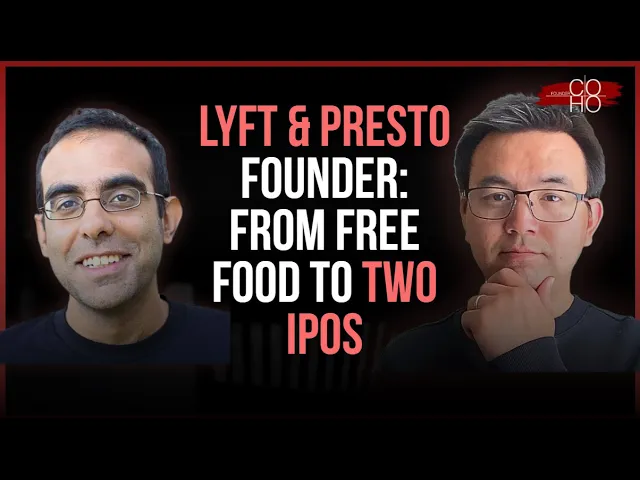
Rajat Suri, co-founder of Lyft and Presto, on the brutal realities of entrepreneurship and venture capital.

|
Co-founder of Lyft and Presto
Rajat Suri, co-founder of Lyft and founder of Presto (IPO 2022), reveals the raw, unfiltered reality of entrepreneurship that Silicon Valley doesn't want you to hear. This isn't your typical "hustle culture" success story – it's a masterclass in survival, resilience, and why 99% of founders should NEVER take venture capital.
Mind-Blowing Insights You'll Discover:
- The dinner bill "aha moment" that created a $100M+ company
- Why he worked as a waiter for a YEAR to test his product
- The shocking truth about venture capital (this will change everything)
- How to build teams so loyal they're "willing to die for the company"
- His controversial take on why going public isn't worth it
Connect with Rajat:
Rajat Suri Linkedin: https://www.linkedin.com/in/rajatsuri/
Jing(host) Linkedin: https://www.linkedin.com/in/jingconan/
FounderCoHo Linkedin: https://www.linkedin.com/company/foundercoho
Tribe-Chat: https://www.tribechat.com/
Lima: www.limadream.com
Founders in Arms Podcast - https://www.youtube.com/@FoundersInArms
Timestamp
00:00 - The Rajat Suri phenomenon begins
00:48 - Introduction and Early Days; Interview Focus of Presto Journey
02:31 - Journey with Presto starting with dinner bill splitting
04:51 - Going door-to-door: Customer validation 101
06:40 - Becoming a waiter to perfect the product
07:26 - Live debugging in restaurants (chaos ensued)
08:25 - First major win: Cracking the Applebee's deal
10:35 - 15 years condensed: Presto's evolution phases
13:26 - How to keep You and your team Motivated
15:14 - Building teams that inspire YOU back
17:52 - The Best Trait you need for a great Team
19:03 - Scaling Challenges and Culture Framework
20:53 - Fundraising masterclass: Think like an investor
23:24 - CONTROVERSIAL: Why to avoid venture capital
24:45 - Thinking about your Business Model
26:43 - IPO reality check: Not what you think
29:31 - Current ventures: Lima & Tribe revealed
31:13 - Why he keeps founding companies
33:31 - Essential reads for entrepreneurs
34:37 - Outro
Full Transcript
I come from an Indian family. Indians like to have their kids be doctors. I got into MIT
for a joint PhD and MBA program, which is a very unique program. Only four people in the
world were accepted into it out of many, many applications. At some point my bank
account became less than a hundred dollars.
I was living in like this very tiny room with mice
everywhere. So that type of environment is not,
maybe a lot of people cannot deal with that and
I think 90% of the people I went to MIT with could not deal with that. I was very focused
on like building a great product , but it also helped that restaurant give me free food.
And so like, you know, as a very poor ex student with making no money and having a very small bank account, that helped a lot. And they were like willing to die for the company
that I was like, okay.
Welcome to another episode of FounderCoHo
where we dive into the journeys of extraordinary entrepreneurs who've turned their visions into
reality. Today, I'm thrilled to introduce you to Rajat. He's the founder of Lyft, the second
largest ride-sharing company in America, and also the founder of Presto - a company he built from
just an idea all the way to a successful IPO.
Rajat's story is one of perseverance, innovation,
and calculated risk-taking. It's a journey that begins far from Silicon Valley's comforts.
Born into an Indian family with traditional expectations, Rajat was initially expected
to follow the path many Indian parents hope for their children – becoming a doctor. But Rajat's
ambitions led him in a different direction.
During his early entrepreneurial years,
he experienced financial hardship that would have broken many others.
What's particularly remarkable about Rajat's journey is how he managed to
inspire unwavering loyalty from his early team members. Their dedication became a powerful
source of motivation for Rajat himself, creating a virtuous cycle of commitment and perseverance.
In today's conversation, we'll explore Rajat's fascinating journey with Presto - from
identifying product-market fit and building a winning team culture to navigating the complex
waters of fundraising, and ultimately, the decision to take the company public.
Let us get started.
Like in next 15
years, you build a company called Presto.
Speaking of Presto, I heard that there's a
specific moment when a problem with splitting a bill with friends that made you come up with Presto
idea? What exactly happened in the moment?
I was having dinner with a bunch of other MIT
and Harvard engineers in Harvard Square in Cambridge. And it came time to split
the check between us and, we had this huge problem where we couldn't figure out between
a bunch of MIT engineers, how to split a check, it just became like this bad joke.
How many MIT engineers does it take to split a check and it turns out that it was very
difficult for us and that we ended up getting
it wrong. We had to do the whole thing again
after about an hour. And it was just this "aha"
moment where it was like, okay, you realize that
restaurants are so far behind the rest of the world in technology and physical spaces in
general are very hard to adopt technology.
And so Presto was really this idea of digital meets physical which is still an idea today that's very relevant. How do you insert technology
into the physical world? And that idea I think is a very powerful idea. There are many companies now
in that space a toast is one that's doing really well in the restaurant space.
But there's also lots of others, there's flock safety, which is doing computer vision for license
plates, and, helping with, catching criminals in neighborhoods, by putting cameras everywhere, right? This is something that China does already, but they're doing that here in the us So there's a lot of these interesting very, physical meets digital companies.
Presto itself is still doing now just pivoted to voice AI for drive-throughs. We made that
pivot while it was still there, because the pandemic basically shut down the initial idea,
which was like tablets on tables for restaurants. And in the pandemic nobody wanted to touch a
tablet on their table, right.
The basic idea of Presto is a
very powerful one.
It's, incredible to hear like you had this "aha" moment, like a problem you face in your life and you realize that's a problem many people have. Many of us would have ideas and only very few ideas become business.
What thing did you do to turn that into Presto?
First thing I do is talk to customers. So I, instead of going to class, I went, door to door in restaurants in Boston. So I knocked on the door of restaurant, asked to talk to their owners
and I asked, and I said, Hey, I'm from MIT have this idea, what do you think?
A lot of owners said, yeah, this is a good idea. I was pretty unsavvy, I didn't have a good business sense at that time, but I got enough feedback that some people, said they would test it
if I built it. So I was like, I'll just go build it. And so I got another MIT guy as a co-founder
and we started building it together.
And then, we started to learn about the
industry. I actually waited tables as a waiter to understand how the industry worked. The first
year, the half of the company, actually, I stayed at that apartment and making under minimum wage
but I was 16 hours a day inside a restaurant, like testing, like building the product inside the
restaurant and testing it inside the restaurant with a, with real users and real waiters.
So that's how I really learned about the industry and that's how I learned about
how the product works. I was very focused on building a great product, but also helped that
restaurant give me free food. And so as a very poor, ex student with making no money and having
a very small bank account, that helped a lot.
That's a very genius idea of being a waiter to
testing your early product prototype. And that also relates to many startup from the early
stages is like they have problem to get it to their customers. And so
in your cases you actually become a waiter like for a year for doing that.
So what is the everyday life of the waiter, and at the same time, testing product?
So what I would do is test the product. I would be coding inside the restaurant. So I'd have my
laptop and I would be building writing code inside the restaurant, and then I'll be using these
remote desktop basically to desktop into the tablet we built. We got these like
Samsung tablets. We put duct tape around and we built like the software for people
to order and pay from their seats.
We put that on the tables and then I
would remote desktop into the tablet to see how users were clicking on which buttons and what
they like to do. And then after they finished, I would ask them for their feedback. What do
you think of this, product and now we talk to the waiters all the time and I would just be
testing the product very intensively.
I think it's the right way to test it. You
have to be there to see, and you have to talk to users, all the time. So I learned a lot about the product that way. In some cases
I crashed the whole restaurant, basically
they have the point of sale system and I wrote an integration to that and I made a mistake
and I just crashed the whole restaurant.
The whole restaurant could not operate because
I did something badly. So that was unfortunate times, but I fixed those issues and then, eventually got our first funding through those tests and then, got into Y Combinator after that and moved out to the Bay area into 2010.
So you did a lot of work in testing the product
and with the users and talking to them. Is there any particular moment, as you are testing that
made you realize, wow, I'm building something that is really real? and then take off.
Like Lyft, Presto took a long time to take off. It took like four, four or five years.
We got a pilot with Applebee's. We had a pilot with Uno Chicago Grill in 2010. We knew that
there was some chain Uno, Chicago is a small chain, maybe a hundred restaurants in Boston.
It was like someone who was interested in our product and so they decided to do a trial.
And then we did another trial with Applebee's starting in, I think around 2012. And then so
Applebee's was interested enough and then they eventually signed a contract in 2013
that was our first big contract. And then we got several others later Chili's or Red
Lobster and stuff. We had many near death moments along the whole journey.
'cause what we were doing is very unpopular at the time. Hardware products were not popular. Selling
to restaurants was seen as a big problem. It was a very contrarian play for many years. Eventually we
figured it all out, in 2017, 2018, 2019. But then by, by the time we figured it out, the
pandemic happened 2020, which killed that whole business, the tablet on the table business.
Even though, some chains still use that today. The big chains still use it.
But then we pivoted to ai. We were starting to
work on AI stuff in 2018. We started doing computer vision and voice ai. In fact
we built a tablet that actually had voice AI embedded into it in 2019.
You can go to a restaurant and you can just talk to a tablet as you would talk to a waiter. And
you can order your food that way. I still think that could be an interesting play for a lot of
people. But ultimately one thing we realized too is that the sit down restaurant market
it's actually pretty small, especially for the big chains. They're very few restaurants, whereas
the fast food market is much bigger and that, that makes a huge difference if you're a startup.
You mentioned that the journey of Presto,
there's different phases of the company that
if you divide the Prestos like 15 years, how would you divide a different period of presto? What
are the significant milestones you mark
on a different period of time?
Yeah, good question. I would say the first period was basically trying to figure out
product market fit, right? Getting a customer to buy the product. We had zero revenue for maybe
first four or five years of the company, maybe, up until 2013, we had zero revenue, or very close to zero revenue.
Until we got our first enterprise customer to buy a product, we were nothing, right? I didn't know
how to sell any enterprise customers. I didn't know anything about enterprise sales.
It's very different, I would say, for a founder, especially an engineer. To know how to sell to
enterprise. It's like a totally different game. It's very relationship driven, very political. It
is not an easy thing. Then even after we went Applebee's, it took two or three years for us
to figure out how to roll out Applebee's and then how to win other customers.
So I would say up until 2016. It was a lot of failing. Basically failing and just surviving. I
actually think that's true for many founders. Like the first, five to eight years of being a founder
or being a CEO is very challenging, typically. You have to just get through that piece of it, and you
have to learn a lot from that process.
But then after that, we actually had a lot of
success in our 2016 onwards. Where we were winning other customers, we were handling
tough situations better and we basically won a lot of deals. Like we, we were winning a
lot of enterprise deals, first in tablets and then in ai. And we built a great team.
We eventually went public in 2022. We were able to raise money in many cases successfully. So
ended up being basically a tale of two halves. The first half, very challenging. A lot of
failure. The second half, a lot of success, but dealing with external crises like pandemic and the
market crash in 2022 where tech markets just died, we had to deal with those issues, but
but we knew how to deal with it at that time.
So like you mentioned that oftentimes like as a
startup founder, you need a very long time. Basically like fighting surviving mode for
your case that all the way until 2016, 2017 that's probably the time that you were doing that.
That's a pretty long period of time. How did you have the mode stay motivated you
throughout the period? How do you keep your team motivated through the period?
I was motivated because what we were dealing with was very challenging and I wanted to prove
to myself that I could handle the challenges.
I was excited by the idea and I was motivated by
the team as well. Like the team I assembled, I think was very strong. A lot of them are still
there. Several of them are working with me on my new companies. Because we went through many near
death moments together, we had a very strong team bond and we had a very motivated people
in the team, so they kept me motivated as well, because like I put the team together and they were
so motivated and they were willing to die for the company, I'm gonna do this as well for them. So
and then also the fact that the challenges we were taking on were very difficult challenges.
And this basic idea of like digital meets physical is such a really thorny problem that really no one
has solved, right? Even today, if you look at open AI or some of the companies that we all respect
they can solve a bunch of software problems, but they haven't solved physical meet digital.
That's like a Tesla level problem or SpaceX level problem it's a very challenging problem and it's
quite motivating to make a dent in that problem. So the combination of the problem and the team
were the most motivating things for me.
You mentioned about the team, is that your
team keep you motivated. That's a thing that many founders don't realize that it actually.
It's like a teamwork and founders help to set the vision for the team, do good work
actually will make founders feel fulfilled and also get the motivations on the processes.
I'm very curious about how you build your early team. How do you find them?
It's absolutely true that the team motivates and inspires founders. And it goes both ways.
Founders inspire their team and then the team inspires their founders. I found out
my CTO is still there. I found him actually at a career fair where he was recruiting for Microsoft.
I met him at the lunch line for employers. All the employers were
getting lunch and he just in front of me in the lunch line and I talked to him and
he's like, I'm Microsoft and this time Steve Ballmer was working with the CEO.
I'm like, oh, I'm sorry to hear that. So Microsoft is a terrible place to be right now. And he was
laughing. And then we started the conversation. And I realized he is very smart and he's
managed to get him to leave Microsoft to come, join us. And then he became our CTO.
We have several other people like that. A lot of people came from MIT initially. We have had
other people referrals. We hired some former waiters as well. But they wanted to work on the
technology side. Several of them are still there at the company, so we changed their careers.
We hired someone who didn't have any computer science degree. He was a psychology major, making
almost no money. He did a really good job at one of our tests, and so we hired him as an engineer.
He now has a very successful engineering career at Google, so like he's doing very well.
I took a lot of pride in helping people get to the next step in their careers and also like
building a great team of people who are maybe not,
who are not obvious people we hired one person who
was well over 60, very motivated guy and nobody else was hiring him because they thought, oh,
this guy's too old for a set tech company.
I didn't believe that. I really believe that
the talent comes everywhere. Motivation comes from every place. And I really tried to have
a team of diverse backgrounds and diverse like opinions and people who are very motivated and
would be willing to challenge me, but also be willing to get in line and get the job done when it needs to.
When you do the hiring, what is the number
one characteristic you care the most?
I think the number one thing I care about
how proactive they are. Are they willing to jump in, take ownership? Obviously you need to have
good skill for whatever people are doing.
If you're a designer, you need to be an amazing
designer. If you're a developer, you need to be an amazing developer. Have great communication
and talk about problems. If you're the type of person to shrink in meetings and
not bring things up, then I'm probably not gonna be a good fit, for you.
Because I want people who are vocal, who bring up things. I think it's very easy to hide, in companies. I think those are the characteristics. I typically
of course, honest, good person, that you can be friends with, and I'm friends with a lot of my
former team now and I think, you hope to build lifelong relationships with these people.
Finding the good team member is very important. In the amount 15 years, you bring Preto all the
way from idea to IPO and there's a lot of new team members joining. Do you face any challenges too
as you're scaling the company?
Oh, yeah. So hundreds, thousands of
challenges. There's of course many challenges I think just learning how to be a good manager
and leader was a big challenge. And, learning how to build a good culture
all these things are quite challenging.
Is there any culture framework that you used?
As you build a team and manage a team in Presto?
Yeah. You have to be very intentional about building culture. So I think the key thing is that
you have to like really write down all the things you want to see in your culture and understand the
trade-offs that you're making, if you want to be, the type of culture where people speak up
or do you want to be the type of culture where, people are free to, be passive and not have to
speak up. Maybe that's not a great example, but there's real trade offs in everything you do.
So if your culture is gonna be you're gonna work nine to nine
that's the company mercor they really announced that recently, then you have to realize that
you're not gonna be able to hire certain people who can't work that much, right?
So you have to be very explicit about those trade offs. If your culture is gonna be
like Elon Musk has certain cultures, right? Certain aspects of his culture is also
getting stuff done very quickly, right? Then maybe you're gonna make more mistakes. So
you have to be explicit of that as well.
In addition to the people side and very other
important part of the company building is getting the resources like funding. So among
your experiences of getting fundings for Presto, what is the most important message you got?
I think funding is not easy, but you get good at it over time. I think one is having a very clear
message about how investors gonna make money on this deal. So the way they're gonna make money
you have to really spell it out. So even somebody who doesn't know anything about
your business can figure it out, right? So it's like, okay, here we grew this much last year.
We think we're gonna go this much next year. Our market size is this much. If we just get
this percentage of the market, or this is our path to getting, whatever percentage of the market. And
this money helps us get to this level.
And just be really clear about how you make
money for the investor. Then they're more likely to invest. I had a lot of success late
in the second half. I had a lot of failures in the first half, of raising money.
For us, fund raising, the best way to fund raising is for you to have a traction
Funders want to give the money. But also like you mentioned
in the early stages, usually will be a little bit harder
So you mentioned about there the four and five years, in which Presto doesn't have the
doesn't have the income, revenue yet.
Did you get, any fund raised during
that moment and how did you approach that?
I think the way we approached it is, we're about
to get a ton of revenue. We basically like, oh, Applebee's is doing a pilot with us.
This is how much the deal is worth, right? We're about to sign this deal. You invest, you can
basically benefit from that zero to, 10 million
ARR growth, right? Then they would call Applebee's
and they would say, are these guys actually gonna sign with you? Applebee's actually at that time
some people would say yes, right?
So then we got an investment deal done based
on that. Talking about imminent revenue growth, coming very soon is important.
Like you mentioned about Applebee, there was like a few years of deployment. So
even during that period there, when there was, imminent revenue. That can still be
a signal that, investors use for funding.
Absolutely. Yeah. I mean, it's almost like raising
debt. Equity, venture capital doesn't want to take that much risk, they really want to take
as little risk as possible. So either you have this historical growth or you have very imminent
growth that's easy to diligence, right?
I'm actually these days not a fan of venture
capital. I don't think it's the right instrument for a lot of founders. I'd rather founders make
money from customers and grow more slowly than they raise a bunch of VC money and try to max out
growth. I think for most founders they should try to get money from customers 'cause that's a much
better signal than raising money from investors and in, and raising money from investors is also,
it's just a totally different game from getting money from customers.
You have to play, this game where you're really hyping up your company. And I think
it's not the right game for most founders. And too many founders, especially in Silicon Valley
default to raising, too soon, especially.
That's a very good question because
I feel like in the, a founder community, there's like the status game.
As if you raise more money, I become more important in the community. What would be your
advices for founders to decide whether they should think about fundraising
or not think about fundraising?
Try to figure out a business model where
you can make money from customers and, if you can make money from customers
that's the best approach, right?
That money is not only non-diluted
but it's also a good proof that you're building the right product, right? So I think
the only reason you should raise venture capital is a, if you just started and you have really
no money at all. So maybe the first million or 2 million just to get seed capital.
If you don't have your own capital or you can't get any customers until you build a product
maybe a million or 2 million is okay. And then after that, I would say, only raise venture
capital if they're begging you to invest, you're growing so fast and they're like
oh my God, we desperately wanna invest in this and you have full control over the terms.
I was just talking to a founder yesterday and he'd raised multiple rounds of funding
and he hates his VCs. They're the bane of his existence. Once you let these guys in the door
you can't get them out. You have to realize that your whole company, your whole life is
at stake when you raise money, especially when you raise like a priced round, like a Series A.
Giving them preferred shares gives them a real lock of your company. And from a
founder perspective, it's not worth it in 99% of situations. Only when you're a true rocket ship
you know that they're begging you to invest, and when they're begging you to invest, you have a
lot of control over the terms.
So you could basically get rid of
all the onerous terms.
Exactly. Everything has its own
price tag associated with it. Related to also getting the funding, you also eventually bring
the Presto to the IPO, in 2022. So walk through us what a journey, how the IPO processes were.
In the heydays of 2021, we got an offer to go SPAC. The offer was a good one. It was a nice
valuation. It, bring a new bunch of new capital to the company. So we thought it was a good
it was a better option than staying private because private markets were not, that
welcoming towards our ideas.
This was all before like ChatGPT and
LLM's really created this AI boom. And the ironic thing is we were working on this voice AI and all
these things that are really sexy now. We were working on it back then in 2021. 2022. So if we
had probably waited a year, like it would've been even easier for us to go public.
But we chose to go public actually in a very difficult time in fall of 2022
which is like one of the worst periods in like tech in history, right? We managed to, somehow
get the deal done. But I think the company also took on too much debt, to make that happen.
And that ended up hurting the company later. Going public ultimately is not that difficult.
It's just like a legal process. You get some money from some investors, you can go public
you're willing to spend $3 million on legal fees, we can go public. I don't think it's what it's cracked up to be.
I don't think entrepreneurs should aspire to it.
I don't think that entrepreneurs should do what they do because they want to make an impact and I
if they wanna look, get exit opportunities, I think. They can either get dividends
from the company, they can just sell secondary if they really want to.
They can, sell the company. Going public is very challenging, I think
for many entrepreneurs. Even entrepreneurs that, have very good outcomes when they go public
which we didn't really have. But like even founders, they do. They
can't really sell their shares.
'cause every time they sell their shares
it's like a big negative mark against their company. So you're locked in, it's not like this
freedom where you have all this liquidity.
You mentioned Good point. Oftentimes the founders
are always locked in. So the IPO is actually the
liquidation more helps from the people around you
like the investors or the early employee to liquidate.
Thank you very much for, sharing your insight as building a team in Presto
and the fundraising journey and IPO journey in Presto. I would like also to talk about more
about your recent chapter of your life since you, left Presto. So after leaving Presto,
you are very active in startup, landscape and built two startups since then.
Tell us more about your new startups.
So I'm working on two things right now.
Three things actually. Lima, Tribe and, a podcast called Founders in Arms. Lima is,
concierge for immigrants, to help them navigate their journey to the United States.
Nowadays, we're needed more than ever because people are trying to get off the F Visa, get on
O Visa or, green card, get their EB one or EB two. So we've helped many people get approved
for these things and it's not easy to get. We're much better than immigration lawyers
working with them directly because we put the whole package together.
It's not just, filing the paperwork, it's actually very strategic. It helps people build
their profiles, get all the different things they need to qualify for these visas as well.
Lima and if anyone's interested in that, they can email me at rajat@limadream.com.
The other thing I do, is Tribe. Tribe is a next gen group chat app. It's at tribechat.com. We're
trying to build close communities, close human relationships. In a world of ai,
we think like human humans will want to connect with each other even more. And maybe be enabled
by ai. We have this group chat app where people can connect with each other and also leverage ai
but also a bunch of other features that we have there to make a joyful, chat.
And the third thing is the podcast Founders in Arms podcast, which I do with the CEO of Mercury
Immad. And we interview new founders every week, and I think we have some good, discussions.
But you dive back to the funding a startup. So what draw drove
you to dive back to founding.
I really like, building companies.
I'm still the same guy. I think a lot of people get burned out. You're absolutely right that
they really feel burned out. And I think a lot of the reason for the burnout is,
I think the stress of operating a venture backed company, I think when you're most my
companies today are not venture backed.
And I think it's much more fun to build a
company that's not venture backed is really, you focus more on the joy of serving a customer,
enjoy building a good product and enjoy taking care of your team. I think I would
recommend this journey for any founder who feels burnt out by their journey is try to do it
without their venture capital and try to make money from customers instead
of trying to make money from investors.
Talking to investors I find is like the least
favorite part of almost all founders. If you take that piece out of it
you actually are left with the part that you
like the most. I think, some founders don't
like talking to customers, and I don't have any good news for that. It's, if you don't want
you have to be good at talking to customers and or like really enjoy talking to customers.
And if you don't like that, you have to find one that you like.
In my case, I really like helping immigrants, really like helping people who use group chats.
So the Founders in Arms Podcast were serving founders, which is, you know, my tribe, right?
Literally. I think it's, it is very fun. I would say from a work perspective, never had more fun. I'm working very hard, but I've never had more fun.
And I think the more you do it as a founder, the the better you get.
you don't have all of that uncertainty that you have early in your journey.
How many years are you in your journey, Conan? I started in 2022, so it's
three years now. Three years, yeah. Yeah. So, you know, the first few years can feel very confusing. It can feel like a steep learning curve and not that comfortable
right? But as you get later on, you start embracing those challenges and
you start to know how to react in different situations, and it becomes, I think, very fun.
So it becomes more fun later on. And in addition to that, either any other book or
any website or resources you would recommend our audience to check out? I really like
the book Shoe Dog. You know, that's one of the most inspirational books I've read
I like the book. It's not a found, it's not a founding book, but it's, it's a great life book.
It's, uh, when Breath Becomes Air by Paul Kalanithi. It is a great book as well
just about like life and death. I found it really interesting and inspirational.
What else? I think those are the two for now that people should definitely check audience
out. Awesome. Yeah. Cool. Cool. What are the best way for people to reach out to you?
You can find me on the, on my on tribe my app.
So yeah. Put a link in there to, especially to
you can join the Founders in Arms Podcast Tribe and, and message me on there. Awesome. Cool, cool. Yeah. Thank you very much for sharing your entrepreneurial journey with us today.
and your insights has been so, so helpful to, to me personally as well. I had always been
super helpful. I think to your audience also been incredibly helpful. Really appreciate
your time. I love to keep in touch and also compare those ones as well as founders.