Interviews
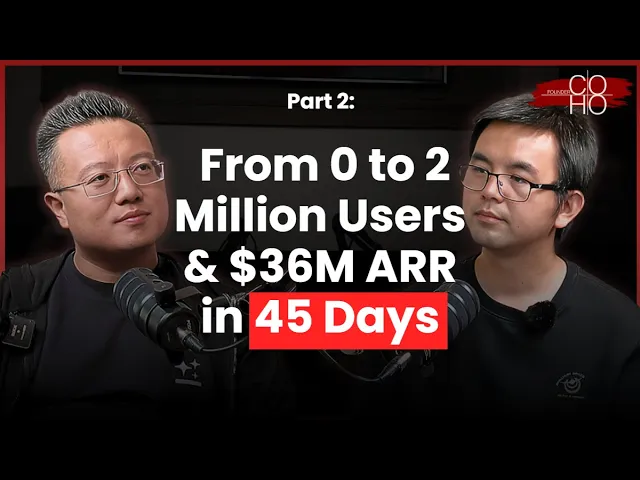
Wen Sang, Co-Founder and COO at Genspark, the agentic AI platform that reached $36M ARR and 2M users in 45 days.

|
Co-founder & COO Genspark.ai
Wen Sang — Co-Founder and COO at Genspark, the agentic AI platform that achieved $36 million in annual recurring revenue and 2 million users in just 45 days. He leads business strategy for the company that's transforming how knowledge workers create presentations, spreadsheets, and documents. With a 15-year entrepreneurial background, Wen brings unique insights on scaling technology companies in the rapidly evolving AI landscape.His journey from a Chinese immigrant to two-time founder offers rare insights into persistence, pivoting, and his vision for AI-powered knowledge workers.
In Part 1, we uncovered the hidden costs of startup success—from near-burnout after nine years in the parking industry to the personal sacrifices, hard lessons in fundraising, and the tough decision to exit. Now in Part 2, we explore how Genspark achieved one of the most explosive growth stories in AI history—$36 million ARR in 45 days with pure word-of-mouth growth. Wen reveals their bold pivot from search engine to agentic AI, his controversial stance that "there's no moat in AI," and why velocity is the new competitive advantage. Also, how their team of under 30 people ships daily using AI agents that write 80% of their own code, and his vision where every knowledge worker becomes a boss managing AI agents for routine tasks.
References
Wen Sang – https://www.linkedin.com/in/wen-sang/
Jing Conan Wang (Host) – https://www.linkedin.com/in/jingconan/
FounderCoHo – https://www.linkedin.com/company/foundercoho
Timestamp
00:00 - Highlights
01:29 - Introduction and Interview Focus
02:50 - The Genspark Journey
07:49 - AI Technology Strategy and Architecture
10:14 - Eric's Background and Impact
14:09 - The 2025 Agentic AI Pivot
16:54 - Explosive Growth: $36M ARR in 45 Days
18:07 - Why PMF is a "Last Generation Term"
20:02 - Business Philosophy: No Moats in AI
23:22 - Customer Success Stories and Use Cases
29:13 - Challenges of building the Best Product
33:51 - Building with AI: Team and Operations
37:57 - Future of Work Vision and Competition
40:10 - Wen's Vision for Genspark
42:06 - Genspark's Mission
44:17 - Thoughts on AGI
48:59 - Founder Advice and Closing Thoughts
50:51 - Outro
Full Transcript
Within 45 days, I remember 2 million users globally and $36 million of ARR. And I was like, when Genspark's co-founder Wen Sang talks about their explosive growth, I don't know, it's the honest answer. I'm still in shock.
He learned the hard way that success isn't about perfection.
Solving the right problem would give you a lot more than solving every problem right in front of you correctly. That's the number one thing. The best defense is offense. You have to constantly innovate and push out new products. It's time for me to kind of build my castle. It's gonna be a sand castle. It's gonna be crushed by the waves. But behind this building down vision lies a story of radical reinvention.
Just months before that breakthrough, Genspark was a completely different company.
We just decided, you know, the world is a different one. You shouldn't be building a better search engine. It's not gonna be about search engine, it's gonna be something completely different. That's when we went all in on agentic AI.
They bet everything on a pivot that most would call insane.
Within 45 days, I remember $36 million of ARR. It blows up. It's insane.
Now, Wen has a prediction that will either terrify you or set you free. We want everybody to have Jensen Huang's work life. I want everybody to feel like damn, I'm dreaming every day and I feel great.
If you don't jump on the wagon, someone is gonna take your lunch. It's not AI. It's people who are really good at using these super agents.
The future of work is here. Are you ready?
Meet Wen Sang, co-founder and COO at Genspark, the agentic AI platform that achieved $36 million in annual recurring revenue and 2 million users in just 45 days. He leads business strategy for the company that's transforming how knowledge workers create presentations, spreadsheets, and documents. With a 15-year entrepreneurial background, Wen brings unique insights on scaling technology companies in the rapidly evolving AI landscape. His journey from a Chinese immigrant to two-time founder offers rare insights into persistence, pivoting, and his vision for AI-powered knowledge workers.
In Part 1, we uncovered the hidden costs of startup success from near-burnout after nine years in the parking industry to the personal sacrifices, hard lessons in fundraising, and the tough decision to exit. Now in Part 2, we explore how Genspark achieved one of the most explosive growth stories in AI history $36 million ARR in 45 days with pure word-of-mouth growth. Wen reveals their bold pivot from search engine to agentic AI, his controversial stance that "there's no moat in AI," and why velocity is the new competitive advantage. Also, how their team of under 30 people ships daily using AI agents that write 80% of their own code, and his vision where every knowledge worker becomes a boss managing AI agents for routine tasks.
Let us get started!
So now I want to learn more about the Genspark journey. You mentioned about it was your tinkering year. You started to know Eric before that. Did he pitch you the idea, Genspark in your trip?
Yeah, roughly. So we're talking. He was not pitching me per se, but obviously we're friends, we're talking, and he basically told me that, look Wen, the world today is one where a lot of these major tech forces from up and coming ones like OpenAI, Anthropic, to big ones like Google and Facebook, they're all throwing money into the effort of building capable large language models. Now, imagine the world with that. What's gonna happen? How the world is gonna look like? So competing with these folks probably is not too meaningful by itself because, you know, essentially, one, it's capital intensive, two, like, a lot of people are doing that. So there is actually a kind of a version of the world where we bet on, you know, in the future, there are gonna be a lot more better capable models instead of just one monopoly. And if we bet on that future, if we write on the wave of the iteration and constant progress or improvement of these models, what can we do? Well, at the end of the day, any technology is to serve human beings, right? So if we could kind of turn or translate all of these capabilities, amazing capabilities of large language models into real work products, into real benefits to human beings, that would be really cool, right? I mean, ChatGPT, sure, everybody knows it, but ChatGPT chats, right, that's it. That's what it does. It probably hasn't tapped, I don't know, 1% of all the potential of large language models yet, or just in general AI models. And we're still seeing landscapes shifting every day, better models coming up. I saw this meme just now that they're all going circles, everybody's launching the world's best model, we're here now. So clearly that's where the world is and it will be really amazing. We're like surfers right like just surf on the wave. And build something amazing. That'd be really cool. I like hell yeah, that makes perfect sense. Right? So I was in this session, a YC event. Vinod Khosla was invited to talk about how he got to invest and decided investing OpenAI in the super early days and what's his kind of view on the, you know, the world and his advice for founders. So he basically said, this is very similar to the early 2000s when internet just came up, but a lot bigger. And people who take advantage of what AI could do and what's happening in AI would do really well. Notice he didn't say people who come up with large language models. He said people who take advantage of those would do really well.
That's a very great point. Internet is not necessarily the people who invented the internet. That actually do very well. It's the person who uses the internet to build a cool application.
So then we got on the topic. Okay, so say we wanted to do that. Who do we pick to serve right? So at that time I think yeah, the world is obviously everything's happening. You're hearing when was that? This was I can't quite, this was probably 2024. And people are hearing things about Cursor starting that time and obviously before that Copilot and then at the same time, we're like, okay.
That's probably June or July of 2024.
Probably yeah, I can't really remember but so anyway, so basically we wanted to. So there were two things, right? One was, we want to get started on building out the technology. So we did that first. This was before I even joined Eric. So he and Kay, our CTO, laid the foundation of our technology. So based off that thesis I just described, that we bet there will be more and better great AI models available in the world. And we wanted to ride the wave and surf on these waves to do great things to bring value to human beings. So we build a three layer technology that, you know, underneath, it's a model orchestration kind of system. It has the capability to call up all the models state of the art, you know, from OpenAI at the time, GPT, you know, 3, 3.5, 4, 4.5, 01, 03, all of those. Anthropic models, Claude, Google models, all the open source models, everything. So we build this technology to really form this kind of orchestration when it comes to specific tasks. We could just use the right model for the right thing because they're all good at different things right by today. We know that OpenAI models are really good at reasoning. Claude models are really good at coding. Google models are probably better at artistic stuff and open source models could be good at you know fast cost kind of tasks and so on. So we wanted to leverage the best for the right tasks, right? So we built that tech and then on top of that the thinking was okay. So large language models are good, but they're like brains, right? They're good at thinking, they're good at taking in the natural language and then come up with kind of a response. But you need to build arms and legs for them to do real work and accomplish real things for you, right? So that's when we built our internal tool layer. This is when people started to talk about agentic AI.
Eventually become like the agentic platform.
Exactly, yeah, at the time we were like, let's build tools. No one was calling, yeah. So agentic AI was kind of, now it's kind of the coined terms for this kind of tool calling capability.
Yeah, but the tool calling is actually also very interesting capability that Genspark is very good at and also I want to dive a little bit more into the roots of Genspark. A lot of our audience is probably already see some videos from Eric launching because there are so many of them. Yeah, great job. That's fantastic and I think a lot of artists...
On weekly basis, we ship daily.
That's fantastic, and I think a lot of audience probably don't know a lot more about Eric's background and what he did before he started Genspark. From what you know, what type of person Eric is and what made him to originally start his ideas of working in Genspark.
He's my big brother. I was putting it that way. Well, so who he is, so I mean he worked at Microsoft was his first job. He worked at Microsoft for a long long time, had to overlap with folks like Andrew Ng who later on, you know, he's the founder of Coursera and Coursera and deeplearning.ai. And that was before, that was after, no so Microsoft. He spent a long time in Microsoft. He was one, I think he was fastest promoted product or engineer person within the whole company. History to date, history.
Yeah, he's very experienced leader before.
Yeah, yeah. And then he got recruited pretty much roughly in the same time period when Andrew Ng and Dario Amodei, who is the founder of Anthropic, into Baidu. They had that overlap.
That was 2012? Was that around that time?
Yeah, I have no clue, but yeah, that's my impression. And then he was there for a while, and then there was this wave of smart devices and so on. So he came out of Baidu essentially, this company was, I think they got their first check from Baidu. Later on, raised a lot of money from amazing investors like GIC, Temasek, and all that. But this was kind of the smart audio box where you can talk to it. And it's like Alexa. They sold tens of millions of devices. And he grew that company to about $5 billion worth of market cap valuation. They didn't go public yet. And yeah, he just came out and decided, he's done kind of the corporate job. He's done, you know, he's being a top executive at a top tech company. He's kind of founded a company with the support from this big company, and now he wanted to start a company on his own.
He's a very very experienced engineering leader.
Product and yeah, he was training computer scientists, computer engineer, yeah, but then I think he shifted to more, you know, product strategy related tasks. He was overseeing the whole thing. He still code. He still codes from time to time.
Probably a lot of vibe coding. A lot of vibe coding, you're right. And another thing that you mentioned, he also have a long, like a rich experience of building this smart devices that interface with all these like physical world. Does that lead to some of the ideas when you are designing tools in Genspark?
I'm sure all his experiences would contribute to how we think about product. I mean, he's the PM on team. I mean, he has to do everything. But I learned a ton from him in terms of how to craft really good products that could scale and could delight a lot of people. So yeah, so he's definitely one of the, he's a world class, I'd say, obviously business leader, but also product leader, who knows a lot about how technologies work. Yeah, which is, that's scary, right?
Yeah, it's very important to have both the product skills and the technologies. For the next part, I want to also dive into a particular like evolution of the industry, like that happened in the early of 2025. What are we doing when that happened?
Yeah people were talking about 2025 is the agentic year. We sunset a project we working on before which we got to find more users. We just decided okay, we wanted to take advantage of the same technology architecture and really focus on helping a specific group of people, knowledge workers. So think about it, Cursor is trying to help the four million software developers in the country, 30 million worldwide, right and they're doing awesome. Bravo, we love that. Now people who we know the best, most intimately, are people like ourselves, knowledge workers, people who make a living off slides, spreadsheets, documents, Word docs, and everything. And historically all we and all the Google suite and all this you know amazing stuff like slack, notion, whatever right, all the tools from the internet age. So historically the way we craft our work is word by word and pixel by pixel. Human beings use the tool to generate work product. That's perfectly fine. Up until now, people are like, well, what can we do with AI? Right? Like, and our view is like, right with our technology architecture, we have in place all the amazing models in the bottom layer, all the amazing in-house tools we have available as the armors and legs for the, you know, larger language model brains. We could do so much more. Right? So that's when we launched our Super Agent Suite, April 2025.
And in order to do that, you mentioned that you also sense that your previous version of...
Yeah, so previously, because Eric and Kay our CTO they have a lot of insights in the world of searching and the first kind of, I mean startup as you know, it's kind of a journey of trial and error, right? You just try something, see how it goes. The growth was really good. Actually a lot of people loved it, but we just decided you know, the world is a different one. You shouldn't be building a better search engine. It's not going to be about search engine. It's gonna be something completely different. That's when we went all in on agentic AI and just focused on helping out a specific group of people, knowledge workers, to do better, to do more, to accomplish more with a lot less time. Yeah.
You did a really great decision. And after you launched Super Agent in April, you had explosive growth.
Yeah, that was insane. I mean it's still going like a wildfire. So within 45 days I remember we got to about 2 million users globally and $36 million of ARR and I was like...
36 million ARR in 45 days? How did you do that?
I mean, I don't know. It's an honest answer. I think today's world, if you have a good enough product and distribution is not blocked by procurement processes, because everything's digital, you can just sign up. And the words get spread really quick, right? Word of mouth, it's pure word of mouth, product-led growth. If your stuff is good, people are going to talk about it everywhere online. On X, on LinkedIn, on TikTok, on Instagram, and by human nature, people who ever see those, they would want to try. And yeah, I mean, it's just, it blows up. It's, yeah, it's insane. I'm still in shock.
That is the definition of product market fit, which is growth and like you're like people evolve and you shock and understand what's going on.
Yeah, but look. I mean, this is kind of separate topic, but in my view, product market fit is such a last generation term in a way that I don't mean it's not important. Product market fit is absolutely important, but what I am saying is it's not something once you have it, you won't lose it, or once you have it, it's just gonna be there for you forever. Disruptors getting disrupted these days, right? Like back in 22, everybody was like Copilot, right? And then it's Cursor. And now, nobody talks about Claude, everybody's like Claude Code. It's the same thing.
It's a dynamic thing.
Yeah, yeah, why? Because large language models are getting better and better every day. They're pushing the boundaries. And at the same time, more people are jumping into this AI game, right? Trying to build amazing stuff. I've met so many talented founders in the past months who are just building amazing things. Everybody wants to kind of do something and make something awesome and get something out of it. So this dynamic is just great. It's like pure innovation. You're experiencing this every day. With this, there's no way one could just sit on the PMF and say, hey, we're all set. Let's now optimize for the, let's tweak the knobs and then see how we can squeeze out more. Absolutely not. You have to constantly push the product boundary. That's what we're doing every day at Genspark as well.
Yeah, you had a very great point like a product market fit is not a static concept. It needs to be earned and constantly maintained through hard work. And the last time we talked in the last event, I heard a very interesting yet controversial statement you made. It is that there's no moat in AI. Tell us more.
Yeah. That's... Well, look, so I may be exaggerating a bit, but what I meant is... When you talk about moat, it is a concept of defense. You're trying to protect your business from potential competition and so on, and in my view, that is just not possible in today's world. Why? Because as we just talked, the technology landscape shifts so quickly. Large language models are iterating every day. And so many people are jumping in to do all the amazing stuff constantly. The only way to win and our view is speed, velocity. You gotta go hard, go quick on constant innovation, constant releasing, coming up with new stuff that people love, people wanted to use that creates real value, that makes money for the users. That's what we're trying to do. And that's what a lot of power users told us, why they're constantly doubling down on us. We're making money for them, not just that it's something they use to consume. Only by shipping so quickly, so rapidly, and creating constant and more value for the users, you can survive and potentially get to the other end of this whole wave, right? If one just thinks, okay, it's time for me to kind of build my castle, it's going to be a sand castle. It's going to be crushed by the waves. We're going to surf. We'll just keep surfing. You know, find the new wave and then just keep going. That's what we do.
Exactly. So what I hear you say is that you think the velocity is the moat. It's like when you mentioned about there's no moat in AI, you were referring there's no traditional moat like data moat or technology moat. But the velocity is really the new moat for the AI.
I would just say my view is that kind of the framework of thinking about moat or defense is not what we're focused on today at Genspark. What we're focusing on is you know offense. The best defense is offense is how we would kind of look at it. And how do you do offense in today's world? You have to constantly innovate and push out new products that generates real value. Users tell you that I love this. I was just looking at this LinkedIn post yesterday. A user basically said he experimented with Genspark and then canceled four of the other AI subscriptions he was paying for. And why? Because not only he was getting stuff done, but also he was making money by selling his work product to his customers with Genspark. That is kind of the, why do people love Cursor? Well, you can have production code and that's real work with real value. And why do people want to use Genspark? Because they can craft real work product and they could make money off those real work product.
And it seems to be for many industry, like traditional industry, different countries. What are the most three most interesting use cases you have seen?
For example, this user from Michigan told me, young man, Michael. He said, look, I'm trying to start a company by myself, but I need to support myself. So what I do is I build websites for my, you know, freelance kind of websites for my customers. I get customers, I don't know how to code myself, so I would hire someone like in Poland or India to build these and then I sell the websites. And now with Genspark, 20 bucks a month, I don't need them. My margin just went way up. That's his story. So I'd say, I think there are, I'm also learning, you know, amazing use cases that I would personally never think of from a lot of these power users. This marketing professional, Sarah, based in Nashville, she's like, okay, look. I have a lot of these amazing people asking for marketing materials or lead magnets, whatever, from me and they'd be willing to pay money for it and also some kind of automated workflow and I don't know how to do it myself. I just throw a task at Genspark and then Genspark will build for me and I'll just turn around and sell it. A few thousand dollars a piece, that's amazing. We plan to keep doing that and empower, you know, solopreneurs, consultants, bankers, CPA folks, all the, you know, executives in the boardroom who's tired of building so many slide decks, people who are too busy to take meeting notes, people who are just, you know, having like 100 emails waking up every day waiting for them. Don't want to write emails, you know, by themselves. I don't write my emails these days. So every morning I just, just scan through my inbox, lay out, you know, all important stuff and urgent stuff, drafts the top three for me, and then I'll take a look and then send it. It's a dream, three day work week. So of course you can choose to, you know, accomplish more or earn more or you can choose to just take a break. That's up to you but what we're seeing is a world where human beings flourish, human beings get elevated to focus on the high value, high leverage stuff while AI gets 50, 60, 70, 80, 90 percent of work done for us and then we give it a final touch and of course human beings take responsibilities.
Exactly. I think what I have is that because there are still so many interesting use cases and also the market and technology is moving fast. So the best move now is and adapt to it.
Yeah, that's our view. Besides that, we've also gotten a lot more, we've been flooded with actually corporate inbounds since the launch of the Superagent. So seems to me what happened was when individual users tried it, they were like, oh wow this is great, I need to get my company to buy this for me and I need to recommend this to my other colleagues so we could really you know trade notes and or in the future maybe even work together on projects and so on. So all of a sudden we're getting you know inbounds from oil gas company you know from South America, PE firm in Japan, investment bank in London, the government agents from Dubai, real estate company in Texas. These folks reached out to us and they were like we want a piece of Genspark, do you guys have kind of a group plan and that was actually what drove us to release our team plan and enterprise plan about just two weeks ago.
Two weeks ago, I saw that video. That's very interesting. One thing that you mentioned, I also heard from many other founders mentioned about is when we build startups in Bay Area, we often think about our customers, our startups, in these small bubbles. But there's a lot of companies like the oil industry is in the different parts of world. The real people, are using, and if you ship and give the product to them, they will find out the creative use cases and they will come to find you.
Yeah. Yeah, exactly. One of the CFOs of this public insurance company told me, look, when we tried like 20, 30 tools on the market, you guys, your work, your AI slide, your AI sheet is boardroom ready. And I'm like, wow, that, I mean, the quality of the work product definitely makes a difference. So that's what we focus on. Our sole focus is to craft the product, you know, and make it so much better. So I say this to everyone, if you love Genspark Super Agent today, you'll love it even more tomorrow. Why? Because this is going to be the worst version you're ever going to use. We're going to make it so much better day after day. And yeah, our users give us amazing ideas to continuously extend our roadmap. And yeah, like what we just talked about, the corporate clients reached out and they were like, we want your team plan. So they drive us to really come up with these amazing you know, new product features, capabilities. And now, I'm spending a lot of time on working with amazing partners like FANHA and so on to get through SOC 2 type 2 compliance for us certification. Our practice is already pretty awesome, but we need to get those, you know, trust portals up running, get the, you know, certification done so we could serve a lot more enterprise clients is also one part of what I'm doing day to day.
Yeah, so a follow up question on that. I think you laid out a beautiful vision about when knowledge workers are empowered with Genspark agents, how beautiful this, like everyone can just dream with their own ideas. What do you think is the biggest hurdle before you can achieve that vision?
I think I don't know if I call that I mean there are definitely challenges all around. In my view though, just like what we talked about before for any new technology to kind of hit the market. There was always this adoption curve right like it starts with the you know innovators and then early adopter and then kind of the first half of the adopters and then you go mainstream, and then there's the followers, and then there's the dinosaurs. So how to essentially make the product available or more, you know, how to create more awareness that this thing exists is important because there are also a lot of noises out there, right? People charge for showing a list of AI tools, selling classes, you know, people for hundreds of dollars an hour. That's how much noise there is out there. Now, so with this chaos, how do you cut through the noise? Because I'm absolutely confident if one has tried Genspark, within 10 minutes you're gonna see value. And you're gonna want to keep using it. But how to essentially get the initial engagement or the interaction going is kind of a topic that, you know.
You mentioned a very great topic. A16Z recently published a mantra saying that distribution is everything. Do you agree with them?
I mean, from the perspective that nothing matters unless users could use your stuff, of course. But there are different ways to get there. Now, at Genspark, so far, the only thing we have been focused on is crafting the product. The good thing about that is if your product is really good, purely based off the word of mouth today. You can get amazing growth. But what I am talking about is from this point on to the trillion dollar company vision that the future of work is just different in a way that human beings are only doing the last 10% and then giving their final touches. From here on to that point, what we wanted to make sure is no one is really missing out simply because they don't know that we exist. That is, I guess, too, A16Z's point. Distribution is absolutely important. Yeah, yeah.
Yeah, exactly. Yeah, there's like you mentioned at different stages, whereas a word of mouth, we have an awesome product. It can expand to a very large group of users and who are tech, they're aware of technologies. But there's more people, like you mentioned, that even ChatGPT's are building while the world population is eight billion. There's a lot of people, they probably never used very AI before, or they don't browse all the traditional AI forum to see those information. How do you reach those group of users is very important.
I mean, clearly we're just getting started here, right? We're still in the super early stages. ChatGPT is the first wave, and people are going to want to take on a lot more AI tools, capability services, and so on. For us, I mean, internally, we so far mostly focused on product-led growth, basically word of mouth. But moving forward, we are engaging more efforts when it comes to marketing-related efforts, PR efforts, as well as we do communities, events, we talk to amazing people like yourself. Yeah, we're doing everything we could to help people to get to know us.
It's amazing to have you here. I am paid Genspark user. We absolutely love the product. Thank you. We love our users. It's amazing to see that you can ship a feature almost every single week. And I am very curious, how did you do that? How big is the team?
Well, I think we're not yet 30, but we're probably getting there to get to 30 people.
It's like less than 30 people and you shipped like...
Look, I'm the only guy who doesn't code on team. Everybody else, we have a complete flat kind of org structure. So every one person or one or two people would take on a project and they just run with it. And then they just keep shipping. And that's how we have a portfolio of new products that we've only executed like 10% of our products roadmap right now. The way we look at the future is, we're building the future of work. Essentially.
And you are living by it by leveraging a lot of the tools.
Absolutely, you have to. These days, before I apply myself onto any task, I throw it to our super agent first.
So I want to dive a little bit deeper into how you organize your whole crew to make it happen. You mentioned you are dividing the whole team, the Genspark team, into a smaller team. Each is responsible of a project.
It's more bottom-up than that actually so basically everybody on team except myself is a full stack developer with great product sense and certain business sense.
So everyone is full stack to both frontend and backend.
Exactly and we do have dedicated folks to I mean obviously people have strength and you know weakness so we kind of compensate that from a team perspective and we have dedicated folks for DevOps for infrastructure for you know dealing with all the large language model APIs and so on. That's where we kind of really have that team platform. But from a product standpoint, it's really everybody's running with their own project. And that's what, I mean, I'm probably sharing too much here. Letting out all the secrets. Yeah, but I mean, look, large companies are not capable of organizing their work this way.
Yeah, you mentioned a very great point is that the startups now are able to move way much faster than the big companies even if they have 10x more of the employees and for your case because you are serving knowledge workers and I'm very curious of how you are leveraging Genspark to develop Genspark. Any story to share?
Absolutely, so I mean 80% of our code is written by our agent. Yeah, so, I mean, obviously underneath we use Claude Code, right? A lot of times, anything that is related to developing a PRD and or spec out kind of the UI and coordinating among each other when it comes to having meetings. We have our AI meeting notes. When it comes to building out a of a storyboard or whatever, we have our AI slide. If we're modeling kind of the certain perspective, certain products, we have our AI sheets. Yeah, I mean, sure, there's a lot of, you have to dog food your own thing, but I personally, I mean, I'm also fortunate in this perspective, I just ask for more free credits when I use them up. Yeah, a lot of my work is done by Genspark Super Agents from responding to clients' emails, crafting those messages to prepare for the client meetings, all the way to craft my LinkedIn posts. Yeah, it's amazing.
Yeah, that's a very amazing world in which there's many agents that would do work for us as humans. I have a follow up question on that. A lot of people are talking about the future of work as now we have more and more agents. In fact, we had a live stream just last week with the Stanford researcher about what the future of work would look like. From your perspective, what do you think the future of work would look like if everyone is using Genspark?
Yeah. Actually, yeah, to your point, there are scarier statements out there saying that knowledge workers are gonna go away, jobs are gonna be taken by AI and so on. We just don't see the future that way, okay? Knowledge workers are the pillar of the society, obviously, and our view is when AI is capable of doing more, accomplishing more, human beings are gonna get elevated and everybody becomes a boss, right? So we all get a promotion. You have a fleet of Goldman Sachs associate in your pocket who is competent, smart, fast, never tired, capable of working on your behalf for a lot of the things that you used to have to craft like little by little. That is just amazing. You can blast through all of these work tasks like you used to have to spend a week in, I don't know, two hours. That is kind of the time gain and efficiency gain we see in the future of the world and the future of work. And if you don't jump on the, I mean, if you jump on the wagon, you're clearly gonna lead, right, within your org. If you don't jump on the wagon, I mean, yeah, someone is going to take your lunch. It's not AI, it's people who are really good at using these, you know, Genspark Superagents.
So it's not the AI who are taking people's job. It is the people who are using AI.
100%. Yeah, 100%. I yeah, I mean, to today, like, people stopped talking about AGI, right? Like everybody knows it's kind of marketing terming away. I mean, it may still come but hey, look, realistically, what what has happened so far is breakthrough AI technologies that can be leveraged to help us to accomplish more work. And we're just focused on that realistic perspective.
You mentioned about a very great point, which is AGI. Like back two years, in past three years, this term has been talked extensively. And people talk about the general intelligence and future of that. And you also mentioned about that last discussion about AGI. And from your perspective, what is the vision that the industry is forming? What is the vision that you have in Genspark?
Yeah, I mean, we can look at this basically back, of, compared to when internet happened before that, Bill Gates called it the, called the internet the highway of information. Yeah, I remember that. I think it's similar, in a way. To a certain extent, AGI is defined by everybody and every agency in all different ways, right? Like, from a day-to-day knowledge worker's perspective, I'd say if this thing could give me a lot of benefits of, you know, saving me time, saving me efforts on getting the actual work done, it's a balance, right? So there is this fine balance. If you all in all spend less time, less energy on to getting the same or even better results than without the super agent, super AI agent, then you're better off with it. And then you can call it whatever intelligence you like, but it is intelligence. And our goal is to crystallize that. Our goal is to capitalize on that. Our goal is to make that a really useful part for your day to day. You can call it AGI. You can call it whatever. But what is important is, you know...
Yeah, like the productivity boost. One interesting thing I have for you is that you put a different anchor point as the vision. Like in AGI, the anchor point is about the general humans. It's a human as a species. And in your case, you're comparing with the status quo. Like if the knowledge workers who use the Genspark agents get a lot of benefits, like X percentage of benefit. That's already amazing world to be in.
Yeah, yeah, I mean we got for anything we got a kind of care about the why right like sure we talk about AGI. Why do we talk about it? At the end it comes back to human beings. Human beings is what I care about, is what we care about. We want to make human beings life a lot better and we want to unleash human potential. That's what we're all about and when it comes to how to leverage AI to do that. That's our mission. We want the future of work to be so enjoyable to be so awesome like everybody probably remember what Jensen Huang said, he said I never work, I just dream. How is he capable of doing that? Of course he has millions of people working, not millions but hundreds of thousands of people working for him right? He doesn't have to craft his work word by word. We want everybody to have Jensen Huang's work life. I want everybody to feel like damn, I'm dreaming every day, and I feel great. That's what we wanted to do.
Yeah, that's a very beautiful picture to have. And I think the future world will be very good for the ideal person, like the people who have a lot of ideas.
I think everybody could be that person. I think for too long, we're being suppressed with all these mundane work that our creativity couldn't come out. Imagine, imagine AI allows us to do that. It's a better world.
It's way much better. Like you mentioned that as we are all empowered by the agents, our creativity will increase by a large extent that it will lead to a better future. I want to dive into another topic. I know we talked about AGI and your version of the future. The company who mentioned about AGI a lot is OpenAI. They have a lot of users. I heard they have kind of close to a billion users. They have thousands of users. And from your perspective, how do you view the competition for OpenAI? What if one day OpenAI say, I want to eat Genspark's pie?
Huh. Look, I view the world in a way that I mean, I'm not to sugar coat it. There is really no competition. I respect OpenAI as a pioneer of the industry. We respect OpenAI a lot. We work together very closely, actually. Our technology is only possible because of the amazing work done by the OpenAI team and, you know, Anthropic, Google, and a lot of these amazing folks, right? If a lot of people ask, what is AI native? It might be AI native is what what is possible only possible because of the amazing work, you know based off, you know, you know OpenAI and Anthropic, Google all of these, you know, amazing folks work on the model side. So ChatGPT has a near a billion active users. Yes, and that is fantastic. Why? Because the world we have what seven billion people out there. Whenever there is a new technology hit the world, it takes time why it kind of penetrate the world and then just you know make waves everywhere, right? ChatGPT is absolutely the first wave and it's an amazing wave. A lot more people got aware of what is possible and got inspired and started jumping in to build and so on, including us. Now what we're focused on though is, how do we, if you purely just look at the product, what ChatGPT really focused on today is to give you really thoughtful, awesome response. ChatGPT chats. What Genspark Super Agent does is we deliver, we do, right? We don't talk much. We think, we do, and we deliver. That's today kind of what we focus on. Now in the future, I'd say, yeah, the world is our oyster. Everybody has a chance. It's this level playing field. Everybody has access to all of these amazing large-language models as long as you have an idea, you have the ambition, you wanted to commit to your mission. Everybody has a shot to build the amazing products that people could really you know enjoy, could people could really benefit from and people could really you know love using and tech in general, it's ever-changing thing, right? Like there's no, there's no way you can say, simply because one company becomes successful at one time, then that's it. That's the end of the game. I mean, look at Intel versus Nvidia, right? So yeah, I'd say quoting Andy Grove, who was one of the founding president at Intel, the paranoid could survive. And that is one thing that will never change, in my view. Everything else changes.
There's 8 billion people in the world. And even ChatGPT already has a lot of users. We're still in the first wave. Yeah. And there's a lot of room for stuff.
Yes, a lot of people would, I mean there's no, so I know this as a fact, a lot of our power users, they're like rather kind of the early adopters or innovators. Whenever there was something new, they would jump onto it. Actually when ChatGPT came out, they were the first group to jump on. When Genspark Super Agent came out, they were the first group to jump on. And once they've used all of these, they would craft these different available solutions or tools to their need, to their like, essentially to make it valuable for them. And if there are like, let's say, here and there from time to time kind of competitive dynamics among different products, that's fantastic. That's good for the users, right? And that's good for the world.
In fact a lot of technology revolution we had before in the past few cycles like computers, personal computers, like internet. There's always competition. Competition is a norm when you are building all these things.
Yeah, it's a great thing. Cool. Really appreciate you taking time to share with the community. Coming to the concluding part of the interview, I would like to dive back a little bit of founder journey. There's a lot of our audiences are aspiring founders and founders in the early parts of their career. Imagine 10 years, yourself 10 years ago. What would be your advices to them given all the learnings you had in the past like 10-15 years of startup journey?
That's a deep, profound question. I'd say if I'm talking to myself 10 years younger, I'd probably say solving the right problem would give you a lot more than solving every problem right in front of you correctly. That's the number one thing. Number two, I'd say take good care of yourself. If you don't do that, you're a mess and no one is gonna want to work with you and you're not gonna produce much. You gotta take good care of yourself first physically mentally everything then take care of your family and then everything else would follow through and it'll be good. Yeah.
Yeah, those are amazing advices and I'm very, very, really like resonating to me. Like you mentioned actually making the right choices. It actually provides very high leverage. And also this is a journey. This is not, this is not like sprint. Like you just do this a couple of months and you are done. This is a lifelong journey. You have been here for more than like, 10, 15 years. 15 years. 15 years. That's a time. And a lot of the founders I met, it's like, this is a whole life long journey. When they started to become a founder, they never go back. You gotta live a little as well. Enjoy it, like you mentioned, put away, like take care of yourself, take care of your family, people support you. It's a journey you're going to make, the journey to be fun. Yeah.
Yeah, 100%. Yes.
Awesome! It's so much fun to have a conversation with you. I really appreciate the conversation sharing community.
Yeah, I enjoyed our conversation. This is amazing. Thank you guys for having me.
Thank you.
Thanks for watching the full interview. If you got value from this conversation, please like drop a comment and subscribe to FounderCoHo. We've got more founder insights and deep dive interviews coming your way, so don't miss them. See you in the next one.