Interviews
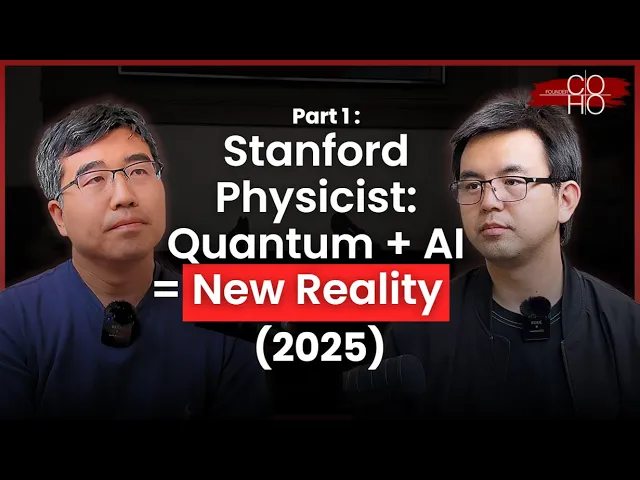
Stanford physicist Xiaoliang Qi on quantum entanglement, AI, and redefining reality, with 84,000+ citations.
|
Stanford Professor Co-Founder @ Path Integral Technology
That's just one mind-bending revelation from my conversation with Prof. Xiaoliang Qi - a Stanford physicist who went from rural China to unlocking the universe's deepest mysteries at Stanford. His story will completely change how you think about reality. The Incredible Journey: At 16, Qi scored #1 on the Gaokao exam in his entire province, which had a population of 37 million people. But his real breakthrough came from a small local library that opened his eyes to physics. Now with 84,000+ citations, he's proving that "if it's beautiful, it must be true" - a philosophy that's revolutionizing physics.
Mind-Blowing Concepts You'll Discover:
- Quantum Entanglement: Why particles instantly "know" about each other across the universe (Einstein called it "spooky")
- Traversable Wormholes: How negative energy could let us travel through spacetime
- The Holographic Principle: Why our 3D world might be encoded on a 2D surface
- Quantum Computing: How we're building computers that think like the universe itself
- AI + Quantum: The powerful combination that could solve impossible problems
Reference:
- The Lucien project aims at building the first AI scientist platform with the global research community. (X account:@Lucien_Science)
- Prof. Qi Linkedin: https://www.linkedin.com/in/xiaoliang-qi-a5b9a615/
- Jing (host) Linkedin: https://www.linkedin.com/in/jingconan/
Timestamp
0:00 - Highlights
1:28 - Introduction and Interview Focus
2:43 - From rural poverty to academic excellence
4:56 - The library that sparked a physics revolution
8:16 - Academic Journey and key people
12:18 - Journey to Stanford and meeting his mentor
15:03 - "Have faith to nature" - the principle that guides discovery
18:00 - The holographic principle: reality's biggest mystery
22:42 - Creating wormholes with negative energy
24:54 - Quantum entanglement explained (finally!)
27:00 - Revolutionary applications of quantum communication
31:04 - Where quantum computing stands today
35:04 - Why thousands of qubits matter
36:17 - How AI fixes quantum computers' biggest problem
40:27 - Using quantum computers to understand quantum reality
40:59 - Outro and preview for part 2
Full Transcript
I think that's really essential. Have faith to nature.
It's so beautiful. It must be true.
This is the philosophy that changed everything
for one of the world's leading quantum physicists.
The most important part, maybe defining the
question to define what you are interested in, gather all the related information.
Once in this mode is very natural to do the frontier research
From rural China to Stanford University. Professor Qi discovered that asking the
right questions, matters more than having the right answers.
I was born in countryside in a village in northeast
China. The material life is really different.
but you feel like a lot of parts of the modern life, they're not really so essential.
Growing up in poverty. Taught him what truly mattered. At 16, he became number one in the
GaoKao exam in his entire province which had a population of 37 million people.
There was a library. Which was like something I didn't know existed when I was in the,
in my home. That's the time when I really just fall in love in physics, we are starting to
realize that these very different phenomena in the extremely early universe, gravity
and quantum mechanics work together that's related to the very daily life, things like
how you pour hot water to the cold water.
He's now unlocking the secrets that connect
blackholes to your morning coffee. Using quantum computers to traverse wormholes and proving that
the most beautiful theories in physics
must be true.
Meet Dr. Xiaoliang Qi a physicist-entrepreneur who believes beautiful math must exist in nature.
From a poor Chinese village to Stanford professor with 84,000 citations, his journey is remarkable.
At 16, he was the top scorer (1st out of 200,000+) in his province on China's national exam,
blazed through Tsinghua University, and is now winning major physics prizes.
But he's not just an academic, he's also revolutionizing scientific research as Co-Founder of Path Integral Technology,
using AI to revolutionize scientific research through their platforms txyz.ai and lucien.science.
Today we're exploring mind-bending physics that sounds like science fiction. Dr. Qi will
explain quantum entanglement - "spooky" correlations across any distance, why we
might build traversable wormholes, and how quantum computers could solve impossible problems. We'll
discover the holographic principle - the idea that our 3D world is encoded on a 2D surface,
and learn how his AI company is revolutionizing scientific research. From quantum-AI combinations
unlocking room-temperature superconductors to his vision of human-AI researchers
working together to push the boundaries of knowledge itself. Let us get started.
I was born in countryside,
in a village in Northeast China. When I came to the city, I came to Beijing for college and then
came to the Bay Area. I feel like this kind of
experience when I grow up in the countryside,
in the village, taught me a lot about this, what is important.
because like compare with let's say kids growing up here.
the material life is really different. But you feel like all these modern,
a lot of parts of the modern life
they're not really so essential because it doesn't matter whether you have like hot water,
at your home 24 hours or not and all these things doesn't really matter because when you learn the
same kind of knowledge and got excited and then so it's that kind of experience which I think
it gives me some different angle when I look at the different
lifestyles different countries and yeah it gives me some different feeling.
Yeah, what I hear is that you learn the first principle from a very young age,
the first principle of life. And that's also very useful for many research and also start of
life as well. I realize that later you did all the, you did great in school. I heard you are
ranked number one in whole Liaoning province.
The primary is more than 20 million population.
I forgot, population wise it's probably several tens of millions. I forgot how many people take the exam that year. But yeah, was 1999 and it was a little surprising. I was 16.
Wow, that's cool. Yeah, so you basically had a great achievement at a young age and then
went to Tsinghua University, which is number one university in China,
and then you chose physics. Tell me why, why you chose physics?
Yeah, actually the choice didn't happen when I go to Tsinghua. It was earlier. So
this was like when I was in the first year of my high school. So I think that was a time
when I went from my village to this little city where I had the high school. That's my hometown,
Kamping. And then I experienced a lot of change. One of the things that
mattered a lot for me was there was a library which was like something I didn't know existed
when I was in my home. So this was a dramatic change because I read different books and then
just fell in love in physics when I read the books about physics and also about physicists like about
biography of Albert Einstein. So that's the time when I really just fell in love
in physics and then I also start to feel maybe because I was interested in math
and philosophy and physics, these different things. So I kind of feel like I need to set some goal. Like before that, I just never thought about this, but that was probably also the right age to start thinking about these, like what's the goal of my life? So when I think about
this naturally, because I already fall in love with physics, I said I think if there
is one principle that I should set so that I won't be like, I won't get lost when I meet
all different situations because I have this clear goal, then I was set the goal to be doing
physics. So that was like two years before I go to college. And then ever since, I have
never dotted that goal. So when I feel like what majors I want to go to, like when I take the exam
you need to say which departments you want to go, I chose physics and applied physics.
These are the departments I chose when I went to Tsinghua.
Actually I have very similar experience like
you. When I was in high school, I found a library in the school, and it has these incredible books about artificial intelligence back then. I read it and it end up becoming my career of life. I think the key takeaway I from both of our learning is that we should have a free public library available for high school students.
Yeah, that's a really important thing. Of course nowadays library may not just mean books,
but it could also be other formats like the AI agents and make these more available.
The access to the knowledge
Access to the knowledge is really
The access to the knowledge is incredibly important especially for young kids that will shape their future. And
without that library in the book over there, we wouldn't have a Stanford Professor research about
the most advanced topics in Physics.
Yeah so you chose your life passion
very early on decided to do physics in Tsinghua university and you did excellent job over there
you've got your both undergrad and PHD degree in combined only eight
years which is incredibly fast How did it make it?
I think it was a combination of being lucky and
has the passion to really focus on this. So I think I really had been very lucky.
I guess it's not just that, you must be working very hard in the schedule.
Yeah, it's like from, it was a really good time,
good timing, because when there was the Institute for Advanced Study in Tsinghua University
which was founded by Professor C.N. Yang. He was one of the Nobel laureates in Chinese Americans.
So that was founded like two years before I go to Tsinghua University. And then related to that,
they have this fundamental science class that focus on more like science and focus on mainly
physics and math and the class was founded like one year before I come to Tsinghua so it was
really good timing like when I entered Tsinghua
in 1999 there is a really good program both in
term of the education and also the research so like we got all these deeper classes that are
suitable for doing research but also we get closer to these research opportunities so that's
really given me a very good environment. I think the other thing that was helpful was
yeah, for me, because it was clear I want to do research and it's clear I want to do research in
physics, so I spend a lot of time thinking about physics in my undergraduate. It means a little
different from the regular way students work on physics, because usually students spend
more time on attending the class and then do the homeworks. And I think for many purposes, when you want to do research, that's not deep enough. So it's really important to
just spending a lot of time just playing with the thing you learn
about and come up with problems yourself. Just investigate, just like doing research.
Even when you are in undergrad, because you know you want to do research in the future
you start to proactively think about how do you apply this research thinking in your study.
Yes, so I think that was really helpful for me. I didn't even want to spend much time on doing
homeworks, but instead I want to, when I learn something new, I come up with questions myself, like what are the interesting things I want to know, and then I will try to do research on them,
and only if I couldn't figure out, I will go read some more. But I will first try to do these kind of things myself and spend a lot of time in the library just working on this. So I think that was the, it's kind of like
practicing for the future research I'm going to do and that feels really helpful for me.
So that's also a great tip for many students who want to do research.
Yeah, because the most important part may be defining the question. Like, if you get used to just take the class and do the homework, and if you do well on the homework, you think you are done, then when you go start doing research, you will feel like, okay, I don't know what I'm interested in. I'll just go ask the advisor what
topic you want me to work on. But instead, the really important thing is to define what you are interested in. And then with that goal, gather all the related information and do that.
And once you are in this mode, then it's
very natural to do the frontier research.
After graduating
from Tsinghua University, you came to US for the postdoc. And your professor is a Stanford
professor, Shoucheng Zhang. Can you tell us more about how did you get out of this opportunity
and how did you like the new life in Stanford?
Yeah, this, so to continue what I was describing, I was really fortunate and then we had this Institute for Advanced Study in Tsinghua University, which bring in a lot of the interactions between China and the international research community, particularly in the US, because like the whole Institute was founded by a group of scientists coming back from
from the US. So that brings us as students a lot of opportunity to learn what are the new things happening. And among them, Professor Shoucheng Zhang was one of the physicists who often did it.
And he's one of the leaders in the condensed matter physics, which is the physics research on all kinds of macroscopic phenomena, like materials like crystal, solid, and all these.
and discovering new phases of matter. That was also what I worked on. I was working on
in the same field but for different topics. then, Shoucheng certainly influenced me and many other young people at that time. He's very charismatic. The ideas he described in his talks certainly had a lot of influence on me and also these ideas.
inspired a group of people working in this new direction, later known as topological states of matter. So that's the thing that
I, me as a student, was a quite exciting time.
It was a quite exciting encounter. I had all these ideas I was thinking about and some of them are related to this new direction.
So this new direction hasn't been defined yet. At that time, then I met Shoucheng
and then we started together working in this
direction. And it turns out this is like
Now you look back, you see that these are the time where this new phase of matter is
being discovered. So our works are among these pioneer works in that field. Yeah, so that's how we started working on this already when I was a student. And then naturally I came as his postdoc here in 2007.
it looks like your mentor, Shoucheng, has played a very critical role in your career.
I'm curious about what is the biggest impact he has on you outside the physical research.
Yeah, so outside the particular physics
research directions here at Pioneer, I think I learned a lot about the style and what makes a great physicist like him. One thing I feel I think is really essential is have faith to nature. This is what he told us. It means that when we
have these discoveries, like we together
worked on this new thing called quantum spin how effect topological insulator and that's the time when
At the beginning we have all these theoretical ideas, like if this happens it will be really interesting. But then, like me and many other people, most other people, feels like this is just a theorist game. Like,
okay, I came up with this idea and say, what if this, this happens, it will be dramatic it will be wonderful. But I didn't really believe that this will actually happen in nature. Because there was no reason, like nobody knows where to find this material. Like, is this just our made up story?
or is it like actually happening in a real material. But Shoucheng is the one
who strongly believes that this will occur. And then he has, he knows how to like connect with
experimentalists and like understand the realistic part. But that's all driven by his belief that
this thing is so beautiful, it must occur in nature. And this thing just, this is the key thing that later when I ask him,
At that time we didn't know whether this
will work. How do you know this will be the right direction? He doesn't just convince me,
he convinced many people to work on this and that's how this field got started. And then his summary is have faith to nature. Basically it means it's so beautiful, it must be true.
Have a faith to nature,
it's such a good standard to describe about the instincts that Shoucheng and you have about a
lot of the physics theory and the phenomena behind it and in fact this principle also applies to many
other things like you have to have the faith, a lot of times even you don't obviously
see the things, you have to believe it and continue work until you see it.
Yeah, because that seems to be the deepest mystery of nature. That there's a lot of things that are mathematically beautiful
and there's no reason they are correct, they are true, like in our real world.
I'm very curious. that if you pick one that you think is most beautiful thing and people haven't really proved it exists yet
what would you pick?
Yeah, I think the thing that hasn't been proven, what makes me feel most amused about is this holographic principle. It means that this relation between information and the space-time.
and like why there are certain things like area of the black hole which is related to concepts like entropy which is counting how many uncertainties is in a system. But this is like the one example where we don't know for sure that's true but there are so many evidence seems to suggest this is true and it's kind of very surprising.
Yeah, that's a very fancy topic that you mentioned about. You are doing the research here that connects the reading information and also the formations of the Blackhole theory and why it exists. And for the audience who has less background on both the field, would you please explain why this problem matters? Why you are so passionate about this problem?
Yeah, think maybe because when I started to
fall in love in physics, one book that affected me strongly was a biography of Einstein. So I always feel like space-time is really the deepest mystery I want to understand. And also, it's true that.
Most other, basically everything else we understand now is based on quantum mechanics. So gravity is the only thing that's standing outside, like standing alone as something that we don't know how to connect with quantum mechanics. So all the other force, like we have these four different fundamental forces. We have electromagnetism, strong force and weak force, and gravity. So all these, the other things, we mostly understood them. This is known as the standard model.
And they are all within the framework of quantum mechanics. But gravity is really the remaining deepest mystery that we don't really have any fundamental theory. And so it could matter for understanding fundamental things in our universe, like why do we have this expanding universe and dark matter and dark energy? All these things we observe and we still don't know a reason.
Maybe this will give us some reason. So that's the motivation I feel like
this is like the most fundamental thing we want to understand. But also, it's.
It's not like only relevant to these very far away things in cosmology.
This connection with information seems to suggest it's something that happens in.
our lab in our daily life. It's not something that's, it's kind of like Newton's time when
Newton realized that this apple falls and it's the same force as the moon going around the Earth. Like in our time we are starting to realize that these very different phenomena like how this, in
the extremely early universe, gravity and quantum
mechanics work together. That's related to
the very daily life things like how you pour hot water to cold water and then they
equilibrate into warm water. This is known as the thermodynamics. So this is related to how the black holes absorb some matter and become a bigger black hole. This is the
There are some fundamental principles that both
apply to the whole universe but also is applied in fact. And what you mentioned is such a fascinating description about the field. It actually reminds me the movie of Interstellar. When I was watching
this movie, was also. that movie gave me a
lot of education about physics as well.
I think there are some CalTech physicists
that will give consulting to them.
Exactly, that was very fantastic. One thing I remember very clearly about is its description
of gravity and in fact in that movie they used gravity to communicate information for
when the main character was get stuck in
a library in a high dimensional space.
Yeah, actually
that's related to my research field. A few years ago I had some works in this direction called Traverse of a Wormhole. Like how do you traverse through a wormhole and then like, and this was a collaboration with Juan Maldacena, he's a leading string theorist in the Institute for Advanced Study in Princeton. This is an example, this is exactly like all these sci-fi movies, the central concept that people are interested in.
is this like how do you go to the past or like
how do you travel across through space-time using this wormhole and then it was known to be not possible unless you have negative energy and then if you have negative energy you could like go create a wormhole and then you can go to some other part of the universe effectively much faster than just traveling there and so that's our traveling to the
past. And then what we learn now is what does this negative energy mean? Like in principle in the lab, what do you need to do to create this kind of negative energy? And that's by creating quantum entanglement and like having some kind of control on far away qubits,
controlling their coupling. So in these kind of ways, you can create effectively negative energy and traverse the space time.
I think you're right people are very fascinated about this gravity and this concept because of the way to transport either travel through time or to transport information through the wormhole. And you mentioned about another interesting concept is that in order to do that, you need to create a negative energy on that. And that ties to the quantum entanglement, which is another research you did. I wonder if you could give some very simple example about what is a quantum entanglement for our audience who might have less background of the theoretical physics.
Yeah, quantum entanglement is a format of correlation that's unique to quantum systems. But roughly you can understand it as like if we hold a pair of let's say a quantum version of a coin, then they are in the entangled state, which means we put two coins into boxes and you take one and I take the other. And then when you open the box, I don't know which one I will see, is it up or down? Or is it like one side or the other side? And when you open it, you also don't know which one you will see. But then when we come back and check our results, we always find that they agree. We always find that it's up up or down down.
And that is an example of a correlation. And then in the quantum case, it's like the difference from classical mechanics is you know these quantum systems, their state depends on your observation. So it's like if you don't look at it, it's income some kind of quantum state. When I open the box, I see it and then it depends on how I open the box. I could see up down or I could see like left right. But if I see left right and you are also observing in the left right, you will see they are also perfectly correlated. So in that sense,
It s a little different from the coin because
the coin is like it lays in the box it's already decided to be this way or this way right so so the quantum thing is like the state that depends on your observation but this correlation remains perfect that's the quantum entanglement
Yeah, that's a very great example for the quantum entanglement. Basically, are two observations you have that will be correlated regardless of the distance. Even if very, very far away, they always have this correlation. Either they always be opposite to each other, or
Or always be the same. So it's an interesting kind of correlation which does not allow you to send a signal. It's not like I can look at my coin and determine and influence what happens in your side. If that happens, it's going to be like a signal propagation faster than speed of light.
Based on Einstein's theory, nothing can move
faster than the light speed. like you mentioned, these types of phenomena, regardless of how far
away they are, they always be correlated. And so this kind of, in fact, is traveling faster than
light speed in some sense.
So it's not a nothing traveled from my side to your side. It's like a correlation that like you can somebody can prepare and then send it to us. And then if we want to know that correlation occurs, we have to come back together and check. so, so it's something that is not a signal that present from me to you, but it's a resource. It's like we share this and then we can use it for all these fancy things like quantum communication. Like, like I can use these as resource to
send an encrypted message to you so that no one else can see. So you can think of this entanglement as like a phone line. It's like there is this phone line. The line itself will not lead to a faster speed of propagation, but it's a resource we can use for better communication.
So this doesn't mean that we are allowing information to travel faster than light speed, but it's a resource that we can use to solve some problems. You briefly mentioned about quantum communications, which you can use this to do the encoding of the information and decode. Among these, what are the most exciting applications that you are interested in?
There's a lot of progress in recent years in this direction of quantum communication and quantum computing. We have thousands of qubits now. Qubits is like this fundamental coin that we're talking about. So there's a lot of progress. And I think the most exciting thing is actually in near term, the most exciting thing will be using these quantum systems, the quantum computers, to understand the physics itself.
Maybe in future is going to have more realistic applications like replacing something in our daily life computer or like like decode the encryptions. But I think before that, it's going to be really useful for understanding quantum systems themselves. Like we have these theories about how to create a wormhole by doing these and these in these particles. And then these quantum computers could allow us to really test these kind of theories and really let us understand quantum phenomena like how do you get a better superconductor? How do I make a better superconductor material that could
maybe allow us to do this superconductivity and like magnetic alleviation, all these things at
room temperature. That's one example of something we can do if we understand better quantum
systems. So this could be probably the first kind of applications we see for all these new quantum technologies.
What is your take about the current status of quantum computing?
Yeah, actually I co-organized a conference in February in Aspen about this topic of AI plus quantum. So these two directions, this quantum computing and AI is coming together. So I'm co-organizing another conference that's longer next year in Santa Barbara. So quantum, I think my, as I mentioned, I think quantum computing, there has been a lot of
progress experimentally in the past 10 years. We see from tens of qubits to thousands of qubits, the qubits are having higher and higher quality.
Why it matters that quantum computers have more qubits?
Because we need, it's like a classical computer we need these memories to be certain size. We need a CPU to have certain speed. So basically
before having the CPU, we need to have this enough bits to act on, right? We have like, we have maybe 100 gigabits, 1,000 gigabits now on our hard drive. So in quantum computer, we need also these kind of things. And also quantum system,
that are pretty fragile, they can, you want
to isolate them really, really well with the environment, otherwise they're going to basically
decay back to classical. So just like classical computers, they need error correction, which means that there are chance that you're going to make mistake in your computation, and then you want to make sure that these errors are corrected so they do all the computations precisely. And in order to do that, you need many more qubits.
You need millions of qubits in order to
do computations on thousands of qubits precisely. All the other qubits are just doing the job of correcting the errors. So this is the biggest challenge now people are addressing in both theory and experiments. And this is actually, by the way, this is one direction why there is an interaction with AI. Like AI actually giving people new models, new ways to correct these errors. Because basically you have all these millions of qubits and they are doing all these kind of things. And then if you're seeing certain behavior,
you know there's errors occurred. And the AI could be better than us in detecting these errors and then correct them. So this combination of quantum and AI is actually leading to a lot of progress now.
So what I hear you
say is that these quantum computers, they have some fundamental principle similar to computers. There is a way you need to store information. In a traditional computer, you store it at 0 or 1, and each time it's either 0 or 1.
So it makes it more robust because of that. But
the quantum computer, each of the bit is stored in multiple states simultaneously get it.
superposition.
It's superposition on top. It s basically a
controlled physical process and do some processing and it becomes another process. Versus in the
traditional computer is like simulation. You have a process that is simulated at zeroes and ones, do it and turn it back into the physical process, which is like highly lost in the processes.
So that's the
reason why quantum computing can be fast, because it's not trying to do simulations, it's directly
the physical processes. So it's fast.
The downside for that is it's very error
prone because there's like all this superposition happening in different
states. It's very error prone. And so we need a lot of qubits to do the error checking. And that's the reason why the number of qubits matters. And another thing you mentioned is very interesting is that the development of AI technology also make it more efficient to check in errors. So we can make sure the quality
is good even if have less qubits. that?
Is that? Yeah, yeah. Yeah
so the quantum error correction is basically the procedure that you try to hide the information in more qubits. And then, like, if these different states you're using for your computation
if they can't be distinguished from each other, then they are safe. Otherwise, the superposition may be destroyed. So, and then the AI is basically helping you to identify any symptom that shows that you go out of that secure place.
You're not hiding your secret well, then I'm
going to put you back to that secure part.
So it's kind of like decoding processes using AI.
Yeah, there different parts you can use AI, like identifying the errors, correcting the error, decoding.
Yeah, and also another thing I'm very curious about is that because a lot of people are saying that quantum computing is developing very, very fast, but you also mentioned about it's very experimental. Right now, it's just focusing on a small set of problems right now. What is your vision for the development of this technology ahead? Like, when we're going to have a quantum computer that can solve more general problems?
Yeah, it's true. So far, the problems that we know quantum computers do much better than classical problems is very specific. There are like factorizing and large numbers. like a lot of useful problems I know are basically simulating the quantum system themselves. Of course that's better for quantum computers.
Here is like
you also mentioned this earlier, like you can use this quantum computer to understand quantum from. Can you elaborate that a little bit more?
Yeah, so it's like if you take a material, let's say lanthium, strontium, copper, oxide, right? This is one material that's a
superconductor and relatively high temperature.
So we are interested in making something that's like that, but even better, like making
an even higher temperature superconductor. Or some other, let's say I want a chip, so I want to find
a material that's even more conductive than the current materials. So all these things requires us to simulate or understand that kind of physical system. But that physical system itself
is just like many, many atoms and electrons there. So in principle, you have a quantum computer
you can just simulate that whole thing. Because at a fundamental level, we know
what are these systems. We know that these are the atoms there, these are the electrons there, but we just don't know what happens when we put so many things together. So the number of the atoms in a material is like 10 to the 23. That's what happens to like a cup of water, where there's 10 to the 23, other 10 to the 23.
atoms, molecules. So we just don't know what happens when you put so many things together. And that's something quantum computer can simulate much better because they are the same quantum systems. You can set up the system to be like an actual physical system and simulate it rather than put it on a classical computer which would be much, harder. So I think that kind of application is quite promising and probably in a few years we will see more and more. We already started seeing
some of these and within a few years, three years, five years, this will probably make a significant contribution to physics research. But like more daily life things, like in 10 years will our computer be replaced by any quantum computer? I would guess for most applications not, because for the daily life for all these things, it's not really guaranteed that everything you want to do has an algorithm that makes it better on quantum computer. It's not like generically.
better. It's still better on the particular tasks that are suitable for quantum.
I think, the early stages that all the science is, is theoretic science, like human and immediately understand the same. I think recently, the trend is that problem get harder, so we need help. We need help from computers for us to understand the behaviors of this science.
like that how comes like there's a lot of simulation driven science and traditional simulation done by traditional computer that has been very helpful but also we realize that for a lot of scientific problems like the quantum mechanics it requires super computer so we used to build like this super help computer that can do simulation very very fast and then we translated these physical behavior into that mathematical formulation and then do traditional computer to solve it
And those computers are extremely expensive to make. But what you mentioned about it specifically about in the quantum physics field is already quantum physics. So there's no reason to turn this mathematical formulation and then use the traditional computer. Using quantum computer is such a natural feat for this case
That s actually such a fantastic insight and many of us in the society have to realize that using quantum computing, understanding quantum behavior.
Yeah, and it's not just about physics research because all the, like when we study chip for making better or smaller transistors, or when we try to predict behavior of molecules, there are also quantum systems. Like which drug interact with which molecule, all these things are also quantum systems, so it could be also useful for that.
Exactly, you are exactly spot on that.
Thanks for watching Part 1 of our interview with Professor Qi.
In Part 2, coming next week, he shares his bold vision for AI in science and the story behind his startup.
Subscribe so you don’t miss it!